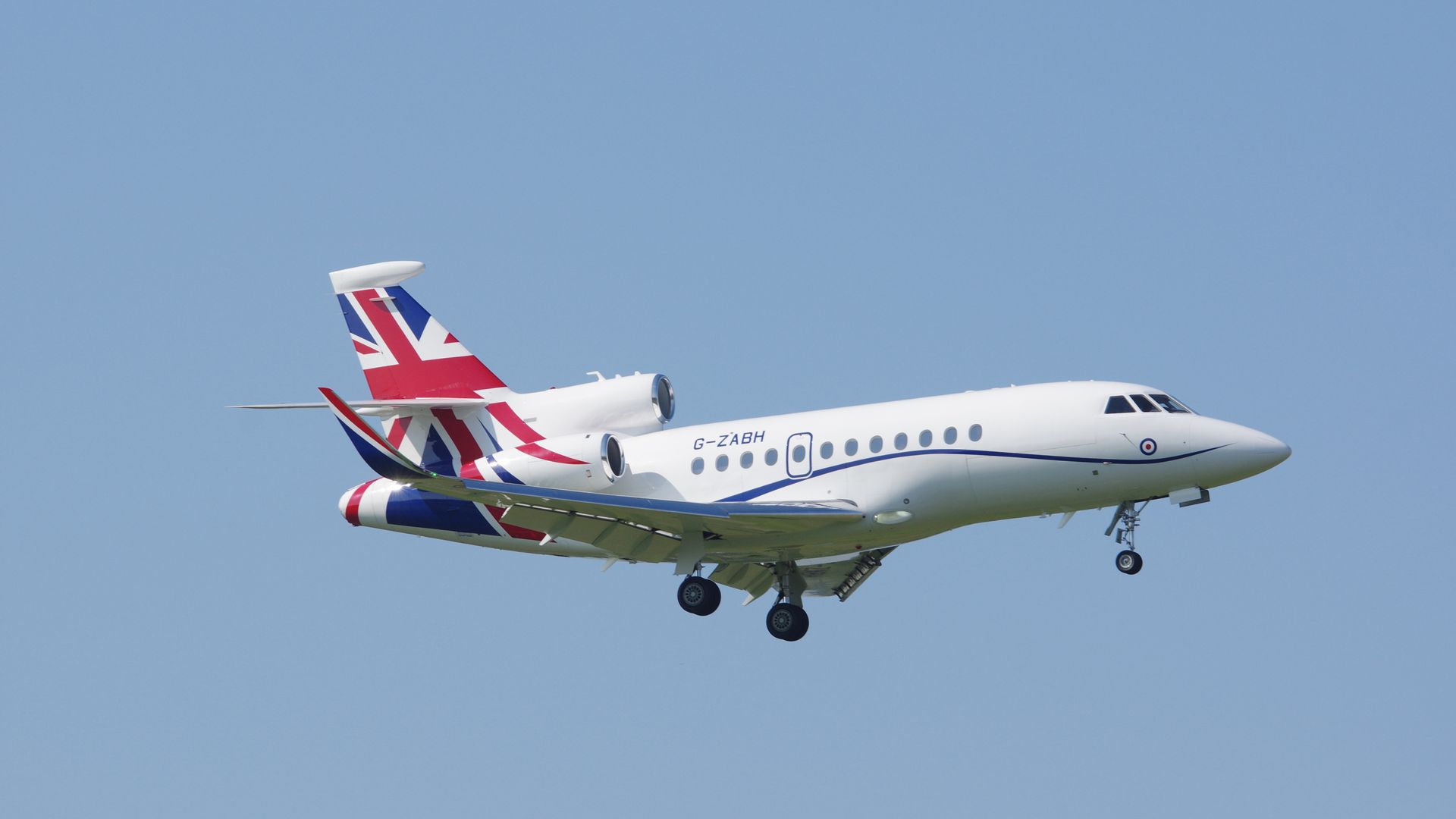
The cockpit of an RAF Envoy IV transport jet is usually a place of clinical, mathematical quiet. At thirty thousand feet, the world shrinks to the steady hum of twin turbofans and the green, glowing geometry of the instrument panel. On this particular afternoon, the cabin carried Grant Shapps, the British Defence Secretary, on his way back from a high-profile NATO exercise in Poland. It was supposed to be a routine milk run. A bureaucratic commute.
Then, the screens went blank.
It did not happen with a dramatic explosion or a flashing red alarm. Instead, the aircraft’s Global Positioning System simply ceased to exist. The digital maps, which seconds before had tracked the plane’s precise trajectory along the edge of Russian airspace, dissolved into useless static. The crew could no longer connect to internet networks. The plane’s secondary navigation systems, designed to validate their position against satellite constellations, fell silent.
For about thirty minutes, a aircraft carrying one of the most powerful military officials in the Western world was effectively blinded in the sky, forced to rely on manual, analog backups to find its way home.
This is the reality of modern shadow warfare. It is invisible. It leaves no craters, shatters no glass, and draws no blood. Yet, its implications are chilling. What happened to the British delegation over the Baltic Sea was not a technical glitch. It was a deliberate, targeted act of electronic aggression, executed from a heavily fortified patch of land that most Westerners could not find on a map.
The Island of Electronic Fog
To understand how a sovereign military aircraft gets blinded in mid-air, you have to look at a geographic anomaly called Kaliningrad.
Picture a Russian island trapped inside the European Union. Wedged tightly between Poland and Lithuania, right on the coast of the icy Baltic Sea, Kaliningrad is a geopolitical pressure cooker. It is completely detached from the Russian mainland, yet it is packed to the gills with Moscow’s most sophisticated military hardware. Among the missile silos and submarine pens sits an array of electronic warfare complexes with names like Murmansk-BN and Krasukha-4.
These are not weapons that fire lead or steel. They fire invisible walls of electromagnetic energy.
Imagine standing in a crowded room trying to speak to a friend across the floor. If someone next to you suddenly turns on a massive, industrial-grade megaphone and begins blasting white noise at maximum volume, your friend will not hear a word you say. That is electronic jamming. The Russian stations in Kaliningrad flooded the sky with high-powered radio frequency signals on the exact wavelengths used by Western satellites. When the RAF jet flew past, its sensitive receivers were overwhelmed by the digital noise. The satellite signals, traveling from thousands of miles in orbit, were drowned out by a bully with a megaphone just across the border.
The vulnerability is terrifyingly simple. We have built a world entirely dependent on invisible threads of data. Our phones, our supply chains, our financial markets, and our precision-guided missiles all rely on the same fragile satellite architecture. When those threads are cut, the modern world reverts to 1945 in an instant.
Thirty Minutes of Ghost Flying
Step into the shoes of the pilots at that moment. Air traffic control in the Baltic region is a delicate dance. The skies are crowded with commercial airliners, cargo transports, and patrol jets. When your GPS dies, you lose your digital identity. You become a ghost on the screens of everyone around you, and they become ghosts to you.
The crew of the Envoy IV are elite professionals. They did not panic. They trained for this exact failure protocol, reverting to inertial navigation systems—essentially onboard gyroscopes and accelerometers that calculate where the plane is based on how fast it has been moving and in what direction since it last had a confirmed signal.
But inertial navigation drifts. Every minute you fly without a satellite correction, the mathematical error grows. You think you are here, but you might actually be a mile to the left. In the narrow, highly contested airspace hovering on the razor's edge of the Russian border, a mile to the left can mean an international crisis. It can mean crossing a line that triggers a surface-to-air missile battery to lock onto your cockpit.
The tension in that cabin during those thirty minutes was not born from the fear of falling out of the sky. The plane was mechanically perfect. The engines roared with reassuring strength. The terror came from the profound isolation. It was the sudden realization that the rules of international sanctuary had been dissolved by an invisible hand.
The Kremlin was sending a message directly to the man sitting in the passenger cabin: We see you. We can touch you. And we can make you disappear from the grid whenever we want.
The Wild West of the Baltic Skies
It is tempting to view this as an isolated provocation, a cheeky stunt pulled by a rogue commander in a Russian outpost. It is not. It is a systematic, escalating campaign that has been quietly terrorizing Eastern Europe for months.
Consider what happens next when these signals spill over from military transports into civilian life. In the months surrounding the incident with the Defence Secretary, thousands of commercial flights operating over the Baltic region have experienced identical GPS blackouts.
- Commercial airliners carrying vacationers and business travelers have been forced to abort landings or alter routes because their automated systems suddenly lost track of the earth.
- Maritime shipping vessels navigating the treacherous, narrow straits of the Baltic Sea have seen their digital maps wander onto dry land, their screens insisting they were driving through Lithuanian forests instead of open water.
- Regional emergency services on the ground have reported their communication networks failing during critical response windows.
The Baltic Sea has become a laboratory for the future of gray-zone conflict. This is a tier of warfare designed specifically to sit just below the threshold of an open military response. You cannot invoke NATO's Article 5 mutual defense clause over a dropped internet connection or a scrambled map. It is the perfect weapon for an asymmetric adversary: highly disruptive, deeply psychological, and entirely deniable.
When questioned, the Kremlin simply shrugs. Atmospheric interference, they might say. A technical anomaly on your end. Meanwhile, the digital foundations of Western security crumble just a little bit more.
The Illusion of the Technical Fix
We have grown arrogant in our technological supremacy. We assume that because our systems are expensive, sleek, and computerized, they are inherently superior. The incident over Kaliningrad proved that our sophistication is our greatest vulnerability.
The West has spent billions developing stealth fighters, smart bombs, and interconnected command structures that communicate in real-time across continents. But all of it—every single piece of this multi-trillion-dollar apparatus—is tethered to a handful of fragile satellites spinning in the cold vacuum of space.
Russia, conversely, has spent decades perfecting the art of the spoiler. They know they cannot match the economic or conventional military might of the NATO alliance. So, they don't try to outbuild the machine. They simply build cheap, brutal tools to jam its gears.
A high-powered truck-mounted jamming system costs a fraction of a single RAF transport jet. Yet, that truck can neutralize the strategic advantage of the jet without ever firing a shot. It is a sobering asymmetric math equation that the West is only now beginning to calculate.
When the Static Clears
Eventually, the Envoy IV cleared the electronic shadow of Kaliningrad. The static on the monitors quieted. The numbers began to scroll again, updating rapidly as the onboard computers re-established contact with the satellites orbiting overhead. The digital world snapped back into sharp focus. The maps showed they were safe, well within friendly airspace, heading toward the UK.
The Defence Secretary landed safely. The politicians went back to their offices, and the news cycle moved on to the next screaming headline.
But something fundamental shifted in the cold air above the Baltic that day. The incident was a jarring reminder that the boundaries of peace and war are no longer defined by trenches, walls, or barbed wire. The new front line runs through the dashboard of your car, the navigation system of an airliner, and the cockpit of a diplomat's jet.
We live in a world where an adversary can reach out across borders and erase your sense of place, leaving you blind, isolated, and grasping in the dark. The static may have cleared for Grant Shapps, but the quiet hiss of that electronic fog still lingers over the horizon, waiting for the next signal to kill.