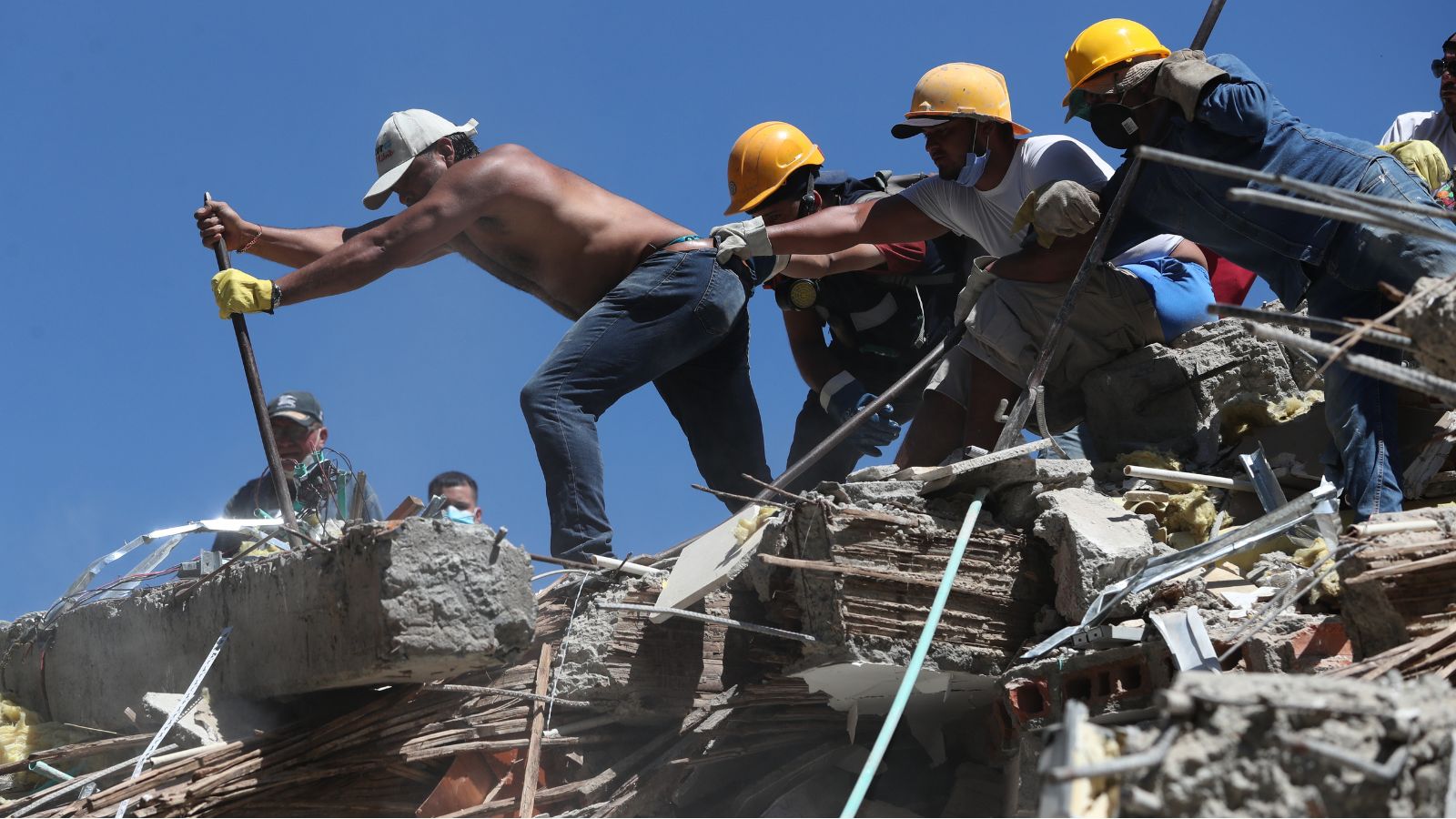
Every single time the ground shakes and concrete turns to dust, the media rolls out the exact same tired script. We get the breathless reports, the footage of panic, the casualty counts, and the inevitable collective sigh about the sheer fury of an earthquake. The standard narrative treats a major seismic event like an act of God, an unavoidable atmospheric strike from an angry deity.
It is a comfortable lie. It protects politicians who signed off on bad permits, developers who cut corners on rebar, and engineers who forgot that gravity applies to calculations. If you liked this post, you might want to read: this related article.
Mother Nature did not murder 132 people in Colombia during that 7.4 magnitude disaster. Poor concrete did. Corrupt zoning laws did. Institutional negligence did. Earthquakes are a constant, predictable variable of geography. Collapsed buildings are a human choice.
The Lazy Consensus of Natural Disasters
Walk into any newsroom after a structural failure and you will hear the same framing. The disaster is framed as an external shock wave that defied human engineering. The unspoken premise is simple: when the earth moves past a certain threshold on the Richter scale, things just fall down. That is fatalism masquerading as journalism. For another look on this development, see the latest coverage from Associated Press.
I have spent two decades walking through disaster zones after the dust settles, and let me tell you what actually happens on the ground. I have seen apartment complexes reduced to powder while buildings standing ten feet away, constructed with the exact same soil conditions and the exact same seismic exposure, remain completely unscathed.
If the earthquake was the sole executioner, the destruction would be uniform. It never is.
Destruction follows the path of least resistance, which is always paved with financial greed and regulatory failure. When a 7.4 magnitude earthquake hits, the ground accelerates at violent rates. That is a physical fact. How a structure responds to that acceleration is entirely within human control. We possess the material science, the structural engineering principles, and the seismic isolation technology to keep buildings standing through violent ground motion.
When we fail to implement them, we are not victims of nature. We are victims of budget sheets.
The Myth of Magnitude
The public obsession with magnitude numbers is a distraction. A 7.4 magnitude earthquake in a desert with no population yields zero casualties. A 7.4 magnitude earthquake in a region with rampant municipal corruption becomes a mass casualty event.
Focusing on the magnitude of the tremor is like blaming the ocean for drowning someone who was tossed overboard without a life jacket. The hazard is the earthquake. The risk is the vulnerability of the built environment.
Vulnerability is manufactured. It is manufactured when a municipal inspector takes a bribe to look the other way on cement curing times. It is manufactured when developers use substandard steel imported from unregulated mills to shave three percent off construction costs. It is manufactured when cities sprawl upward and outward into liquefaction zones without investing in foundational anchoring.
The earthquake is merely the auditor. It exposes every shortcut taken during the boom years when nobody was watching the blueprint.
When we treat these events as natural tragedies rather than man-made failures, we absolve the guilty. We donate money to relief funds while the exact same contractors bid on the reconstruction contracts using the exact same substandard methods. It is an endless, cynical loop of preventable catastrophe.
The Engineering Reality Nobody Wants to Fund
Earthquake-resistant design is not a mystery. We are not guessing. Seismic retrofitting, moment-resisting frames, base isolation pads, and high-performance fiber-reinforced concrete are well-established realities.
So why do buildings still pancake? Money.
Proper seismic architecture costs more upfront. It requires deeper excavation, higher-grade steel, rigorous independent testing, and strict adherence to load-path continuity. In developing markets—and plenty of developed ones, for that matter—those requirements are treated as optional suggestions rather than physical laws.
Imagine a scenario where municipal governments held every structural engineer, developer, and city planner criminally liable for manslaughter if a building collapsed under a seismic load well within the design parameters of the region. The entire industry would clean up overnight. Builders would double-check every pour of concrete. Inspectors would reject compromised materials without hesitation.
Instead, we hide behind the phrase natural disaster. We treat building failure as bad weather.
Dismantling the Rescue Narrative
Look closely at the post-disaster coverage. It is always a celebration of heroics. First responders pulling survivors from the rubble, international aid workers flying in, communities coming together in grief.
Heroism is admirable, but it is also a symptom of a profound societal failure. If your building design requires brave men and women to crawl into crushed concrete cages to pull out bodies, your engineering has failed. Prevention is infinitely cheaper than rescue, both in human lives and economic capital.
Yet, governments routinely underfund building code enforcement while overfunding emergency response budgets. It is the political equivalent of refusing to fix a leaking roof and instead buying more buckets. You look proactive while the house rots from the top down.
What Real Preparedness Looks Like
If we want to stop writing these same stories after every tectonic shift, we have to change how we talk about risk.
First, stop calling them natural disasters. Call them structural failures triggered by natural phenomena. Language shapes policy. When you label an event natural, you invite resignation. When you label it a structural failure, you demand accountability.
Second, mandate transparency in material sourcing. Every kilogram of steel and every cubic meter of concrete used in multi-story construction must carry a verifiable audit trail. Blockchain verification or simple immutable ledger logging for material grades eliminates the counterfeit supply chain that floods emerging markets with brittle steel.
Third, empower independent oversight bodies that answer to no local political machine. When building codes are enforced by the same municipal authorities who rely on construction taxes for their budgets, safety always loses to economic growth.
The Uncomfortable Truth
The 132 people who died in Colombia did not die because the earth shifted. They died because someone decided their lives were worth less than the cost of proper reinforcement bars.
Until we summon the courage to prosecute negligence with the same intensity we apply to rescue operations, the ground will keep shaking, the buildings will keep falling, and the media will keep blaming the planet for our own cheapness.
Stop mourning the force of nature and start prosecuting the weakness of concrete.


