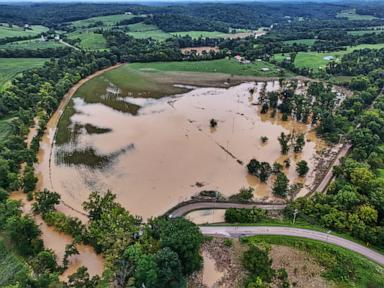
Every time a weather system rolls across the American heartland and tears a path through a sleepy town, the media machine spins up the exact same tired script. We get breathless panic, aerial shots of splintered lumber, and a chorus of pundits pointing skyward as if Mother Nature woke up with a personal grudge against Peoria.
It is lazy. It is inaccurate. And it lets the people responsible off the hook completely.
The mainstream narrative treats tornadoes and flash floods as acts of god that drop out of an innocent blue sky to punish the unprepared. They tell you it is about fierce winds, anomalous pressure drops, and tragic bad luck. I have spent decades analyzing regional infrastructure development and disaster response economics, and I am here to tell you that the meteorological event is only half the story. The other half is human hubris, terrible zoning laws, and municipal leaders who refuse to admit that our real estate expansion model is a catastrophe waiting for a calendar invite.
We are not victims of the atmosphere. We are victims of our own balance sheets.
The Consensus Lie
Open any standard report on Midwest severe weather damage, and you will find a familiar refrain. The consensus claims that climate volatility is making storms unpredictably violent, leaving communities defenseless against the wrath of the jet stream.
This argument is a comfortable shield. It removes accountability from local planning commissions, state legislators, and developers who pave over natural water retention zones so they can cram another subdivision of oversized houses onto the floodplain.
Think about how a modern Midwestern suburb is built. Decades ago, prairies and wetlands handled massive surges of spring rainfall naturally. They absorbed water like a sponge, slowing runoff and feeding aquifers. Then came the bulldozers. We laid down millions of square feet of impermeable asphalt, straightened winding creeks into concrete drainage ditches, and built strip malls where floodplains used to breathe.
When an inch of rain falls on a natural meadow, much of it stays put. When that same inch falls on a sprawling asphalt parking lot, it becomes an instant wall of rushing water that overwhelms every downstream culvert for miles.
Then, when the inevitable flash flood washes out a housing development built six feet too low in a historical basin, the news anchors look shocked. They ask why this keeps happening. The answer is obvious: we built swimming pools where rivers used to sleep, and now we act surprised when the water remembers its address.
The Engineering Mirage
Let us talk about structural resilience, or the lack thereof. We spend billions of dollars on structural defenses like levees, seawalls, and retention ponds, operating under the dangerous assumption that we can completely out-engineer geography.
History is a graveyard of failed concrete. Every time you build a higher levee, you encourage more development right behind it. People feel safe, property values rise, and the vulnerability compounds exponentially. When a storm eventually arrives that exceeds the 100-year design threshold—which, thanks to shifting weather patterns and poor maintenance, happens every few years now—the catastrophe is not a minor leak. It is a catastrophic inundation that destroys an entire community that never should have been built to that density in that exact spot.
I have watched local governments blow millions of dollars on vanity infrastructure projects while ignoring the basic, unglamorous work of maintaining drainage clearings and upgrading outdated stormwater mains. They want ribbon cuttings for shiny new civic centers while the underground pipes beneath them are literally crumbling into Victorian-era dust.
The structural approach fails because it treats nature as an adversary to be defeated rather than a system to be accommodated. You cannot defeat gravity with a bigger concrete wall. You can only delay the reckoning.
The Architecture of Denial
Why do we keep building this way? Simple: short-term municipal finance.
Local property taxes drive local budgets. Cities expand outward because new greenfield developments generate immediate construction tax revenue and developer impact fees. The long-term maintenance liabilities—the road repairs, the sewer upgrades, the emergency response costs for flood rescues—get kicked down the road to future administrations.
It is a Ponzi scheme of suburban growth. We subsidize the risk. Through federal flood insurance programs and disaster relief funds, taxpayers across the country end up subsidizing the rebuilding of homes in high-risk zones over and over again. If an insurance policy or a government bailout guaranteed that you could rebuild your flood-prone property three times on the public dime, why would you ever change your building codes? Why would you ever move to higher ground?
We have created a moral hazard of epic proportions. We insure vulnerability and penalize prudence.
The Uncomfortable Reality of Tornado Resistance
When it comes to tornadoes, the fatalism is even worse. The common belief is that an EF4 or EF5 tornado is an equalizer that reduces everything in its path to toothpicks, making architectural prevention futile.
That is false.
While you cannot easily stop a two-hundred-mile-per-hour vortex, you can entirely change how structures react to it. Most tornado fatalities and catastrophic structural failures do not happen because the wind blows the walls down from the outside. They happen because the roof lifts off, the exterior walls cave inward from internal pressure, and the entire building pancakes from the top down.
Standard stick-built construction in the Midwest is often shockingly fragile. We build houses out of two-by-fours and plywood stapled together because it is cheap and fast. We treat building a home like assembling IKEA furniture.
Imagine a scenario where building codes required continuous load paths from roof rafters down to reinforced concrete foundations in every single residential build. Imagine if exterior walls were framed with concrete masonry or insulated concrete forms instead of hollow wood framing.
The upfront cost of construction would rise by a modest percentage. But the catastrophic loss of life and property during a severe weather outbreak would plummet. We choose cheap upfront costs over long-term survival every single time, and then we blame the wind for doing what wind naturally does to flimsy structures.
What Real Preparedness Looks Like
If we want to stop mourning the same Midwestern towns every spring, we have to abandon the comforting myths of natural helplessness and face three hard truths:
- Retire the Floodplain. We must stop issuing permits for residential and commercial construction in known floodways and low-lying basins. If a piece of land floods once every decade, it is not a building site; it is a river that is temporarily out of work. Give it back to nature.
- Mandate Structural Integrity. Upgrade regional building codes to mandate wind-resistant and flood-resilient architecture. Stop allowing developers to throw up papier-mâché suburbs designed to maximize quarterly profits while maximizing forty-year liabilities.
- End Perverse Subsidies. Reform disaster relief and flood insurance so that rebuilding in high-risk zones without significant structural upgrades becomes economically unviable. Let the market price the actual risk instead of hiding it behind federal bailouts.
The next time a severe weather system forms over the plains and the cameras start rolling to capture the wreckage, look past the fallen trees and the twisted metal. Look at the zoning maps. Look at the paved-over creek beds. Look at the political cowardice that allowed a predictable tragedy to be branded as an act of god.
Nature is doing what nature has always done. We are the ones who forgot how to live in it.