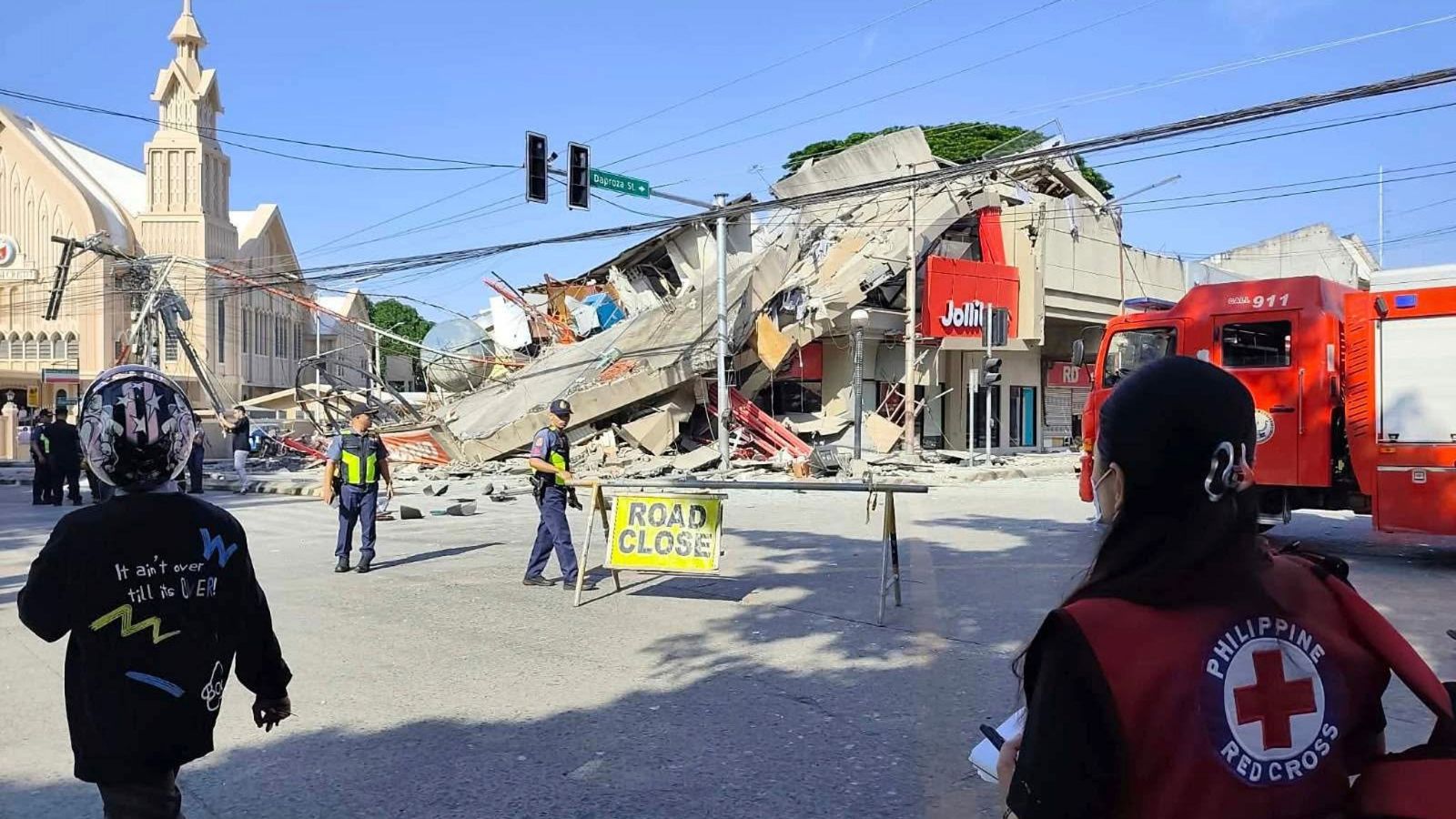
The media has a predictable script for natural disasters. A 7.8-magnitude earthquake strikes the Philippines, buildings turn to rubble, and the headlines immediately scream about the sheer, unstoppable power of Mother Nature. They treat the body count like an unavoidable math equation dictated by geology.
It is a lie.
Earthquakes don't kill people. Bad engineering and corrupt municipal oversight kill people.
When you see a headline pointing to a 7.8-magnitude tremor as the sole culprit behind 32 deaths and collapsed concrete, you are looking at lazy journalism sheltering systemic incompetence. We are trained to look at the Richter scale—or the modern Moment Magnitude Scale—and shrug our shoulders in collective helplessness. We treat structural failure as an act of God. In reality, it is an act of criminal negligence.
The narrative needs to flip. The destruction we see in rapidly urbanizing zones like Metro Manila isn't a geological inevitability. It is a design choice.
The Faulty Logic of "Magnitude Panic"
Mainstream news outlets focus entirely on magnitude because it is flashy. It generates clicks. A big number looks terrifying on a breaking news banner. But magnitude only measures the energy released at the source of the rupture, often miles underground and kilometers away from urban centers.
What actually matters to a building—and the human beings inside it—is peak ground acceleration (PGA) and local soil dynamics.
Imagine two identical structural frameworks. One sits on solid basalt bedrock. The other sits on loose, water-saturated alluvial soil, much like the areas surrounding Manila Bay or the Marikina River Valley. When a seismic wave hits the bedrock, the motion is rigid and brief. When it hits the soft soil, the ground acts like a bowl of gelatin. The shaking amplifies. The soil undergoes liquefaction, essentially turning from a solid into a liquid state in seconds.
The competitor articles tracking these disasters completely ignore this mechanics. They tell you how big the earthquake was, but they fail to tell you why a specific building pancaked while the one next to it stayed standing.
During my years reviewing structural forensic data across Southeast Asia, I have walked through post-disaster zones where one side of a street was completely leveled while the other suffered nothing more than hairline plaster cracks. Was the earthquake magical? Did it choose sides? No. One developer cut costs on foundation piles, and the other did not.
The Structural Sins: Why the Concrete Fails
To understand why buildings turn to rubble, we have to look at the concrete itself. The general public looks at a concrete column and sees strength. A structural engineer looks at it and sees a brittle disaster waiting to happen without the proper internal tension.
Concrete is phenomenal under compression; it can bear immense weight pressing straight down. But earthquakes do not press down. They push and pull horizontally. They shear.
The Non-Ductile Trap
Older structures, or those built by cut-rate contractors, suffer from a lack of ductility. Ductility is the capacity of a structure to deform under severe lateral loads without experiencing a sudden, catastrophic loss of stability.
- Inadequate Stirrups: Transverse reinforcement ties (stirrups) hold the vertical steel rebar together. If these ties are spaced too far apart, the vertical rebar will buckle outward under stress. The concrete core then crushes instantly.
- The Strong-Beam, Weak-Column Disaster: Many collapsed residential blocks in developing urban hubs suffer from this exact engineering inversion. Contractors find it easier to cast heavy, rigid beams. But during lateral shaking, you want the beams to yield first to absorb energy, keeping the columns intact to hold up the roof. When the columns fail first, the entire floor drops vertically, squashing everything below.
"A building should be designed to bend, not break. If a structure cannot dissipate seismic energy through controlled, ductile deformation, it will store that energy until it fails catastrophically."
Dismantling the "People Also Ask" Mythos
If you look at public forums or standard search queries surrounding seismic safety in developing nations, the premises of the questions are fundamentally broken. Let's address them with zero corporate fluff.
"Can we build earthquake-proof buildings?"
No. Stop asking this. The term "earthquake-proof" is an engineering myth peddled by marketing teams. Nothing is proof against the absolute worst-case scenario. We build earthquake-resistant structures.
The goal of modern seismic codes is not to ensure your apartment remains pristine after a major event. The goal is life safety. The building is designed to sacrifice itself to give you enough time to walk out alive. If a structure suffers massive internal warping but remains standing long enough for evacuation, the engineering succeeded perfectly, even if the property value drops to zero.
"Are modern building codes enough to save us?"
A building code is a legal minimum. It is literally the lowest quality building you can legally construct without getting arrested.
Citing the National Building Code of the Philippines is meaningless if the local government unit lacks the technical capability or the ethical fortitude to enforce it. The gap between the code on paper and the actual pour of the concrete mixer on-site is where those 32 casualties occurred.
The Uncomfortable Economics of Seismic Safety
Let's talk about the hard truth that non-profits and safety advocates hate to admit: seismic resilience is an economic luxury.
Upgrading a standard multi-story mixed-use building to incorporate proper seismic isolation systems—like elastomeric rubber bearings or friction dampers—can add anywhere from 4% to 12% to the total structural construction cost.
$$Cost_{total} = Cost_{baseline} + Cost_{seismic_isolation}$$
In hyper-competitive real estate markets where margins are razor-thin, developers face a brutal incentive structure. They know a massive quake might not hit for another fifty years. They know the average buyer cannot see the rebar spacing behind the drywall. So, they build to the absolute minimum, or worse, bribe inspectors to look the other way during the foundation pour.
I have sat in boardrooms where executives explicitly calculated the risk of seismic litigation versus the immediate capital expenditure of structural retrofitting. They chose the risk.
If you want to stop buildings from turning to rubble, stop funding awareness campaigns. Start auditing the supply chains of local ready-mix concrete suppliers. Start tracking the unaccounted cash flow in municipal permit offices.
The Actionable Diagnostic: How to Spot a Death Trap
Instead of reading sensationalized disaster reports and panicking, you need to know how to evaluate the built environment around you. If you are living or working in a high-seismic zone like the Pacific Ring of Fire, look for these structural red flags immediately.
1. The Soft-Story Defect
Look at the ground floor of your building. Is it a parking lot, an open retail space, or a lobby with massive glass windows and minimal solid walls, while the floors above are heavy, dense residential units? This is a soft-story hazard. During lateral shaking, the flexible ground floor sways violently while the rigid upper floors act as a massive hammer, snapping the ground-floor columns instantly.
2. Captive Columns
Walk around the exterior. Are there concrete columns that are partially restricted by low masonry walls or decorative concrete barriers? When an earthquake hits, the free portion of the column tries to move, but the restricted portion cannot. This concentrates all the shear force into a tiny section of the column, causing a rapid "short-column" failure.
3. Structural Pounding Gaps
If your building is constructed flush against another building without a distinct expansion joint (typically several inches of clear space), they will destroy each other during a quake. As the two structures vibrate at different natural frequencies, they will literally hammer into each other until one or both collapse inward.
The media will continue to show you aerial footage of wreckage, accompanied by solemn commentary about the unpredictable wrath of nature. They want you to look at geology so you do not look at the ledger sheets.
The 7.8-magnitude event didn't kill those people. The human decisions made years before the ground ever moved did. Until we treat structural failure as white-collar manslaughter rather than an unavoidable disaster, the body count will keep rising, one predictable headline at a time.