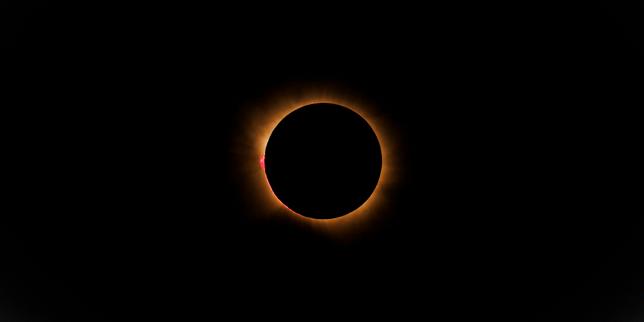
Millions of people stood in the streets of France and Spain recently, staring at the sky with moist eyes, clutching cardboard glasses, and gasping as the moon took a bite out of the sun. Media outlets rushed to publish the same tired narrative. They called it a moment of profound cosmic communion. They painted a picture of humanity holding hands, touched by the ephemeral beauty of the cosmos, weeping at the edge of darkness.
It is romantic garbage. For a different view, read: this related article.
I have watched spectators lose their minds over an alignment of spheres that happens with clockwork predictability, calculated down to the millisecond by seventeenth-century mathematics. The tears are not a spiritual awakening. They are a biological startle response mixed with herd psychology. We are romanticizing a shadow.
Strip away the emotional hyperbole pushed by the press, and a solar eclipse is nothing more than a predictable planetary geometry lesson. Yet, society insists on treating it like a secular religious revival. It is time to stop weeping over a shadow and look at what is actually happening above our heads. Further analysis regarding this has been provided by The New York Times.
The Myth of Cosmic Unison
The lazy consensus in modern journalism is that eclipses unite us. Headlines scream about shared humanity, collective awe, and a rare pause in our divided world. This is a comforting fiction designed to sell clicks and tourism packages to people desperate for manufactured meaning.
True communion requires agency. Standing in a designated parking lot in southern France while a chunk of rock blocks a massive ball of burning plasma does not make you part of a global brotherhood. It makes you an occupant of a specific cone of umbra.
Imagine a scenario where the moon's orbit was skewed by a fraction of a degree, plunging random cities into sudden darkness without warning every few centuries. That would be terrifying. That would warrant existential reflection. Instead, we have an event so mathematically precise that NASA can tell you the exact shadow path for the year 2300 down to the backyard. We know the schedule. We buy tickets. We book hotels months in advance to watch a script play out that was written billions of years ago by gravity and angular momentum.
There is no mystery here. There is only math. When you weep at an eclipse, you are crying at a geometry equation.
Why Our Evolutionary Hardwiring Betrays Us
To understand why otherwise rational adults turn into sobbing mystics during totality, you have to look at the primate brain. We are hardwired to panic when the primary energy source of our biosphere dims without seasonal authorization.
For ninety-nine percent of human history, a sudden midday twilight meant something was profoundly broken in the natural order. Predators stir. Temperatures drop rapidly. The light takes on a sickly, metallic hue that triggers a visceral, ancient dread in the amygdala.
When modern humans experience this drop in luminosity, the autonomic nervous system fires off a cocktail of cortisol and adrenaline. Because we are safe behind concrete barriers and holding smartphones, our brains misinterpret that spike of physiological arousal as profound spiritual transcendence. We confuse a mammalian fear response with inner peace.
I have spoken with amateur astronomers who spend small fortunes chasing these shadow paths across the globe, treating every clear sky like a sacred pilgrimage. They talk about the corona as if it were a personalized blessing from the universe. But the corona is just superheated plasma trapped in a complex magnetic field millions of miles away, completely indifferent to your existential dread or your tears.
The Economics of Manufactured Awe
Let us talk about the financial reality that the emotional commentators conveniently omit. Local governments and hospitality syndicates love the eclipse narrative because it is a license to print money.
Municipalities inflate hotel prices by three hundred percent, restaurants push mediocre prix-fixe menus to captive tourists, and airlines market special mid-air totality flights. The media plays along because manufactured communal harmony generates high engagement metrics.
I have seen small businesses blow thousands on eclipse-themed merchandise and marketing campaigns, only to be clouded out for two minutes of grey gloom. The gamble is staggering, yet people line up for blocks to pay a premium for a natural phenomenon that is entirely free and visible from thousands of other uncommercialized locations.
The industry surrounding celestial tourism relies entirely on making the mundane feel miraculous. They take a predictable celestial transit and wrap it in a veil of exclusivity. If you miss this one, the narrative goes, your life will somehow remain incomplete. It is a brilliant marketing funnel disguised as astronomy outreach.
The Real Wonder We Are Ignoring
While millions of people stand shoulder-to-shoulder in European town squares, weeping into their cheap cardboard visors because the sun looks like a glowing ring, they are missing the actual marvels of modern astrophysics happening right above them.
The solar corona—that wispy white halo visible only during totality—is one of the great unsolved puzzles of modern physics. The surface of the sun sits at a relatively cool six thousand degrees Celsius, yet the corona stretches outward into a million-degree furnace. For decades, researchers have argued over how magnetic reconnection and wave turbulence heat this outer atmosphere to temperatures that defy standard thermodynamic expectations.
That is not a poetry prompt. That is an active scientific battleground involving magnetohydrodynamics, space weather forecasting, and particle physics.
When a coronal mass ejection erupts from that halo and heads toward Earth, it does not care about your emotional state. It threatens power grids, scrambles satellite communications, and triggers magnificent auroras at latitudes where people are completely unprepared for them. Space weather is a multi-billion-dollar infrastructure vulnerability.
Yet, the public prefers to focus on the poetry of the shadow rather than the hard mechanics of the star sustaining our existence. We treat the sun like a theatrical stage prop rather than a volatile nuclear reactor sitting eighty-three light-minutes away.
Reclaiming Rationality in the Dark
If you want to experience an eclipse, go ahead. Step outside. Check your filters. Protect your retina. But drop the performance.
Stop pretending that a shadow moving across the earth's surface validates your life choices or connects you to the cosmos on a spiritual frequency. The universe does not know you are watching, and it certainly does not care that you are crying.
The true beauty of the cosmos is not that it stops to give us emotional breakthroughs on cue. Its beauty lies in its absolute, cold, breathtaking indifference. It operates on laws so precise and unyielding that we can predict its movements centuries in advance without a single prayer, a single tear, or a single corporate tourist trap.
Next time the moon slides across the solar disk, don't look for meaning in the darkness. Look at the math that put it there, respect the sheer scale of the mechanics keeping our rock in orbit, and keep your handkerchief in your pocket.