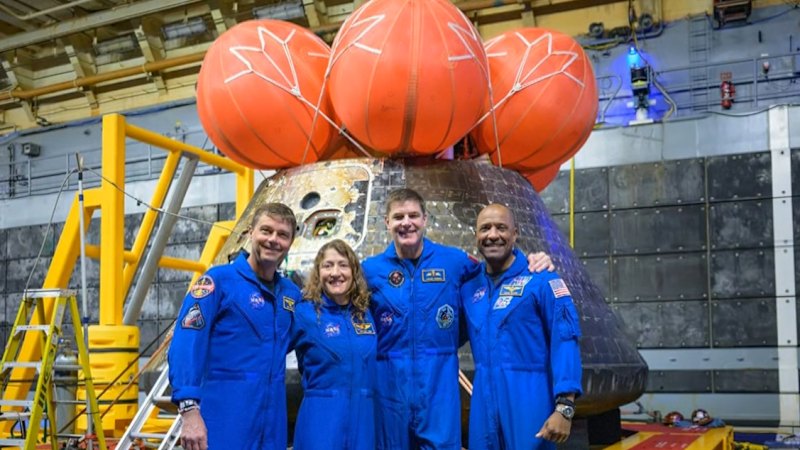
The media is currently choking on its own sentimental exhaust. The recent coverage surrounding the Artemis II crew—the four brave souls scheduled to loop around the Moon—has devolved into a series of soft-focus reunions and tearful family portraits. It is a masterclass in distraction. While the public is fed a steady diet of "astronauts coming home to their kids," the actual mission is quietly morphing into one of the most expensive and technologically conservative gambles in the history of aerospace.
Focusing on the domestic lives of Reid Wiseman or Victor Glover is a convenient way to avoid talking about the Space Launch System (SLS) and the Orion capsule. We are treating these pilots like celebrities because it is easier than treating them like what they actually are: passengers on a multi-billion dollar heritage project that is decades behind the private sector's curve.
The Sentimentality Trap
Every time a major news outlet runs a "reunion" story, a NASA PR official gets their wings. It is the oldest trick in the book. If you can make the mission about the people, you make the mission beyond reproach. To criticize the Artemis program then feels like criticizing the astronauts themselves.
But let’s be brutally honest. Artemis II is a flight to nowhere. They aren't landing. They aren't docking with a gateway. They are performing a figure-eight around the Moon—a feat the Soviet Union’s Zond 5 did with two tortoises and some mealworms in 1968. Apollo 8 did it with humans in the same year.
We are paying $4 billion per launch for a nostalgia act.
The "lazy consensus" suggests that these human-interest stories are necessary to build public support for space exploration. That is a lie. Public support for the Apollo era didn't come from photos of Neil Armstrong’s kitchen; it came from the raw, terrifying power of the Saturn V and the audacity of the goal. Today, we use "family time" to mask the fact that the SLS is an expendable rocket built with 40-year-old Space Shuttle technology. We are literally throwing away four RS-25 engines—engines meant to be reused—every time we push the button.
The Orion Heat Shield Scandal
While the press was busy filming astronauts hugging their spouses, a massive technical failure was being swept under the rug. During the Artemis I uncrewed mission, the Orion heat shield didn't just work; it eroded in a way NASA engineers didn't predict. Large chunks of the ablative material—the stuff that keeps the astronauts from turning into ash during atmospheric reentry—charred and cracked unexpectedly.
In any other era of flight testing, this would be the only headline. Instead, it’s a footnote.
We are sending humans on the very next flight of a vehicle that showed "unexpected charring" on its last run. If this were a private vehicle, the FAA would have the program grounded for years. But because it is a "national priority" with a high-profile crew, we pivot the narrative to their "emotional journey."
I have seen aerospace giants burn through billions of taxpayer dollars by prioritizing optics over engineering. This is the "Sunk Cost Fallacy" dressed up in a flight suit. We have spent so much on the SLS/Orion architecture ($42 billion and counting) that we cannot afford to admit the heat shield is a potential death sentence. So, we humanize the crew to make the risk seem noble rather than avoidable.
The False Dichotomy of Artemis vs. Starship
The public asks: "When are we going back to the Moon?"
The brutal truth is: "We aren't, at least not with this hardware."
Artemis II is the "People Also Ask" equivalent of a filler episode in a TV show. It satisfies the requirement for "progress" without actually delivering the capability to stay.
Compare the SLS to the development of Starship.
- SLS: Costly, expendable, infrequent, and technologically stagnant.
- Starship: Rapidly iterating, fully reusable, and designed for mass.
The industry insider’s secret is that Artemis II is essentially a massive subsidy for Boeing and Lockheed Martin. It’s a jobs program distributed across all 50 states to ensure political survival. That is why the narrative stays on the "human element." If we looked at the cost-per-kilogram to get those four astronauts to lunar orbit, the math would be offensive.
The Myth of the "Reunion"
The competitor article wants you to feel the warmth of a father returning to his daughters. I want you to feel the cold reality of the Specific Impulse ($I_{sp}$) of the Orion Service Module.
The Orion capsule is heavy. It is so heavy that the SLS—the "most powerful rocket ever built"—can barely push it into a Trans-Lunar Injection (TLI) with any meaningful cargo. In fact, to get to the Moon for a landing (Artemis III), NASA has to rely on SpaceX to launch a separate lunar lander because Orion can’t carry one.
Imagine a scenario where you buy a luxury SUV to take a cross-country trip, but the SUV is so heavy and inefficient that it can’t carry your luggage. You have to hire a separate U-Haul to follow you the entire way. That is the Artemis architecture.
When we focus on the "family reunion," we ignore the fact that we are building a transportation system that is fundamentally broken. We are celebrating the pilots of a vehicle that is an aerodynamic and fiscal dinosaur.
Human Risk for PR Gains
There is a legitimate argument for human spaceflight, but it must be based on exploration, not brand management. Artemis II is a "shakedown" cruise. In the aviation world, you don't do a shakedown cruise with a full crew and a massive media circus if your previous test flight had "ablation anomalies."
The risk-to-reward ratio for Artemis II is skewed. The reward is a handful of high-resolution photos of the lunar far side and a bump in NASA's social media engagement. The risk is four lives lost because we refused to go back to the drawing board on the Orion heat shield.
If we were serious about the Moon, we would be focusing on:
- Orbital Refueling: The only way to make deep space travel sustainable.
- Modular Construction: Building ships in LEO rather than launching monolithic, expensive rockets.
- Nuclear Thermal Propulsion: Cutting travel time and radiation exposure.
Instead, we are focused on the "human interest" story of four people who are effectively being used as high-stakes props in a political theater.
Stop Asking the Wrong Questions
The media asks: "How does it feel to be back with your family?"
The media should ask: "Why are we using 1970s solid rocket booster tech to launch a 2026 mission?"
The "family" narrative is a pacifier for a public that has forgotten how to be critical of government spending. We are being sold a story of bravery to distract us from a story of bureaucratic inefficiency.
True "Authoritativeness" in this field comes from recognizing that the astronauts are the best of us, but the system they are trapped in is the worst of us. They are being asked to fly a mission that serves a political timeline rather than a technological one.
If you want to support the astronauts, stop liking the photos of them hugging their kids. Start demanding to know why we are risking their lives on a heat shield that hasn't been fixed and a rocket that costs as much as a small country's GDP.
Space is hard. It is dangerous. It should be about pushing the boundaries of what is possible, not about recycling old technology and wrapping it in a flag of sentimentality. The Artemis II crew deserves a better ship, and the taxpayers deserve a better mission. Until we stop falling for the PR fluff, we will continue to get neither.
The next time you see a "heartwarming" story about the Artemis crew, remember: that heart you feel warming is actually just the friction of $42 billion burning up in the atmosphere.