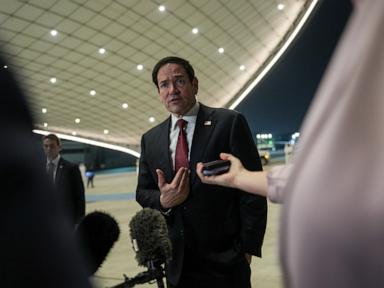
The mainstream foreign policy press is running a tired script. They want you to believe that U.S. Secretary of State Marco Rubio landed at Al Bateen Executive Airport in Abu Dhabi as a savior, sent to soothe the frazzled nerves of terrified Gulf monarchs. The narrative is as lazy as it is predictable: Washington signs a tentative 60-day ceasefire framework with Tehran, and its regional allies immediately collapse onto the diplomatic couch with a case of the vapors.
It is a complete fantasy. Also making headlines in related news: The Quiet Steel on the Saigon River.
Abu Dhabi is not panicked. They are not shaking in their boots over the missing clauses on ballistic missiles or the architecture of a theoretical $300 billion reconstruction fund for Tehran. The "unease" reported by legacy outlets is entirely performative. It is a calculated diplomatic stance designed to extract massive, long-term concessions from a lame-duck or hyper-anxious Washington. The U.S. foreign policy establishment is playing the role of the worried parent, completely blind to the fact that their supposedly dependent partners have already outgrown the house.
I have spent years watching Western diplomats misread the Gulf. I have seen administrations blow billions on defense commitments based on the flawed premise that Arab capitals view the world through a 1980s Cold War lens. They do not. To understand what is actually happening while Rubio shakes hands with Ambassador Yousef Al Otaiba, you have to throw out the entire Washington playbook. More details regarding the matter are covered by BBC News.
The Myth of the Anxious Ally
The dominant media argument says the United Arab Emirates, Kuwait, and Bahrain are uniquely vulnerable right now because they were hit by Iranian drones and missiles during the recent war. The logic follows that any deal failing to immediately disarm Hezbollah, defang the Houthis, or dismantle Iran's missile capability leaves these states exposed.
This completely misunderstands how modern Gulf diplomacy operates.
The UAE is not waiting for Washington to protect it. Abu Dhabi initiated its own quiet de-escalation tracks with Tehran years ago. While American lawmakers were busy posturing on cable news, Emirati banks and Iranian merchants were keeping billions of dollars in cross-gulf trade alive. Dubai remains Iran's primary economic lung. The idea that the UAE is fundamentally shocked or terrified by a U.S.-Iran diplomatic opening ignores the reality that the Emiratis themselves helped build the backchannels that made the Swiss talks possible in the first place.
When the Gulf states complain loudly about the lack of regional proxy restrictions in the memorandum of understanding signed last week, they are not crying for help. They are building a dossier of American debts.
Every public statement of concern is a deliberate setup for a transaction. By signaling "unease" over the 60-day framework, the UAE creates a situation where the United States feels obligated to pay a premium to maintain the alliance. They do not want the deal to fail; they want to be compensated for letting it succeed.
What Abu Dhabi Actually Wants
Let us look at what happens when Washington tries to reassure an "uneasy" partner. The currency of reassurance in the Middle East is not rhetoric. It is advanced hardware, sovereign security pacts, and semiconductor access.
Imagine a scenario where the UAE quietly tells the State Department that they can tolerate the release of Iran's frozen assets in Qatar, but only if Washington signs off on the unrestricted transfer of proprietary artificial intelligence chips and long-delayed fighter jet programs. That is the real game. The unease is a pressure point used to bypass congressional restrictions on tech transfers and high-end military sales.
- Advanced Computing Power: The true balance of power in the Gulf is no longer measured solely in artillery barrels. It is measured in data centers. Abu Dhabi wants explicit guarantees that its domestic tech initiatives will not face U.S. export controls.
- The F-35 Files: The lingering friction over advanced aviation systems remains a primary bargaining chip. "Anxiety" over Iran is the perfect justification for the UAE to demand the immediate finalization of weapons packages that domestic critics in Washington have stalled for years.
- Formal Security Assurances: The Gulf states want binding bilateral treaties that look closer to NATO's Article 5 than the handshake agreements of the past.
By framing Rubio’s trip as a hand-holding exercise, the corporate media covers up the fact that the U.S. delegation is the one operating from a position of strategic weakness. Washington needs this 60-day ceasefire to hold to claim a major diplomatic win and stabilize global oil markets. President Trump has already praised the drop in oil prices. The administration cannot afford a regional escalation right now, which means Abu Dhabi holds all the cards.
The Strait of Hormuz Toll Illusion
A significant point of media focus has been the dispute over the Strait of Hormuz. Observers are wringing their hands over the fact that the memorandum of understanding leaves room for Iran and Oman to discuss "future administration" after the 60-day period, leading to fears that Tehran will impose maritime transit fees.
Rubio walked off his plane and immediately declared that the U.S. would never allow an international waterway to become a toll road. He argued that international law is absolute.
This is a classic Washington misdirection. The debate over whether Iran can legally charge service fees is a sideshow. The Gulf monarchies are business empires masquerading as sovereign states. They understand logistics better than anyone in the State Department. They know that even if Iran attempts to implement a disguised toll system under the guise of "maritime services," the cost will simply be factored into insurance premiums and passed down the supply chain.
The real issue is not the toll; it is who controls the alternative routes. The UAE and Saudi Arabia have spent a decade investing in pipelines and infrastructure designed to bypass the Strait of Hormuz entirely. If the strait becomes more complicated or expensive to navigate, it accelerates the domestic economic transition toward their own red sea ports and alternative logistics hubs.
They are not panicked about a temporary maritime fee structure. They are using the threat of it to force the U.S. Navy to underwrite the security of the region's shipping lanes for free, while they build out the infrastructure that will eventually render those lanes less critical to their own long-term survival.
The China Realignment the Media Ignores
The most profound blind spot in the current analysis of Rubio's trip is the assumption that the Gulf states have nowhere else to go. The conventional wisdom says that because these nations host vital U.S. military bases, they are locked into Washington’s orbit forever.
This is an outdated way of looking at the map.
The long-term strategic priority for the Gulf is not the containment of Iran; it is the integration of the Eurasian landmass. Look at where the money flows. Iran's chief negotiator, Mohammad Bagher Ghalibaf, is openly talking about a broader regional realignment involving Turkey, Saudi Arabia, Pakistan, and Egypt. The Iranian President, Masoud Pezeshkian, just landed in Pakistan. Simultaneously, China remains the largest buyer of both Iranian oil and Gulf petrochemicals.
The Gulf states are hedging. They are not looking for a permanent American umbrella that requires them to cut ties with Beijing or treat Tehran as an eternal pariah. They want a multipolar Middle East where they can trade with China, buy security architecture from the U.S., and manage Iran through a combination of financial integration and local deterrence.
When Rubio insists that Iran must completely end its proxy network before a permanent agreement can be reached, he is preaching an absolute doctrine that the Gulf capitals abandoned years ago. They know the proxy networks are not going away overnight. They are practical. They are willing to live with a managed threat as long as the financial returns of regional stability remain high.
The Price of Admission
The U.S. approach to this entire diplomatic cycle is built on a misunderstanding of power dynamics. Washington treats its allies like client states that need to be managed through periodic visits and vague statements of solidarity. But the reality on the ground has shifted permanently.
If Secretary Rubio wants the Gulf states to support the administration’s new diplomatic track with Tehran, he is going to have to pay the market rate. The era of the Gulf cooperating out of a sense of shared ideological commitment or dependency is over. They know Washington wants an exit strategy from the region's conflicts. They know the American electorate has no appetite for prolonged foreign engagements. And they know that a 60-day framework is a ticking clock that puts more pressure on the White House than it does on Abu Dhabi.
Stop analyzing this trip as an exercise in American leadership reassuring anxious partners. It is a negotiation between a superpower trying to manage its decline in the region and a group of wealthy, highly sophisticated regional actors who know exactly how much their compliance is worth. The unease is not a problem for Rubio to solve; it is the price tag the Gulf has placed on the table. Washington will either pay it in advanced tech and sovereign guarantees, or watch its new peace deal collapse before the 60 days are up.