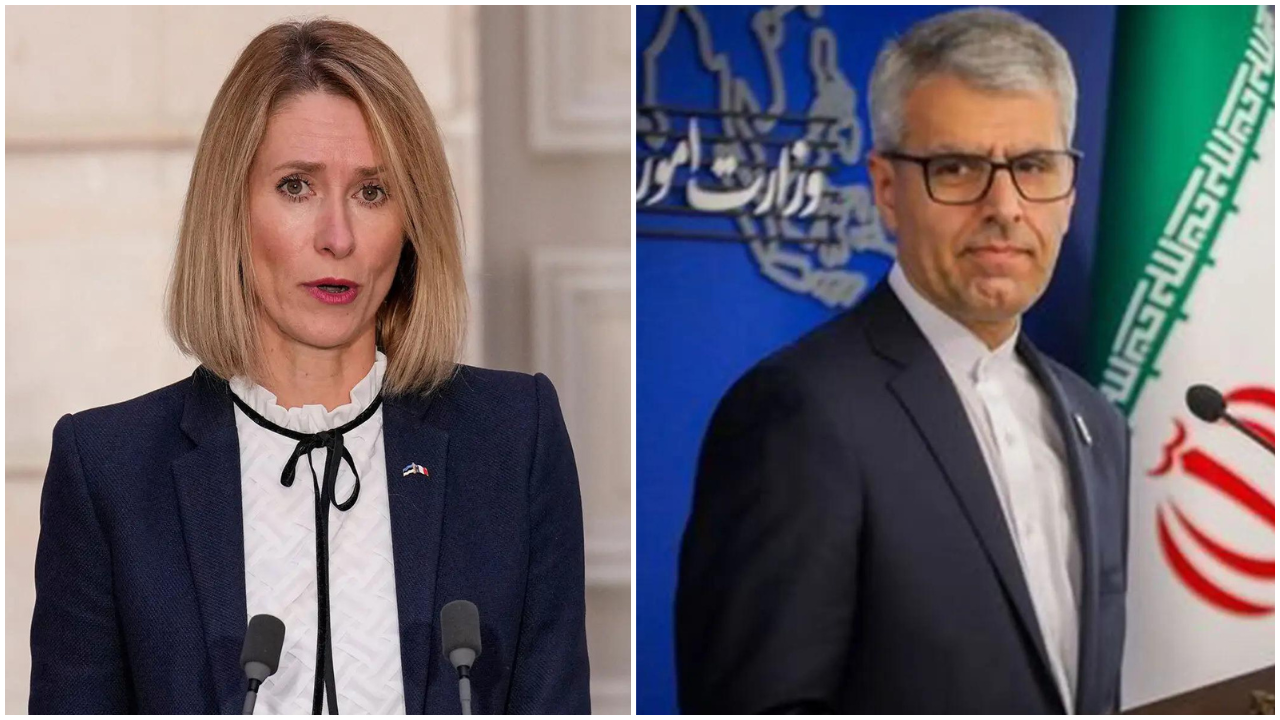
The escalating diplomatic friction between Tehran and the European Union regarding the Strait of Hormuz is not a simple exchange of grievances; it is a calculated collision between two distinct operational doctrines: Rule-Based Institutionalism and Asymmetric Deterrence. When the Iranian Foreign Ministry dismisses EU critiques as "peak hypocrisy," they are not merely engaging in rhetoric. They are signaling a rejection of the West's perceived monopoly on maritime legal interpretation. This conflict rests on a fundamental disconnect between the EU’s reliance on international law (UNCLOS) and Iran’s localized enforcement of "sovereign security," creating a permanent state of low-intensity volatility in the world's most critical energy chokepoint.
The Geopolitical Cost Function of Hormuz
The Strait of Hormuz functions as a global economic bottleneck where approximately 20% of the world's total oil consumption passes daily. The EU’s stance is dictated by a Systemic Stability Mandate. For European economies, any disruption in the Strait increases the risk premium on Brent crude, triggers inflationary pressure, and destabilizes the energy transition timelines.
From Tehran’s perspective, the Strait is a Strategic Leverage Asset. The Iranian logic follows a clear cause-and-effect chain: if Iranian oil exports are constrained by Western sanctions, the "security for all" principle is voided. This creates a reciprocal threat model. Iran views European calls for "de-escalation" as an attempt to maintain a status quo that favors Western economic interests while maintaining a "maximum pressure" environment on the Iranian economy. The charge of hypocrisy stems from this perceived imbalance: the EU demands adherence to international maritime norms while simultaneously enforcing (or complying with) financial sanctions that Iran views as a violation of the same international order.
Operational Paradigms of Maritime Friction
To understand the mechanics of this dispute, one must deconstruct the two competing frameworks of maritime authority.
1. The Institutional Framework (EU/International)
The European Union relies on the United Nations Convention on the Law of the Sea (UNCLOS). This framework prioritizes:
- Transit Passage Rights: The right of all vessels to pass through international straits for the purpose of continuous and expeditious transit.
- Neutrality of Commerce: The principle that commercial shipping should remain insulated from state-level political disputes.
- Multilateral Enforcement: The use of international coalitions (such as EMASoH - European Maritime Awareness in the Strait of Hormuz) to monitor and secure sea lines of communication.
2. The Sovereignty-Security Framework (Iran)
Iran’s counter-logic is built on a "Securitized Geography." Because the shipping lanes in the Strait fall within the territorial waters of Iran and Oman, Tehran asserts a heightened right to "police" the area against perceived threats. Their operational pillars include:
- Defensive Interdiction: The belief that any vessel suspected of violating environmental or safety regulations (or carrying "sanctioned" cargo) can be legally detained.
- Anti-Access/Area Denial (A2/AD): A military strategy designed to make the cost of entry for foreign navies prohibitively high.
- Narrative Parity: Using diplomatic statements to frame Western naval presence not as a security measure, but as a provocative intrusion that necessitates a defensive response.
The Mechanism of Narrative Asymmetry
The "sermon" analogy used by Iranian officials targets the EU’s perceived moral high ground. This is a tactical application of Strategic Relativism. By highlighting the EU’s silence or complicity in other regional conflicts, Iran attempts to delegitimize the EU’s authority to act as an arbiter of international law.
This creates a bottleneck in diplomacy. When the EU issues a statement condemning Iranian maritime actions, it operates under the assumption that its words carry the weight of a neutral, law-abiding international body. Iran’s rejection of these "sermons" indicates that it no longer recognizes the EU as a neutral actor, but rather as a subordinate to U.S. foreign policy. This shift in perception is critical. It means that traditional diplomatic rebukes no longer serve as a deterrent; instead, they serve as triggers for Iranian counter-assertions of sovereignty.
The Triad of Escalation Drivers
Three specific variables currently dictate the intensity of the friction between the EU and Iran over the Strait:
- Sanctions Elasticity: As the efficacy of Western sanctions reaches a plateau, Iran has less to lose by disrupting maritime norms. The marginal cost of "bad behavior" decreases when the economy is already fully restricted.
- Naval Proliferation: The presence of multiple European-led and U.S.-led maritime task forces increases the density of high-value targets and the probability of a "kinetic accident"—a tactical error or miscommunication that leads to a fire exchange.
- Proxy Linkages: The security of the Strait of Hormuz is increasingly linked to the Bab el-Mandeb and the Red Sea. Iran uses its regional influence to create a multi-theater maritime challenge, forcing the EU to stretch its naval assets and diplomatic bandwidth across two critical chokepoints.
The Breakdown of Conflict Resolution Channels
The current diplomatic impasse is exacerbated by the atrophy of formal communication channels. In previous decades, the JCPOA (Joint Comprehensive Plan of Action) provided a structured environment where maritime security could be discussed as part of a larger stability package. With the JCPOA in a state of functional paralysis, maritime disputes are handled in a vacuum.
This vacuum is filled by Signaling Operations. When Iran conducts naval exercises or detains a vessel, it is "speaking" to the EU. When the EU issues a diplomatic censure, it is "speaking" to Iran. However, neither side is "listening" in the traditional sense; they are merely recording the other's moves to calibrate their next escalation. This is a classic "Security Dilemma" where actions taken by one state to increase its security are perceived as threats by others, leading to a feedback loop of tension.
Quantifying the Risk of Miscalculation
While neither the EU nor Iran desires a full-scale blockade of the Strait—which would be economically catastrophic for Tehran as well—the risk lies in Incremental Escalation.
- The 5% Threshold: A disruption that affects even 5% of daily traffic in the Strait can trigger a 15-20% spike in global oil prices due to speculative fear.
- Insurance Premium Spikes: Constant diplomatic "slams" and "vocal condemnations" lead to increased War Risk Insurance premiums for commercial vessels. This functions as a "shadow tax" on global trade, even if no physical damage occurs.
The Iranian strategy is to keep the "threat of disruption" credible enough to serve as a bargaining chip, without actually triggering a global military intervention. The EU's strategy is to maintain the "sanctity of the law" without being drawn into a direct naval conflict. These two goals are fundamentally at odds.
Strategic Pivot: The Move Toward Regionalized Security
The EU's insistence on a globalized, law-based solution is meeting the hard reality of Iran's "neighborhood-first" security doctrine. Tehran’s messaging suggests that the only way to "spare the sermons" is for the EU to support a security architecture managed exclusively by Persian Gulf states, excluding Western naval powers.
This proposal is a non-starter for the EU, as it would effectively hand Iran the "keys" to the Strait. However, the refusal to engage with this localized logic ensures that the cycle of condemnation and "hypocrisy" claims will continue. The diplomatic theatre is no longer about reaching a solution; it is about establishing a record of "justification" for the next inevitable friction point.
For stakeholders in global energy and shipping, the takeaway is clear: the Strait of Hormuz has transitioned from a managed risk to a permanent structural instability. Any strategy relying on a "return to normalcy" ignores the fact that the definition of "normal" is what is currently being contested. The EU-Iran dispute is not a temporary spat; it is the visual evidence of a fragmenting international order where geography and sovereign will are being prioritized over global treaties.
The immediate requirement for maritime operators is the diversification of transit risk and the hardening of vessels against non-kinetic interference (electronic jamming, GPS spoofing), as these "grey zone" tactics will be the primary tools of Iranian pushback against European diplomatic pressure. Expect the frequency of maritime detentions to correlate directly with the timing of EU-led sanctions or critical IAEA reports, as Iran maintains its policy of transactional escalation.