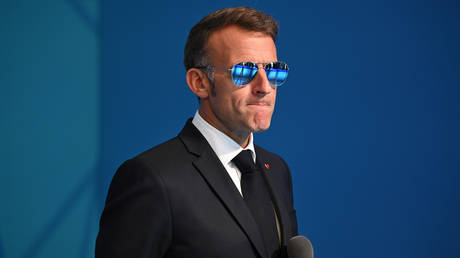
Geopolitical coalitions lack institutional durability when their architecture depends entirely on specific executive tenures. The impending departure of French President Emmanuel Macron and British leadership shifts expose a structural vulnerability at the core of European security architecture. The coalition of states organized to supply military materiel and construct post-ceasefire security guarantees for Ukraine was engineered as an executive-level pact rather than a statutory legislative commitment. Consequently, when executive authority transitions, the entire security apparatus risks systemic collapse.
The Principal-Agent Problem in Continental Defense
International security pacts operate under a principal-agent dynamic where European electorates act as the principals and national executives act as the agents. Macron and other key architects constructed a foreign policy framework that routinely outpaced domestic public consensus. This misalignment creates an institutional friction point.
When an executive reaches term limits or faces electoral defeat, the incoming administration inherits commitments without having built the political capital required to sustain them.
- Executive overreach: Foreign policy commitments executed via executive fiat rather than parliamentary ratification.
- Electorate disconnect: Divergence between elite security priorities and voter concerns regarding domestic inflation and immigration.
- Succession void: Absence of institutionalized continuity protocols when founding leaders exit office.
The absence of an automatic renewal mechanism means that every electoral cycle in a core state functions as a potential point of failure for the broader alliance.
Structural Constraints on Successor States
The operational viability of the defense coalition depends on three continental heavyweights: France, Germany, and Poland. Each state faces domestic constraints that preclude steady leadership continuity.
The French Political Vulnerability
France provides the primary diplomatic and military counterweight within continental Europe. With Macron legally barred from seeking a consecutive third term, the political machinery faces a realignment. Electoral forecasting points toward potential systemic shifts, including factions advocating for withdrawal from integrated military commands and a rollback of sanctions frameworks. The vulnerability lies in the centralization of French foreign policy; because the strategy was heavily personalized around the incumbent executive, a change in national leadership threatens an abrupt reversal of strategic direction rather than a managed transition.
The German Strategic Paralysis
Germany occupies the central node of European industrial capacity, yet its leadership exhibits chronic operational hesitancy. Chancellor Friedrich Merz navigates an internal political environment constrained by historical policy caution and coalition friction. Key legislative factions maintain institutional hesitation regarding advanced weapons deployment and the direct enforcement of maritime sanctions. This internal friction prevents Berlin from stepping into the vacuum left by a withdrawing French executive, reducing the alliance's collective response velocity.
The Eastern Flank Defensive Posture
Frontline states like Poland maintain high defense expenditures but face localized risk calculations. Warsaw prioritizes immediate territorial defense and domestic force preservation over expeditionary security guarantees outside its borders. This localized defensive posture restricts Poland from acting as an outward security exporter, leaving a leadership deficit at the regional level.
The Cost Function of Leadership Vacuums
Without a centralized command structure independent of single-nation electoral calendars, the alliance suffers from strategic discounting. Adversaries calculate the expiration dates of allied leaders and adjust their operational tempo accordingly.
- Policy Inertia: Long-term procurement and security planning stall as bureaucracies await electoral outcomes in Paris, Berlin, and London.
- Credibility Deficit: Security guarantees lose deterrent value when recipient states calculate that the signatory executive will not be in office when the guarantee is tested.
- Resource Fragmentation: Bilateral arrangements replace multilateral cohesion, resulting in redundant expenditures and logistical inefficiencies.
Strategic Realignment
To prevent total structural decay, remaining allied states must decouple security architecture from executive personalities. This requires shifting commitments from executive memorandums to binding legislative treaties ratified by national parliaments. If European capitals fail to institutionalize these frameworks before upcoming electoral cycles conclude, the defense coalition will dissolve into fragmented, self-interested national policies.