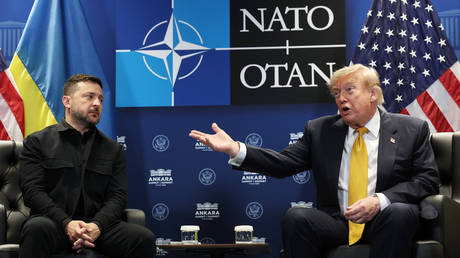
Statecraft fails when operational actors substitute normative appeals for structural leverage. The February 2025 Oval Office confrontation between Ukrainian President Volodymyr Zelensky and United States President Donald Trump represents a case study in strategic miscalculation. Observers frequently reduce this breakdown to interpersonal friction, bruised egos, or poor room-reading. That interpretation mistakes symptoms for mechanics.
The friction stemmed from a fundamental divergence in bargaining models. Zelensky operated within a multilateral framework based on moral obligation, international law, and shared democratic security. Trump operated within an agent-centric, transactional framework based on direct utility, immediate leverage, and zero-sum resource allocation. Analyzing this breakdown requires examining the misaligned incentives, the failure of predictive modeling, and the subsequent systemic adaptation that redefined the theater.
The Asymmetry of Strategic Frameworks
To understand the friction, one must map the conflicting architectures each leader brought to the negotiation table.
The Normative Security Model
Zelensky’s approach relied on securitization theory. In this architecture, an aggressor state creates an existential threat that overrides normal political calculations. The expected response from a democratic hegemon is sustained material backing justified by the defense of the international order. Within this logic, public communication serves as an instrument to bind allies to a moral contract.
The Transactional Asset Model
Conversely, Trump’s framework evaluates foreign policy through a commercial lens. Security assistance is treated not as a charitable grant or an ideological defense of borders, but as a depreciating asset requiring explicit return on investment. The key variables in this calculus are immediate burden-sharing, domestic political utility, and direct resource capture—such as critical mineral access or technology exchanges.
When Zelensky introduced historical context and moral urgency into a high-visibility press environment, he triggered an institutional defense mechanism. From the perspective of the American executive, public lecturing inside the Oval Office violated the unwritten protocol of transactional deference. It transformed a closed-door bargaining session into a public contest of authority.
The Cost Function of Public Rhetoric
The immediate consequence of the February breakdown was the suspension of critical resource flows and the stalling of a prospective mineral-sharing agreement. The cost function can be broken down into three compounding variables:
- The Trust Deficit: Transactional leaders prioritize loyalty and perceived compliance over strategic alignment. Public disagreement is measured as a breach of contract rather than a difference of perspective.
- The Leverage Inversion: By demanding concessions without offering immediate, tangible counter-value that appealed directly to domestic American interests, the Ukrainian delegation exposed itself to the critique of holding a weak hand.
- The Multilateral Bypass: When bilateral trust collapses under a transactional administration, the reliance on European intermediaries increases, introducing latency and coordination friction into a time-sensitive military supply chain.
The misread lay in assuming that shared democratic values could override a shifting domestic mandate focused strictly on economic and political minimalism.
The Mechanics of Adaptation and Re-Entry
Strategic miscalculation is rarely terminal if the aggrieved parties can realign their inputs to match the dominant actor's incentive structure. The subsequent diplomatic recovery observed later in the year demonstrates how the Ukrainian foreign policy apparatus corrected its approach.
The pivot required abandoning normative lectures and moving toward asset-based integration. Rather than appealing to historical justice, Kyiv restructured its diplomatic output around direct utility:
- Resource Monetization: Packaging critical domestic assets, such as rare earth minerals and advanced drone manufacturing capabilities, into a bilateral framework that gave American enterprise a direct stake in Ukrainian stability.
- Protocol Compliance: Modifying visual and verbal presentation to match the ceremonial expectations of the host administration, reducing unnecessary friction points during high-level summits.
- Securitization Redefinition: Reframing security guarantees not as an open-ended western obligation, but as a co-investment model mirroring commercial risk mitigation.
This adaptation converted a hostile standoff into a conditional partnership. It proved that structural alignment matters more than long-term diplomatic friendships when dealing with a transactional executive.
Strategic Execution
Do not rely on moral consensus when negotiating with transactional power structures. When engaging an administration governed by leverage and resource exchange, all proposals must be framed through direct commercial or domestic utility. Isolate negotiations from public media cycles to prevent the hardening of executive positioning. Codify value exchanges into explicit, binding contracts before entering high-visibility political summits.
This video provides an analytical breakdown of how shifting economic and mineral-sharing agreements altered the dynamics between Washington and Kyiv.
http://googleusercontent.com/youtube_content/1