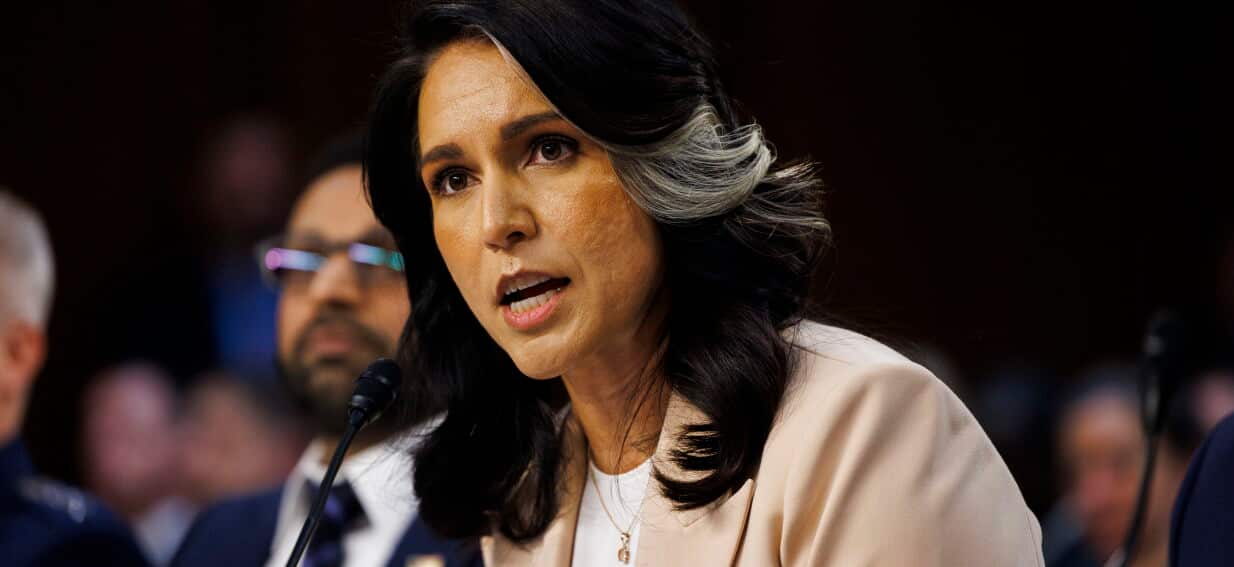
The resignation of a Director of National Intelligence (DNI) represents more than a personnel change; it is a rupture in the coordination mechanism of the seventeen distinct agencies comprising the United States Intelligence Community (IC). When a top official such as Tulsi Gabbard departs from a role defined by the post-9/11 mandate of integration, the immediate consequence is an increase in friction between collection, analysis, and executive dissemination. This analysis deconstructs the structural variables driving such exits and the resulting operational voids created within the national security architecture.
The DNI Authority Paradox
The DNI role was established by the Intelligence Reform and Terrorism Prevention Act of 2004 to solve the "silo" problem. However, the position suffers from a fundamental mismatch between responsibility and authority. While the DNI is tasked with overseeing the National Intelligence Program (NIP) budget, they lack direct "hire and fire" authority over the heads of the CIA, NSA, or FBI.
This creates a Budgetary vs. Operational Authority Gap. A DNI manages the flow of capital but does not dictate the daily tactical deployments of the subordinate agencies. When a leader in this position resigns, it often signals a breakdown in the informal consensus required to bridge this gap. The exit usually follows one of three friction points:
- Policy-Intelligence Misalignment: The inherent tension between providing objective analysis and the political priorities of the Executive Branch.
- Institutional Resistance: The "Iron Triangle" of legacy agencies—the CIA, DIA, and NSA—protecting their autonomy against centralized DNI oversight.
- Credentialing Friction: In cases involving nontraditional appointees, the friction emerges from the IC’s internal immune response—a culture that prioritizes career tenure and specific technical backgrounds over external reform mandates.
The Intelligence Feedback Loop Failure
Intelligence serves as a decision-support system. The effectiveness of this system is measured by its signal-to-noise ratio. A leadership vacuum at the DNI level introduces immediate noise into the feedback loop.
The DNI acts as the Information Arbiter. Without this arbiter, the President is forced to ingest raw or competing data streams directly from individual agencies. This bypasses the synthesis stage, leading to a phenomenon known as "Analysis Paralysis" or, conversely, "Confirmation Bias Cascades," where the most aggressive agency voice dominates the Oval Office briefings.
The Cost of Transition in Covert Environments
The financial and operational costs of a top-tier intelligence resignation are non-linear. The damage is not localized to the office of the DNI; it cascades through the entire IC.
- Strategic Drift: Major multi-year initiatives—such as the transition from counter-terrorism to Great Power Competition (GPC)—require consistent top-down pressure. A resignation resets the momentum, allowing agencies to revert to legacy operational modes.
- Trust Erosion with Five Eyes Partners: International intelligence sharing relies on stable, predictable leadership. Frequent turnover at the DNI level signals instability to the UK, Canada, Australia, and New Zealand, leading to a temporary "throttling" of sensitive data exchanges as foreign partners wait to see the new director's stance.
- The Vetting and Confirmation Bottleneck: The process of selecting, vetting, and confirming a successor is a months-long drain on executive resources. During this period, an "Acting" DNI often lacks the political capital to make hard decisions on budget reallocation or inter-agency disputes.
Distinguishing Ideology from Infrastructure
Public discourse frequently centers on the political leanings of the DNI. From a strategic consulting perspective, this is a secondary variable. The primary variable is Institutional Integration.
An effective DNI must manage the "Principal-Agent Problem." The President (the Principal) wants objective truth to make decisions; the Agencies (the Agents) want to maximize their specific influence and budgets. A resignation occurs when the DNI can no longer facilitate a productive exchange between these two parties.
In the specific context of recent departures, the tension often stems from the Analytical Neutrality Mandate. If a director perceives that the intelligence product is being shaped to fit a pre-determined policy, or if the agencies believe the director is ignoring empirical data to satisfy political goals, the structural integrity of the DNI office fails.
The Mechanics of the Exit
Resignations in this tier are rarely "personal." They are strategic withdrawals. Analyzing the timing and language of such departures reveals the underlying cause:
- The Protest Resignation: Intended to signal to the public or Congress that a boundary has been crossed.
- The Forced Attrition: The result of internal agency maneuvering where the director is starved of actionable intelligence, rendering their position untenable.
- The Strategic Realignment: Where the Executive Branch decides that the director’s "brand" no longer serves the current geopolitical narrative.
Operational Vulnerabilities During the Interregnum
The period between a resignation and the confirmation of a successor is a window of heightened vulnerability. Adversarial actors—specifically state-sponsored cyber units and intelligence services—often increase their activity during these windows. They calculate that the US response mechanism will be slowed by the lack of a permanent director who can authorize high-stakes counter-measures.
This "Interregnum Risk" is quantified by the delay in the President’s Daily Brief (PDB) Synthesis. While the PDB continues, the absence of a permanent DNI means there is no single voice to adjudicate between conflicting agency assessments of high-risk scenarios, such as nuclear signaling or rapid territorial shifts.
The Reform Imperative
The recurring instability in the DNI role suggests that the 2004 framework may be reaching its limit of utility. To prevent future systemic shocks from individual resignations, the following structural adjustments are under debate within policy circles:
- Fixed-Term Appointments: Aligning the DNI term with that of the FBI Director (10 years) to insulate the role from election cycles.
- Statutory Budgetary Control: Moving beyond "oversight" to direct management of the NIP, reducing the leverage individual agencies hold over the DNI.
- Defined Intelligence Prerequisites: Establishing strict statutory requirements for the role to ensure a baseline of technical and operational competence, thereby reducing the "immune response" from career staff.
The exit of a top US intelligence official is a stress test for the American administrative state. It reveals the friction points between democracy, which demands transparency and political accountability, and the intelligence apparatus, which functions on secrecy and continuity. The failure to stabilize this role does not just impact the White House; it creates systemic weaknesses that are monitored and exploited by global competitors.
The strategic priority for the Intelligence Community now shifts to containment. Career deputies must manage the "Information Continuity Protocol," ensuring that the loss of a political figurehead does not translate into the loss of tactical visibility. The success of this containment determines whether the resignation is a minor administrative hurdle or a catalyst for a broader national security crisis. Stability depends on the speed with which the Executive Branch can re-establish a credible, authoritative link between the collectors of data and the deciders of policy.


