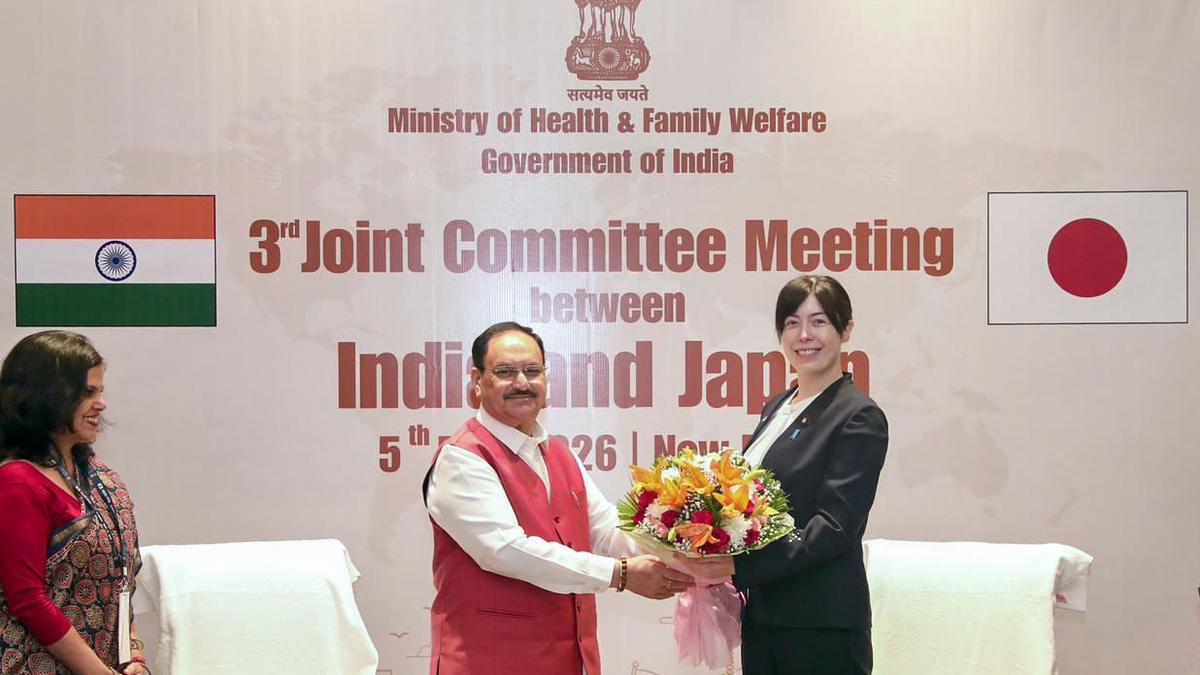
The convergence of Indian demographic scale and Japanese technological precision is not a diplomatic courtesy but a calculated response to two distinct systemic failures: Japan’s collapsing domestic labor supply and India’s fragmented healthcare infrastructure. As both nations convene in Delhi, the objective is to synchronize India’s Ayushman Bharat Digital Mission (ABDM) with Japan’s Medical ICT standards to create a cross-border healthcare corridor. This alignment seeks to solve the "Iron Triangle" of healthcare—balancing access, quality, and cost—by utilizing Japan’s capital and advanced medical hardware to optimize India’s high-volume, low-margin clinical environment.
The Bifurcated Value Proposition
The partnership operates on a reciprocal extraction of value where the constraints of one nation are the surplus assets of the other. To analyze the efficacy of this meeting, one must examine the specific vectors of cooperation through a structural lens.
1. Human Capital Arbitrage and the Skill Residency Gap
Japan faces an existential threat in its nursing and elderly care sectors. The Ministry of Economy, Trade and Industry (METI) projections indicate a deficit of nearly 400,000 healthcare workers by 2035. India, conversely, produces over 350,000 nursing graduates annually but suffers from a lack of high-tier specialized training and domestic wage stagnation.
The Delhi talks focus on the Specified Skilled Worker (SSW) program. Unlike traditional migration, this framework is designed as a "Knowledge-Transfer Loop."
- Stage I: Indian professionals undergo Japanese language and clinical standard certification in India.
- Stage II: Deployment to Japanese facilities, where they serve as the operational backbone for an aging population.
- Stage III: Long-term integration or return-migration where the acquired expertise in geriatric care—a sector India will desperately need by 2050—is localized.
This is not a brain drain; it is a liquidity event for human capital. The bottleneck remains the high friction in license equivalency, which currently prevents 60% of eligible Indian candidates from qualifying for Japanese placement.
2. The Hardware-Software Synthesis
Japan’s pharmaceutical and medical device industry (dominated by Terumo, Olympus, and Fujifilm) excels in diagnostic precision and longevity. However, the Japanese market is saturated, and R&D costs are skyrocketing. India offers the world’s largest "clinical sandbox."
The logic of the Delhi meeting involves shifting from a "Seller-Buyer" relationship to a "Co-Development" model. This is governed by the Cost Function of Diagnostic Deployment:
$$C(d) = \frac{R + O}{V}$$
Where $C$ is the cost per diagnosis, $R$ is R&D/Capital expenditure, $O$ is operational cost, and $V$ is the volume of patients. Japan has high $R$ and low $V$; India has low $R$ and massive $V$. By moving manufacturing to India under the Production Linked Incentive (PLI) scheme, Japanese firms can drive down $C(d)$ to a level that makes advanced oncology and imaging accessible to the Global South, not just the Indian elite.
http://googleusercontent.com/image_content/200
Regulatory Harmonization and the Data Bottleneck
A primary friction point discussed in Delhi is the lack of a unified data protocol. For Japanese AI-driven diagnostic tools to function in Indian hospitals, they require access to diverse genomic and clinical datasets.
The Tri-Layered Data Security Framework
The success of this healthcare axis depends on three specific regulatory layers:
- Interoperability Standards: Adopting HL7 FHIR (Fast Healthcare Interoperability Resources) to ensure that a pathology report generated in a Delhi clinic is readable by a Tokyo-based AI diagnostic engine.
- Sovereign Data Residency: India’s Digital Personal Data Protection Act (DPDP) creates a wall around sensitive patient info. The strategy involves "Federated Learning," where the AI model travels to the data, learns from it, and returns to Japan without the raw patient data ever leaving Indian servers.
- Clinical Validation Cycles: Japanese regulators (PMDA) and Indian regulators (CDSCO) are negotiating "Fast-Track Mutual Recognition." This reduces the time-to-market for new drugs by 30-40% by accepting clinical trial data across borders, provided the ethnic diversity of the trial cohorts meets specific statistical thresholds.
The Oncology and Geriatric Care Core
While the public statements focus on "general health," the internal strategy is hyper-focused on two high-margin, high-complexity sectors: cancer treatment and aging-related diseases.
The Radiation Therapy Gap
India currently has approximately 0.5 radiotherapy machines per million people, far below the WHO recommendation of 1 per million. Japan possesses some of the world’s most advanced proton beam therapy technology. The Delhi roadmap includes the establishment of "Japanese-managed Oncology Centers" in Tier-2 Indian cities. This serves a dual purpose:
- It provides Japanese firms with a recurring revenue model through maintenance and consumables.
- It provides India with a localized "Center of Excellence" that reduces the need for medical tourism to Singapore or the West.
The Digital Health Stack (ABDM Integration)
India’s Ayushman Bharat Digital Mission is the world’s largest experiment in creating a unified health ID. Japan’s interest here is purely analytical. By integrating Japanese "Health-Tech" with the Indian digital backbone, Japan gains insights into population-scale health management that are impossible to achieve in its own shrinking, controlled demographic. This data is the "new oil" for the next generation of preventative medicine.
Operational Risks and Systemic Barriers
The strategy is not without significant points of failure. The most immediate threat is the Cultural-Clinical Mismatch. Japanese healthcare is characterized by extreme risk aversion and high-cost, high-reliability systems. Indian healthcare is characterized by "Jugaad" (frugal innovation), where speed and cost take precedence over total precision.
- Failure Mode 1: Japanese devices may be over-engineered for the Indian environment, leading to high maintenance costs that the Indian public health system cannot absorb.
- Failure Mode 2: The "Language-Culture Barrier" in nursing. While Indian nurses are technically proficient, the high emotional intelligence and linguistic nuance required for Japanese geriatric care remain a significant hurdle that current 6-month training programs fail to address.
- Failure Mode 3: Infrastructure inconsistency. Advanced Japanese imaging equipment requires stable power and specific ambient conditions often missing in the very Indian hospitals that need them most.
Re-Engineering the Supply Chain
The Delhi meeting explicitly addresses the over-reliance on Active Pharmaceutical Ingredients (APIs) from China. Japan and India are moving toward a Resilient Supply Chain Initiative (RSCI) specifically for life-saving drugs.
The mechanism involves:
- Joint Venture API Parks: Japanese capital funding Indian chemical engineering firms to produce high-purity precursors.
- Strategic Stockpiling: A bilateral agreement to prioritize each other’s markets during global shortages, effectively creating a "Healthcare NATO."
- Cold-Chain Logistics: Utilizing Japanese logistics expertise (e.g., Yamato Holdings) to solve India’s "Last-Mile Delivery" problem for vaccines and temperature-sensitive biologics.
The Strategic Shift to Value-Based Care
The ultimate transformation is a shift from fee-for-service to value-based care. Japan’s universal health coverage (UHC) model is one of the most efficient in the world regarding outcomes per dollar spent. India’s goal is to replicate the Japanese insurance-provider feedback loop to prevent the runaway inflation seen in the US healthcare model.
The Delhi meeting marks the transition from "Donor-Recipient" (where Japan gave aid to India) to "Co-Sovereign Strategic Partners." This is a move to decouple from Western-centric medical supply chains and build an Asian-centric healthcare ecosystem that is resilient, digitally native, and optimized for mass-scale delivery.
Investment should follow the Infrastructure-Services-Data sequence. The first wave of capital will hit physical diagnostic centers and API plants. The second wave will monetize the digital health records through AI-driven preventative care. Organizations that fail to align their technical standards with the ABDM-Japan protocols by the end of this fiscal year will find themselves locked out of the largest procurement cycle in modern healthcare history.
Focus must remain on the Unit Economics of Care. The partnership succeeds only if it drives the cost of a cardiac intervention or a cancer screening down by an order of magnitude. This is not a matter of charity; it is a matter of market survival for Japan and social stability for India.