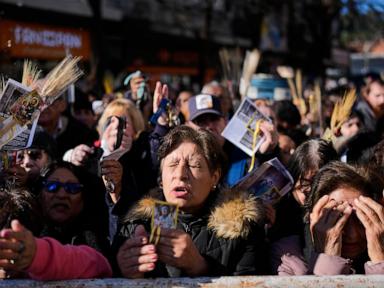
The announcement of Pope Leo XIV visiting Argentina in November introduces a complex variable into an already volatile socioeconomic system. Media narratives frequently reduce such high-level state visits to sentimental exercises or psychological balms for populations enduring acute financial contraction. This framing misdiagnoses the function of sovereign-pontifical interactions. A papal visit to a nation undergoing severe fiscal stabilization does not mitigate economic stress through intangible reassurance. Instead, it functions as an external political catalyst, altering the domestic bargaining space between the executive branch, organized labor, and marginalized populations.
Analyzing the mechanics of this upcoming visit requires stripping away the ecclesiastical rhetoric and examining the hard vectors of influence: state legitimacy, institutional friction, and the distributional consequences of structural reforms. Meanwhile, you can find related stories here: Why Delhi is Losing Bangladesh and Why Washington Is Barking Up the Wrong Tree.
The Architecture of National Economic Strain
Argentina operates within a compressed stabilization cycle characterized by severe fiscal austerity, real-wage compression, and structural deregulation designed to correct decades of monetary expansion. The primary friction point in this model is not theoretical; it is the immediate cost function borne by households during the deflationary transition.
When purchasing power deteriorates, the social safety net experiences extreme load-bearing stress. Traditional media coverage often conflates general hardship with a mandate for spiritual intervention, assuming populations look to religious authorities for material relief. In analytical terms, however, citizens do not look to the Vatican for economic output or monetary policy corrections. They look for institutional signaling. To explore the bigger picture, check out the recent report by USA Today.
The presence of the head of the Catholic Church in Buenos Aires, Córdoba, and Luján creates a focal point for collective grievance and moral authority. This introduces a distinct hazard and opportunity for the sitting administration under President Javier Milei. State visits by global moral figures compress political timeframes, forcing latent societal discontent into visible, concentrated expressions.
State Power and the Moral Arbitrage of the Vatican
Diplomatic interactions between the Holy See and sovereign states involve a constant exchange of soft power assets. For the Argentine government, hosting Pope Leo XIV offers an institutional imprimatur of international engagement and normalcy. For the Vatican, the visit represents an operational deployment of Catholic social doctrine into a live economic laboratory where free-market orthodoxies are being tested at maximum velocity.
The structural tension centers on divergent definitions of the common good. Macroeconomic stabilization programs prioritize fiscal surplus, currency stability, and supply-side incentives. These variables operate on long-term horizons. Conversely, institutional church networks process data through the immediate velocity of poverty, employment precariousness, and community fragmentation.
When Pope Leo XIV addresses industrial leaders and state officials, his framework challenges the absolute efficiency of market self-correction without offering alternative monetary instruments. This creates a dynamic of moral arbitrage. Organized labor and social movements leverage papal pronouncements to validate resistance against austerity measures, while the state attempts to co-opt the visit as validation of national resilience and institutional reform.
Mapping the Domestic Political Transmission Channels
The impact of the November itinerary across Buenos Aires, Córdoba, and the national sanctuary of Luján will be mediated by three distinct structural channels:
- Labor market friction: Unions representing state workers and formal industrial sectors face diminished bargaining power under restrictive fiscal targets. Papal engagement with labor organizations provides a formalized channel for grievance articulation, temporarily elevating the political cost of further state retrenchment.
- Subnational political realigning: Provincial governors and municipal authorities operating outside the federal core view the papal tour as a high-visibility platform to project regional autonomy and highlight local economic degradation directly attributable to centralized budgetary cuts.
- Civil society mobilization: Informal economy networks, which constitute a massive percentage of domestic economic activity in Argentina, rely heavily on parish-level infrastructure for survival support. The visit concentrates national attention on these shadow supply chains, transforming localized charity into a macroeconomic data point regarding state failure.
The interaction of these channels determines whether the visit acts as a pressure valve or a pressure cooker. If the public perceives the event as an empty ritual divorced from their material reality, cynicism deepens, accelerating the erosion of institutional trust. If the visit successfully aggregates disparate social grievances into an organized political dialogue, the bargaining power shifts perceptibly away from pure fiscal technocracy toward negotiated social compensation.
The Limits of Symbolic Diplomacy on Balance Sheets
To evaluate the utility of the forthcoming papal journey, one must establish strict boundary conditions. Symbolic diplomacy possesses zero direct liquidity. It cannot lower sovereign debt spreads, compress inflation indices, or recapitalize central bank reserves.
The mistake analysts make is measuring the event against metrics it cannot possibly influence. The true metric of impact is institutional velocity. By drawing international focus to the social cost of structural adjustment, the visit alters the political discount rate that markets and investors apply to Argentine governance. If social friction boils over into systemic civil unrest during or immediately following the tour, the perceived political risk of the country spikes, raising the cost of capital regardless of fiscal surplus achievements.
Conversely, if the administration successfully manages the optics of the visit while maintaining its core stabilization targets, it demonstrates structural resilience under extreme public scrutiny. The outcome is binary: either the moral weight of the Vatican fractures the political consensus required for reform, or the state absorbs the moral critique while pressing forward with structural re-engineering.
De-escalate reliance on generalized sentiment tracking. Monitor real-time shifts in labor strike frequencies, municipal resource allocation for safety nets, and the legislative voting behavior of provincial blocs during the fourth quarter to quantify the actual impact of the papal visit on domestic governance stability.