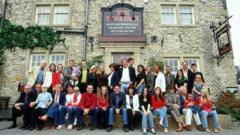
Long-running television serials face a structural contradiction between fictional permanence and real-estate transience. The operational model of a continuing drama relies on spatial continuity, meaning the audience requires visual anchor points to maintain psychological immersion. When a production facility faces lease expiration or urban redevelopment pressures, the physical infrastructure supporting this continuity breaks down. ITV Studios faces precisely this optimization problem with the permanent exterior set of Emmerdale located on the Harewood Estate in West Yorkshire. Relocating a constructed ecosystem of this scale exposes deep vulnerabilities in asset depreciation, capital allocation, and continuity management.
Operating a dedicated outdoor set for a daily serial is not merely a matter of moving physical lumber and masonry. It requires maintaining a complex socio-technical system where real-world zoning laws, environmental regulations, and long-term land lease agreements intersect with tight broadcast schedules. Deconstructing this relocation reveals three underlying structural variables: the spatial dependency coefficient, the capital expenditure threshold of physical reconstruction, and the temporal constraints of production continuity.
The Spatial Dependency Coefficient
The primary operational constraint of a fictional soap village is its spatial dependency coefficient. This metric measures the degree to which viewer engagement relies on specific topographical layouts and architectural geography. In a traditional studio environment, sets are modular and designed for rapid teardown and reconfiguration. Exterior standing sets, however, function as permanent urban or rural simulations with deep infrastructure.
Drainage systems, electrical grids, communication cabling, and structural foundations are permanently embedded into the ground. When a production must vacate a site, these sunk costs cannot be recovered. The physical materials hold negligible salvage value compared to the labor cost of extraction.
Furthermore, viewer spatial memory creates a strict boundary condition for relocation. The relative distance between the fictional public house, the local shop, and residential dwellings forms a cognitive map for the audience. Altering these spatial relationships during a rebuild risks triggering cognitive dissonance among viewers, leading to drops in audience retention. Consequently, any relocation strategy must prioritize topographical isomorphism, replicating the layout of the original site within acceptable error margins constrained by the geography of the new location.
The Cost Function of Infrastructure Reconstruction
Rebuilding an exterior television village from the ground up triggers a complex capital expenditure function. This expenditure is split into distinct cost vectors: land acquisition or lease structuring, site preparation, physical construction, and regulatory compliance.
Land acquisition represents the initial fixed cost. The ideal site must satisfy mutually exclusive criteria:
- Sufficient acreage to house the primary exterior set plus buffer zones for sound and visual isolation.
- Proximity to existing studio production hubs to minimize daily transport friction for cast and crew.
- Compatible zoning classifications that permit commercial television production without violating local environmental protections or residential noise ordinances.
Site preparation involves heavy civil engineering. Unlike standard real estate development, a television set requires precise control over sightlines to eliminate modern intrusions like power lines, contemporary vehicles, or distant housing developments. This necessitates earthmoving, landscaping, and the installation of custom architectural facades designed to withstand weather exposure while remaining malleable enough to accommodate camera rigging and lighting equipment.
Regulatory compliance introduces significant variance into the cost function. Modern construction standards demand strict adherence to environmental impact assessments, carbon footprint regulations, and wildlife protection laws. If a chosen relocation site hosts protected species or sits within a greenbelt designation, the legal friction and timeline inflation can compromise the financial viability of the entire project.
Production Continuity and Temporal Constraints
The secondary operational hazard of relocation is the disruption of the production inventory buffer. Serial dramas operate on strict shooting blocks, typically filming episodes weeks or months in advance of broadcast to maintain a safety margin. A physical move compresses this inventory buffer.
During the transition window, production must either stockpile a surplus of episodes shot on the legacy set, construct temporary swing sets on a studio backlot, or execute a narrative interruption within the storyline. Each mitigation strategy carries distinct operational costs.
Stockpiling requires an intensified shooting schedule, increasing actor fatigue and error rates. Constructing temporary sets duplicates capital expenditure without delivering long-term value. Narrative interruptions risk alienating audiences and lowering advertising revenue yields during the broadcast window. The optimal relocation timeline minimizes this operational downtime by synchronizing the phase-out of the old set with the commissioning of the new infrastructure, a feat that requires precise project management and zero tolerance for supply chain delays in construction materials.
The Strategic Horizon
Managing the relocation of a permanent serial set requires treating physical infrastructure as a depreciating software asset rather than a permanent real estate holding. Production entities must decouple their narrative longevity from specific geographic parcels by negotiating long-term land security models that align with the projected lifespan of the format.
Future-proofing continuing dramas depends on modular architectural design frameworks. By engineering exterior sets using standardized, transportable structural components rather than permanent masonry, producers can reduce the cost function of future relocations. The long-term viability of the format relies on shifting from fixed-site dependency to flexible spatial systems capable of migrating without breaking the narrative illusion.