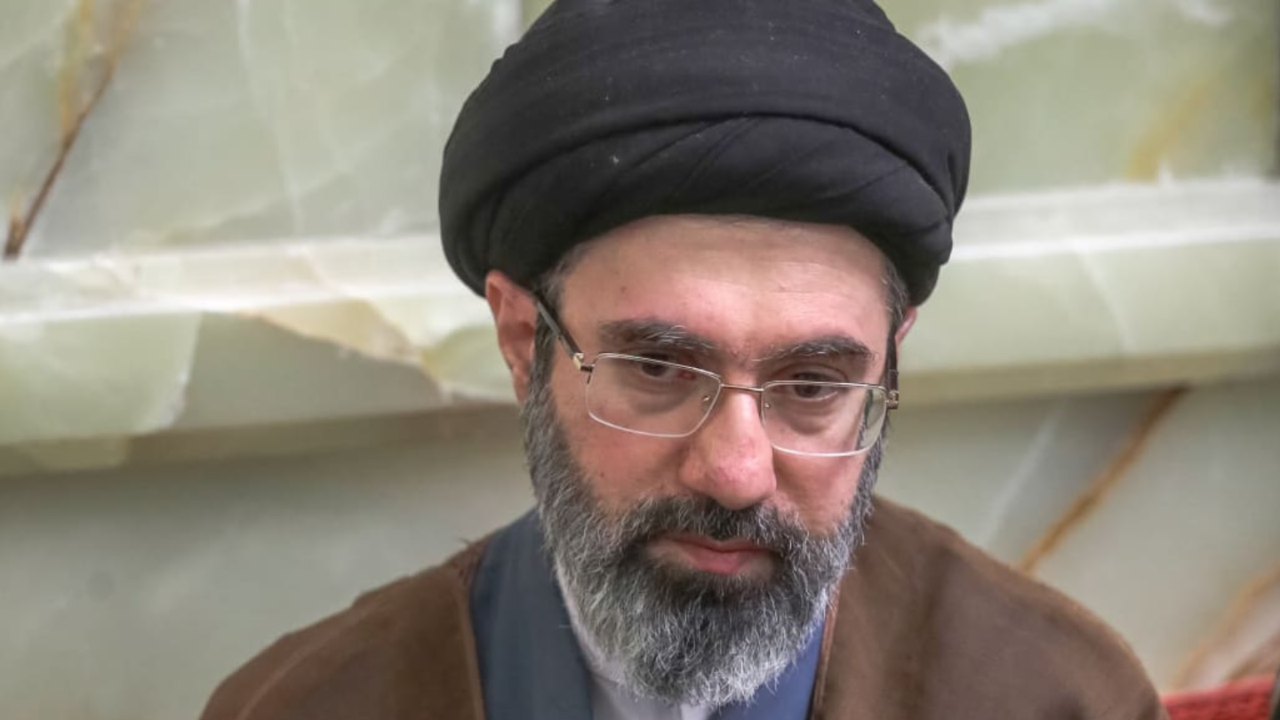
The institutional stability of the Islamic Republic of Iran currently rests on the management of two volatile variables: the perceived physical viability of the Supreme Leader’s successor and the state’s ability to neutralize "information decay" regarding elite health. Recent official Iranian rebuttals concerning Mojtaba Khamenei’s health are not merely denials; they are strategic signaling maneuvers designed to preserve the internal cohesion of the clerical and military establishment. When the state characterizes reports of illness as a "trick used by the enemy," it is deploying a defensive logic aimed at preventing a "lame duck" period that could trigger premature factional infighting.
The Architecture of Iranian Succession
Succession within the Iranian political system is governed by the Assembly of Experts, but the informal power dynamics are dictated by a tripod of influence: the Office of the Supreme Leader (Beit-e Rahbari), the Islamic Revolutionary Guard Corps (IRGC), and the senior clerical elite in Qom.
Mojtaba Khamenei occupies a unique position within this tripod. Unlike his father, Ali Khamenei, who held the presidency before ascending to the leadership, Mojtaba’s influence is largely operational and opaque. His perceived health is a proxy for the stability of the entire transition plan. If the "heir apparent" is viewed as physically compromised, the incentive for rival factions to begin positioning for an alternative increases exponentially.
The state's use of the phrase "God wanted him preserved" serves three specific functions:
- Theological Validation: It frames Mojtaba’s survival or health as a matter of divine will, making political opposition to his rise appear as opposition to a metaphysical mandate.
- Institutional Reassurance: It signals to the IRGC leadership that the succession plan remains on track, preventing the "security vacuum" that occurs when an ideological system lacks a clear future head.
- Counter-Intelligence: By labeling health claims as "enemy tricks," the state categorizes any discussion of leadership frailty as an act of treason rather than political discourse.
The Information Decay Function
In authoritarian systems, the value of information regarding a leader’s health follows a steep decay curve. The longer the state remains silent or provides vague updates, the more the "gray market" of rumors dictates market behavior and political loyalty.
We can analyze this through the lens of The Credibility Gap Cost. When the gap between official state media and external reports (Western intelligence, diaspora media) widens, the state loses its ability to "anchor" the narrative. The recent aggressive pushback from Tehran indicates that the Credibility Gap had reached a threshold where it began to threaten the internal loyalty of middle-ranking IRGC officers. These officers require a stable vision of the future to maintain their commitment to the current hierarchy.
The mechanics of this "enemy trick" narrative serve as a psychological firewall. By pre-emptively labeling health reports as psychological operations (PSYOPs) from the United States or Israel, the Iranian state ensures that even if Mojtaba Khamenei does face health challenges, the domestic audience is conditioned to view the evidence as manufactured.
Operational Logic of the "Shadow Successor"
The transition from Ali Khamenei to a successor represents the most significant stress test for the Islamic Republic since 1989. The strategy surrounding Mojtaba Khamenei relies on Strategic Ambiguity.
- The Visibility Paradox: Too much public exposure for Mojtaba invites scrutiny of his religious credentials (the rank of Ayatollah) and his lack of elective experience. Too little exposure allows rumors of ill health or internal purges to fester.
- The Proxy Governance Model: Mojtaba is widely believed to manage significant portions of the state’s security and financial apparatus. In this model, his health is not just a biological concern but a systemic one. If the manager of the "deep state" is incapacitated, the network of patronage he oversees risks fragmentation.
The recent denials must be viewed as an attempt to re-establish the Visibility Paradox at an optimal level. The state needs him to be "healthy enough" to lead, yet "distant enough" to avoid the political friction that comes with daily governance.
Structural Bottlenecks in the Assembly of Experts
The Assembly of Experts is the constitutional body charged with selecting the next leader. However, their selection process is heavily influenced by the Guardian Council, which vets candidates for the Assembly itself. This creates a circular feedback loop of loyalty.
The primary bottleneck for Mojtaba Khamenei is not the lack of a vote, but the lack of Charismatic Authority. His father’s legitimacy was tied to the 1979 Revolution and a long tenure in the presidency. Mojtaba lacks this "revolutionary resume." Therefore, the state replaces traditional charisma with "Survivalist Legitimacy." The narrative that he has been "preserved" by divine intervention against "enemy plots" is a synthetic form of charisma designed to bridge the resume gap.
The Cost of Narrative Failure
If the state fails to convince the internal elite of Mojtaba’s viability, the following sequence of systemic failures is likely:
- Factional Hedging: Power centers like the traditional clergy or "pragmatic" conservatives will begin seeking back-channel alliances with alternative candidates, such as Alireza A'rafi or others within the clerical hierarchy.
- Capital Flight and Economic Volatility: The Iranian Rial is highly sensitive to succession rumors. Perceived instability at the top translates immediately into currency devaluation, as the merchant class (Bazaaris) hedges against a potential civil-military power struggle.
- IRGC Fragmentation: The Guard is not a monolith. Different wings (Quds Force vs. domestic security) may have different preferences for a successor. A clear, healthy Mojtaba provides a unifying focal point. A contested or "sickly" candidate encourages commanders to seek individual autonomy.
Strategic Forecast of the Succession Timeline
The Iranian state's aggressive defense of Mojtaba Khamenei suggests that the transition period has already begun in an informal capacity. We are currently in the Consolidation Phase, where the state is pruning the field of potential rivals and hardening the public image of the chosen successor.
The "enemy trick" rhetoric will likely intensify as the 85-year-old Supreme Leader’s public appearances become more curated. The objective is to move the succession from a "possibility" to an "inevitability" before any physical transition occurs.
The ultimate test of this strategy will be the next meeting of the Assembly of Experts. Observe the level of "consensus" reported in state media. Any deviation from a unified front—or any increase in the frequency of "divine preservation" rhetoric—indicates that the internal friction is outstripping the state's ability to mask it.
The strategic imperative for the Iranian establishment is to maintain a "frozen" political state until the moment of transition. By aggressively debunking health rumors, they are not just protecting a man; they are protecting the structural integrity of the revolutionary state against the entropy that naturally follows long-term personalized rule. The move to elevate Mojtaba is a move toward a "dynastic-clerical" hybrid model, and the health of the individual is the only variable that can derail that transformation.
The immediate tactical move for the Iranian leadership will be a series of highly publicized, yet controlled, appearances by Mojtaba Khamenei in non-political, religious settings to provide visual confirmation of health without subjecting him to the risks of unscripted political engagement. This "Visual Normalization" strategy will be the primary indicator of the state's confidence in its own succession narrative.


