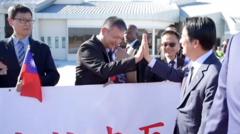
The arrival of Taiwan’s leadership in Mbabane is not a simple diplomatic courtesy call. It is a high-stakes survival maneuver. President Tsai Ing-wen’s recent visit to Eswatini, the absolute monarchy formerly known as Swaziland, marks a desperate yet calculated attempt to preserve Taipei’s shrinking footprint on a continent almost entirely swallowed by Chinese influence. While the official narrative focuses on the 55th anniversary of Eswatini’s independence and diplomatic ties, the subtext is a fierce struggle against isolation.
This trip occurred immediately following the collapse of Taiwan’s presence at the BRICS summit in South Africa, a gathering where Beijing’s shadow loomed large and Taipei’s invitations were nonexistent. By doubling down on Eswatini, Taiwan is attempting to prove it still has a gateway into Africa, even as its list of global allies dwindles to a mere thirteen nations.
The Lone African Outpost
Eswatini stands as a peculiar anomaly. It is the only African nation that refuses to recognize the People’s Republic of China, choosing instead to maintain formal ties with the Republic of China (Taiwan). For King Mswati III, this relationship is built on decades of direct investment and technical assistance that bypasses the massive, debt-heavy infrastructure deals typically offered by Beijing.
Taiwan’s strategy here is surgical. Instead of multi-billion dollar belt-and-road projects that often lead to sovereign debt crises, Taipei focuses on visible, grassroots impact. We are talking about rural electrification, medical missions, and agricultural training. These programs are designed to make the Taiwanese presence indispensable to the daily survival of the Eswatini population, creating a social contract that is harder for Beijing to buy out with a single check.
Beijing’s Strategy of Encirclement
The timing of this visit is no accident. China has spent the last decade systematically picking off Taiwan’s African allies. Burkina Faso and São Tomé and Príncipe were the most recent to flip, leaving Eswatini as a lonely island in a sea of Chinese-aligned states.
Beijing does not just want Eswatini’s recognition; it wants to complete the total diplomatic blackout of the Tsai administration. The pressure on Mbabane is relentless. Chinese officials frequently dangle the prospect of massive tourism investment and trade access to the world’s second-largest economy. For a landlocked nation struggling with high poverty rates and a volatile economy, the temptation to switch sides is a constant factor in domestic politics.
Taipei knows this. The President’s visit is a physical manifestation of "checkbook diplomacy" 2.0. It is about showing face, renewing promises, and ensuring the King remains satisfied with the status quo.
The Economic Reality of Sovereignty
Taiwanese officials often highlight that their aid comes without the "political strings" attached to Chinese loans. This is a half-truth. The string is the recognition itself.
In Mbabane, Taiwanese money has funded the construction of hospitals and the development of the King Mswati III International Airport. These are vanity projects and essential services rolled into one. However, the economic delta between what Taiwan can provide and what China can offer is widening. Taiwan’s GDP is formidable, but it cannot match the sheer volume of capital the Chinese state-owned banks can mobilize for long-term African projects.
To counter this, Taiwan is shifting its pitch. They are no longer just donors; they are positioning themselves as partners in high-tech development. During the visit, discussions moved beyond farming to include cooperation in the energy sector and digital transformation. Taipei is betting that Eswatini would rather have a sophisticated, reliable partner than become another pawn in Beijing’s debt-trap maneuvers.
The Security Implications
There is a quiet, darker side to this diplomatic dance. Eswatini has faced internal unrest, with pro-democracy activists clashing with the monarchy’s security forces. Taiwan, a democracy itself, finds itself in the awkward position of being the primary benefactor to Africa’s last absolute monarch.
This creates a moral friction that Beijing is happy to exploit. While China generally ignores human rights records in its partner states, it uses Taiwan’s support of the monarchy to paint Taipei as an obstacle to democratic reform in Africa. It is a cynical play, but in the world of international PR, it carries weight. Tsai must balance the need for an ally with the optics of supporting a regime that has been criticized by Amnesty International and other watchdogs.
The Microchip Shield and Global Relevance
Taiwan’s biggest leverage remains its dominance in the semiconductor industry. While Eswatini isn’t a hub for 3nm chip production, the global "Silicon Shield" provides Taipei with the diplomatic capital to stay relevant. When Tsai travels, she isn't just representing a small island; she represents the world’s most critical link in the electronics supply chain.
This global importance gives smaller allies like Eswatini a sense of prestige. Being Taiwan’s "only friend" in Africa gives the King a level of international attention he would never receive as just another Chinese client state. It allows him to play the middle, occasionally flirting with Chinese intermediaries to drive up the price of Taiwanese loyalty.
The Shifting Sands of the Global South
The recent BRICS expansion is a flashing red light for Taiwan. With countries like Ethiopia, Egypt, and the UAE joining the bloc, the influence of the "Global South" is consolidating around a Beijing-supported framework. This makes the Eswatini connection even more vital. If Taiwan loses its last African vote at the United Nations and other international bodies, its claim to sovereign legitimacy becomes increasingly theoretical.
The battle for Eswatini is a microcosm of the Cold War 2.0. It is a theater where soft power, infrastructure, and historical loyalty are tested against the gravity of a rising superpower.
Taiwanese diplomats are working overtime to ensure that the "Eswatini Model" remains viable. This involves deep integration into the local economy, including scholarships for Eswatini students to study in Taipei and specialized training for the country’s healthcare workers. These are long-term investments in human capital that China often overlooks in favor of concrete and steel.
The Cost of Staying Put
Maintaining this relationship is not cheap. Critics in Taipei often question the "diplomatic budget," wondering if the millions spent on a small African kingdom could be better used at home or for unofficial trade offices in Europe and the US.
But for the Tsai administration, the cost of withdrawal is higher than the cost of the aid. Losing Eswatini would be a psychological blow that would signal the end of Taiwan’s African presence. It would embolden the opposition at home and provide Beijing with a major propaganda victory.
Strategic Redundancy
The administration is also quietly building backdoors. Even as it clings to Eswatini, Taiwan is increasing its "unofficial" presence in Somaliland. By establishing a representative office in Hargeisa—a territory that, like Taiwan, seeks international recognition—Taipei is diversifying its African portfolio.
This move into Somaliland is a brilliant, if risky, hedge. It signals to Eswatini that while they are valued, they are not the only option. It also creates a partnership between two "pariah" states that understand each other’s unique challenges. This is the new face of Taiwanese diplomacy: agile, unconventional, and unapologetic.
The Intelligence Gap
One overlooked factor in this trip is the intelligence-sharing capability. Having a physical footprint in Southern Africa allows Taiwan to maintain its own eyes and ears on Chinese activities in the region. The embassy in Mbabane is more than a post office; it is a listening station in a region where Beijing is rapidly expanding its military and economic intelligence networks.
Every Chinese mining deal in Zimbabwe or port project in Mozambique is scrutinized from the vantage point of the Eswatini mission. For the US and its allies, Taiwan’s presence here provides a secondary stream of data that is invaluable in tracking the expansion of the People’s Liberation Army’s influence across the continent.
The Inevitable Friction
Pressure from Beijing will only intensify. We should expect to see an increase in "civil society" protests within Eswatini, likely funded or encouraged by pro-China elements, demanding a pivot toward Beijing for "economic growth."
Taiwan’s response must be more than just more money. It needs to demonstrate that its partnership provides a quality of development that China cannot or will not replicate. This means focusing on transparency, the rule of law, and actual technology transfer rather than just building roads that crumble in a decade.
The President’s return to Taipei will be greeted with the usual domestic political bickering, but the reality on the ground in Mbabane remains unchanged. Taiwan is fighting a rearguard action. It is a slow, grueling process of holding the line, one village and one hospital at a time. The survival of Taiwan’s international status depends on these small, often overlooked victories in corners of the world that the rest of the global community has largely forgotten.
Stop looking at the photo ops and start looking at the shipping manifests and the scholarship lists. That is where the real war is being fought.