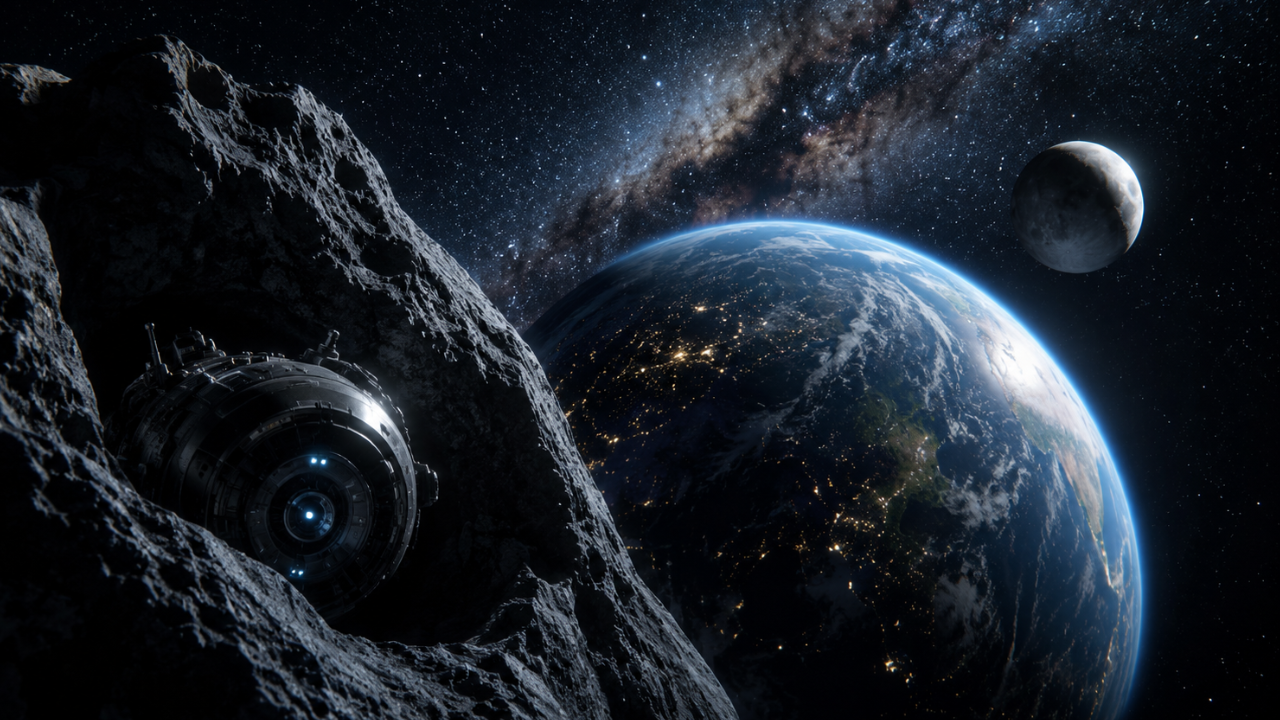
The assessment of whether non-terrestrial intelligence exists within the solar system requires moving past speculative media narratives and establishing a rigorous, probabilistic framework. Popular discourse frequently treats the discovery of alien artifacts or probes as a binary, sensationalized event. A strategic analysis demands that we treat the local interstellar medium as a potential repository of physical anomalies, classified by specific detection vectors, mass-energy constraints, and technological longevity.
To determine if non-terrestrial technology occupies our local space, we must analyze three specific domains: orbital dynamics, materials degradation in vacuum environments, and the energetic thresholds of active versus passive technosignatures. By evaluating the solar system as a thermodynamic sink, we can map exactly where anomalous objects would accumulate and how our current observational arrays are structurally blind to them. For a more detailed analysis into this area, we suggest: this related article.
The Architecture of Local Interstellar Capture
Any non-terrestrial probe or automated system entering the solar system must conform to the laws of orbital mechanics and gravitational capture. Spacecraft do not wander aimlessly; they occupy specific energy states relative to the Sun and the major planets. We can categorize potential local anomalies into three distinct orbital regimes.
                  [Interstellar Object Intersections]
                                  |
        +-------------------------+-------------------------+
        |                         |                         |
        v                         v                         v
[Hyperbolic Trajectories]  [Lagrange Equilibrium]   [Planetary Orbits]
  - Oumuamua type            - L4/L5 stable zones     - Co-orbital captures
  - High velocity            - Long-term storage      - Debris belts
Hyperbolic Flyby Trajectories
Objects like 1I/’Oumuamua and 2I/Borisov demonstrate that interstellar material regularly intersects our heliosphere. These objects possess excess kinetic energy ($v_{\infty} > 0$), meaning they are not gravitationally bound to the Sun. From a strategic reconnaissance perspective, a hyperbolic trajectory maximizes the data gathered per unit of fuel spent during a stellar flyby. The primary limitation for human detection is time; these objects cross the frost line and return to interstellar space within a window of months, requiring rapid-response interception capabilities that humanity does not currently possess. For additional background on this issue, comprehensive coverage is available on Engadget.
Stable Gravitational Sinks (Lagrange Points)
The Earth-Sun and Jupiter-Sun $L_4$ and $L_5$ Lagrange points represent co-orbital regions where gravitational forces and the Coriolis force create stable equilibrium.
$$F_g + F_c = 0$$
An automated probe intended for long-term monitoring would logically position itself within these gravitational wells to minimize the station-keeping propellant required to maintain its position over millions of years. Current optical surveys of Earth's co-orbital regions are incomplete. Objects smaller than 100 meters in diameter possessing low albedos (dark, non-reflective surfaces) are virtually invisible to automated asteroid tracking networks like Pan-STARRS or the Vera C. Rubin Observatory's baseline configurations.
High-Eccentricity Planetary Orbits
A third capture mechanism involves aerodynamic or gravitational braking using gas giants. A probe utilizing a Jupiter gravity assist could shed excess hyperbolic velocity to enter a bound, highly eccentric orbit within the inner solar system. This places the object in a long-period orbit where it spends the vast majority of its time at aphelion (the furthest point from the Sun), far outside the scanning fields of view of terrestrial civilian astronomy.
The Degradation Bottleneck: Material Longevity in Deep Space
A core argument against the presence of local non-terrestrial hardware is the assumption that artificial structures would remain obviously distinct from natural space debris over geological timescales. This assumption ignores the specific material science of space weathering. If an automated probe arrived in the solar system one hundred million years ago, its current physical state would be governed by three primary environmental degradation mechanisms.
- Micrometeoroid Bombardment: Surfaces in the solar system are continuously hyper-velocity impacted by dust grains traveling between 10 and 72 kilometers per second. Over millions of years, this process spallates and pulverizes solid surfaces, turning smooth geometric structures into pitted, irregular shapes covered in a layer of regolith. An ancient artificial object would visually mimic a carbonaceous or silicaceous asteroid.
- Solar Wind and Cosmic Ray Spallation: Unshielded materials are bombarded by high-energy protons and alpha particles. This radiation alters the crystalline structure of metals and silicates, causing amorphization and darkening the material via the precipitation of submicroscopic iron phase grains. This reduces the object's albedo to values below 0.05, rendering it as dark as charcoal.
- Thermal Cycling Stress: Objects in eccentric orbits experience extreme temperature fluctuations as they move closer to and further from the Sun. The resulting differential thermal expansion causes micro-fracturing across structural joints, eventually breaking large monolithic structures down into fragmented debris fields along the orbital plane.
Humanity's current asteroid identification pipelines rely heavily on albedo measurements and basic spectroscopic classification. A highly degraded, darkened, and fragmented artificial probe would be flagged automatically as a common D-type or C-type asteroid, masking its true origin.
Detection Thresholds and Sensor Blind Spots
The debate over why we have not definitively found non-terrestrial technology within our system reveals a significant misunderstanding of modern sensor capabilities. Astronomers do not look at the sky as a whole; they query specific volumes of space for specific signal types.
| Sensor Domain | Target Signature | Primary Detection Limit |
|---|---|---|
| Optical / Near-IR | Reflected sunlight, geometry | Albedo $< 0.05$, diameter $< 100\text{m}$ at 1 AU are missed. |
| Thermal Infrared | Waste heat emission ($30\text{K} - 300\text{K}$) | Masked by solar heating; requires dedicated space cryo-telescopes. |
| Radio / Radar | Active telemetry, communications | Narrow beamwidth requires pointing directly at the receiver; high attenuation. |
The Thermal Waste Heat Problem
Every operating machine must reject heat to its environment to satisfy the second law of thermodynamics. For a probe operating in the solar system, this waste heat must be radiated away as infrared photons. The Stefan-Boltzmann law dictates the energy flux:
$$P = \epsilon \sigma A T^4$$
If a probe operates at ultra-low power states (e.g., cryogenic sleep or passive data logging), its thermal signature matches the background equilibrium temperature of space debris at that specific distance from the Sun. For an object at the orbit of Jupiter, this temperature is approximately 120 Kelvin. Detecting a 10-meter object radiating at 120 Kelvin against the cold background of space requires high-resolution space-based infrared observatories like the James Webb Space Telescope. However, these assets are pointed exclusively at deep-space astronomical targets, not used for blind, wide-field inner solar system searches.
The Spatial Volume Blindspot
The volume of the solar system out to the orbit of Neptune is roughly $1.4 \times 10^{31}$ cubic meters. Our current total sensor coverage monitors only a microscopic fraction of this volume at any given second. Automated sky surveys are optimized to find large, fast-moving hazards (asteroids larger than 140 meters) that present an immediate impact risk to Earth. A small, slow-moving or stationary artifact located outside the ecliptic plane—the flat disk where planets orbit—will bypass these detection algorithms entirely because the algorithms are programmed to discard anomalies that do not match standard planetary or asteroidal drift rates.
Operational Blueprint for System Validation
To transform the search for local non-terrestrial technology from a theoretical exercise into an actionable scientific operation, resources must be allocated away from broad radio SETI toward localized, high-resolution physical searches.
[System Validation Operational Flow]
               |
               v
  [Deploy Dynamic Filters on Survey Pipelines]
               |
               v
  [Deep-Field Infrared Mapping of L4/L5 Sinks]
               |
               v
  [Rapid-Response Intercept Fleets (Flybys)]
First, modify the data-filtering pipelines of upcoming wide-field surveys, specifically the Vera C. Rubin Observatory. Current algorithms automatically purge non-standard moving targets that do not conform to Keplerian orbits or that exhibit minute non-gravitational accelerations. Retaining and analyzing this "discarded" data will isolate objects experiencing anomalous radiation pressure or executing deliberate orbital corrections.
Second, prioritize deep-field infrared mapping of the Earth-Sun $L_4$ and $L_5$ stable zones. These regions must be scanned down to a limiting magnitude capable of isolating 1-meter objects with extremely low albedos. This requires deploying dedicated, wide-field infrared space telescopes outside Earth's distorting atmospheric envelope.
Third, construct rapid-response intercept missions. When an interstellar object like 'Oumuamua is detected entering the system, humanity cannot rely on ground-based telescopes to deduce its nature before it exits our sphere of influence. A constellation of dormant, high-velocity propulsion breakout probes must be parked in high Earth orbit, ready to launch on intercept trajectories within days of an anomaly's detection. Only close-range imaging, mass spectroscopy of outgassing products, and radar profiling can definitively distinguish an ancient, space-weathered piece of alien engineering from a common interstellar rock.