Commercializing space-based solar power (SBSP) requires solving a brutal geometric and thermodynamic constraint: harvesting unattenuated solar irradiance in geostationary orbit ($1,361 \text{ W/m}^2$) and beaming it across $36,000 \text{ kilometers}$ to an terrestrial grid without vaporizing the infrastructure or losing the energy to free-space path loss. Mainstream media reports regularly mischaracterize localized wireless power transmission milestones as immediate precursors to planetary clean energy grids. A rigorous engineering assessment reveals that while recent empirical breakthroughs in multi-target microwave transmission indicate true progress, they expose severe architectural bottlenecks in thermal dissipation, beam divergence, and conversion efficiency.
The baseline system developed under the "Zhuri" (Sun Chasing) project at Xidian University, led by Duan Baoyan, recently achieved a direct current-to-direct current (DC-to-DC) transmission efficiency of $20.8%$ over a $100\text{-meter}$ aperture distance, delivering $1,180\text{ watts}$ of power. A secondary validation test successfully maintained a $143\text{-watt}$ power feed to a drone moving at $30\text{ kilometers per hour}$ over $30\text{ meters}$. To evaluate whether these milestones scale to viable orbital deployments, we must deconstruct the physics of the underlying architecture.
The Distributed OMEGA Architecture
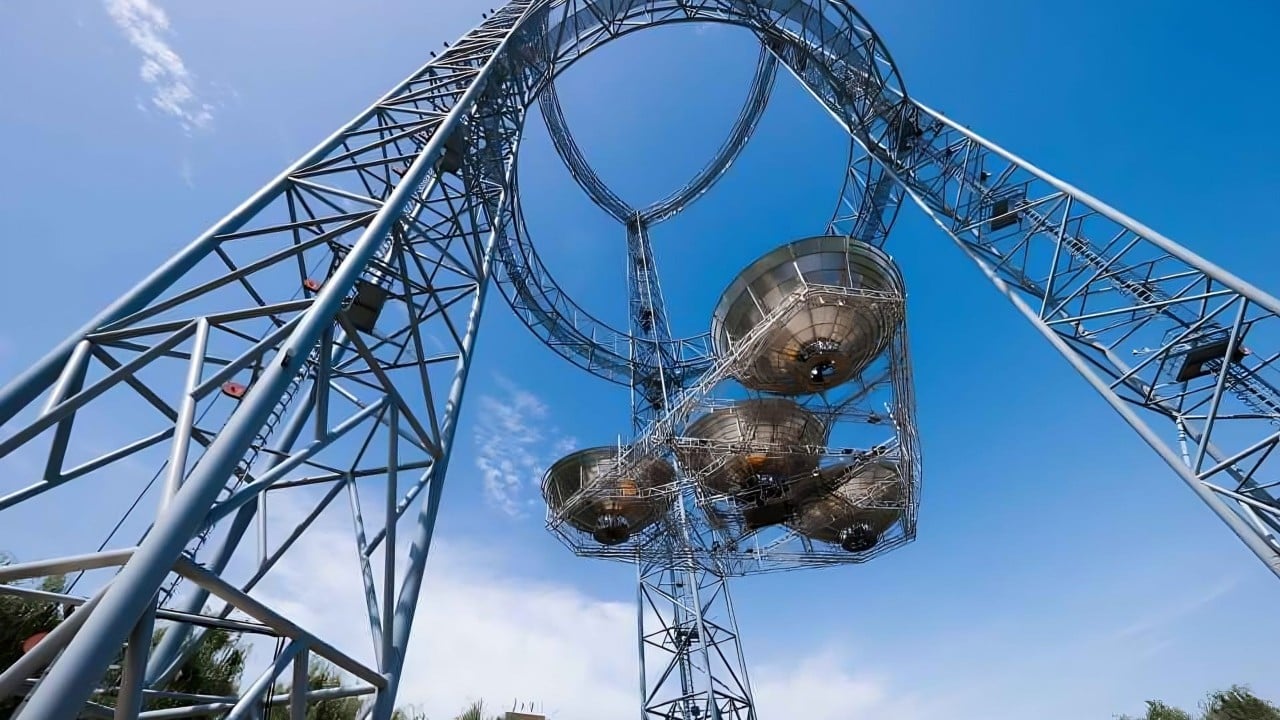
The core structural failure of early SBSP designs, such as NASA’s 1970s reference models, was the reliance on massive, rigid joints to simultaneously point solar collectors at the Sun and transmitting antennas at Earth. China's Orb-Shape Membrane Energy Gathering Array (OMEGA) architecture bypasses this mechanical single point of failure by decoupling collection from transmission through a stationary, spherical configuration.
The evolution from the 2014 baseline OMEGA to the current Distributed OMEGA framework addresses the sheer structural volume required for a gigawatt-scale plant. The system operates via three distinct sequential subsystems:
- The Optoelectronic Harvesting Chain: A large, ultra-lightweight spherical concentrator collects ambient sunlight. Because the outer structure is spherical, it eliminates the need for large-scale mechanical tracking; the sun's rays are naturally focused onto an internal, moving photoelectric line-receiver that tracks the focal point.
- The Internal Bus and Conversion Core: Concentrated photonic energy is converted via high-efficiency photovoltaic (PV) cells into direct current. This DC electricity must then be routed via low-loss power management networks to microwave generation modules (traveling-wave tubes or solid-state power amplifiers).
- The Phased-Array Beaming Aperture: The converted microwave energy ($2.45\text{ GHz}$ or $5.8\text{ GHz}$) is fed into a massive phased-array transmitter. This array uses electronic beam-steering to dynamically adjust phase shifted signals, eliminating mechanical gimbal movement while tracking terrestrial rectifying antennas (rectennas) or orbital satellites.
The "Distributed" iteration optimizes this by replacing a single, monolithic spherical array with modular, autonomous sub-units. These units function as independent building blocks assembled in orbit, mitigating the catastrophic structural risks associated with thermal expansion and micrometeorite impacts on an unsegmented multi-kilometer array.
Quantifying the Efficiency Deficit: The DC-to-DC Chain
The primary barrier to commercial viability is the cumulative efficiency loss across the power conversion chain. The reported $20.8%$ DC-to-DC efficiency over $100\text{-meters}$ represents a notable improvement over the $15.05%$ baseline achieved in 2022, yet it highlights the strict thermodynamic tax paid at each interface.
The total systemic efficiency ($\eta_{\text{sys}}$) of an operational SBSP framework is governed by the product of its component efficiencies:
$$\eta_{\text{sys}} = \eta_{\text{pv}} \times \eta_{\text{dc-rf}} \times \eta_{\text{trans}} \times \eta_{\text{beam}} \times \eta_{\text{rf-dc}}$$
Where:
- $\eta_{\text{pv}}$ is the photoelectric conversion efficiency in orbit.
- $\eta_{\text{dc-rf}}$ is the efficiency of converting DC electricity into radio frequency (RF) microwave signals.
- $\eta_{\text{trans}}$ is the structural transmission efficiency across the phased array.
- $\eta_{\text{beam}}$ is the beam collection efficiency (the percentage of emitted RF energy that actually intercepts the target aperture).
- $\eta_{\text{rf-dc}}$ is the efficiency of the rectenna converting incoming microwaves back into grid-ready DC.
The Xidian University team documented a beam collection efficiency ($\eta_{\text{beam}}$) of $88.0%$ over $100\text{-meters}$. The remaining $12%$ loss across a minuscule distance underscores the challenge of long-range beaming. Over an orbital link of $36,000\text{ kilometers}$, beam divergence increases exponentially according to the diffraction limit. The diameter of the spot size ($D_{\text{spot}}$) cast on Earth is fundamentally constrained by wavelength ($\lambda$), transmitter diameter ($D_{\text{trans}}$), and link distance ($R$):
$$D_{\text{spot}} \approx \frac{2.44 \times \lambda \times R}{D_{\text{trans}}}$$
To maintain an $88%$ collection efficiency at a standard frequency of $5.8\text{ GHz}$ ($\lambda \approx 5.17\text{ cm}$), a transmitter in geostationary orbit requires an aperture measuring approximately $1 \text{ to } 2 \text{ kilometers}$ in diameter, matching with a ground rectenna array spanning $4 \text{ to } 5 \text{ kilometers}$ in diameter. Any degradation in beam pointing precision or phase synchronization directly diminishes $\eta_{\text{beam}}$, bleeding gigawatts of energy into the atmosphere or upper ionosphere as wasted heat.
Dynamic Multi-Target Power Routing
The genuine technical leap demonstrated in the 2026 phase-two trials is not the total power delivered ($1,180\text{ watts}$), but the transition from single-point transmission to dynamic, multi-target power distribution. The successful charging of a drone moving at $30\text{ km/h}$ isolates a specific engineering victory: real-time phase-conjugate tracking.
In a multi-target environment, an orbital station cannot rely on slow, pre-programmed orbital mechanics to point its beam. Instead, it utilizes a closed-loop retrodirective array system. The target (e.g., an auxiliary low-Earth-orbit satellite or a ground station) emits a low-power pilot signal toward the space station. The space station’s phased array analyzes the relative phase arrival of this pilot signal across its millions of individual antenna elements. By reversing the phase profile (conjugation), the transmitter fires a highly focused power beam directly back along the exact path of the incoming pilot signal.
This mechanism resolves two critical operational vulnerabilities:
- Aperture Jitter Compensation: It corrects for any structural flexing or vibrations of the kilometers-wide space station in real time.
- Safety Interlocking: If the target target deviates or the pilot signal breaks due to an intersecting object (such as aircraft), the phase-coherence instantly dissolves, defocusing the beam safely into ambient, non-hazardous background radiation.
The capacity to split this beam mathematically among multiple distinct targets allows a single Distributed OMEGA node to function as a dynamic routing hub, shifting energy allocations between terrestrial regional grids experiencing peak demand, or redirecting surplus juice to low-Earth-orbit satellites trapped in the Earth's shadow.
Operational Trajectory and Strategic Milestones
The timeline for scaling this technology from a $100\text{-meter}$ ground tower to a functional space asset is governed by China's formal 15th Five-Year Plan (2026–2030) and extended aerospace roadmaps. The progression relies on a step-by-step scaling of both altitude and power:
[2022: Ground Validation] ---> [2028: LEO 10kW Test] ---> [2030: GEO 100kW+ Test] ---> [2050: Commercial GW Scale]
- Phase 1: Ground Validation (Completed 2022–2026): Establishing full-link systems on Earth to verify that the conversion from light to DC, DC to RF, and back to DC operates predictably under simulated atmospheric atmospheric conditions.
- Phase 2: Low-Earth-Orbit (LEO) Technology Verification (Targeting 2028): Launching a prototype satellite capable of generating $10\text{ kilowatts}$ in LEO. This mission will evaluate high-voltage power management in a vacuum and test wireless transmission across a $400\text{-kilometer}$ slant range to a terrestrial collection facility.
- Phase 3: Medium-Power Geostationary (GEO) Test (Targeting 2030): Scaling the orbital platform to generate over $100\text{ kilowatts}$. This phase transitions the system to its ultimate operational altitude ($36,000\text{ kilometers}$), validating long-range laser and medium-power microwave beaming configurations.
- Phase 4: Commercial Gigawatt Infrastructure (Targeting 2050): The assembly of a multi-kilometer, gigawatt-scale orbital power plant designed to supply continuous baseload electricity directly to industrial coastal centers.
Structural Bottlenecks to Commercial Viability
Despite successful bench-scale tracking of moving targets, severe engineering bottlenecks remain unresolved. Analysts must distinguish between a validated lab mechanism and a deployable system capable of competing with ground-based alternatives.
The Radiative Thermal Sink Problem
In space, there is no convective cooling. Every watt of energy lost as heat during the DC-to-RF conversion process must be rejected entirely via radiative cooling. Assuming a highly optimistic solid-state power amplifier efficiency of $70%$, a commercial station designed to beam $1\text{ gigawatt}$ of RF power will generate roughly $428\text{ megawatts}$ of pure waste heat in the transmitter array alone. Dissipating nearly half a gigawatt of thermal energy in a vacuum requires massive, heavy graphene-based radiator panels. This adds substantial dry mass to the vehicle and directly penalizes its launch economics.
Mass-to-Orbit Economic Constraints
A standard gigawatt-scale OMEGA station is projected to weigh between $5,000 \text{ and } 10,000 \text{ metric tons}$. Using contemporary reusable heavy-lift launch vehicles (assuming a highly optimized bulk launch cost of $$500 \text{ per kilogram}$ to LEO and subsequent electric propulsion transfer to GEO), launch costs alone would exceed $$2.5 \text{ billion to } $5 \text{ billion}$ per station. This capital expenditure does not account for manufacturing, in-orbit robotic assembly, or the construction of the massive $5\text{-kilometer}$ ground rectenna arrays. To achieve a levelized cost of electricity (LCOE) that competes with traditional terrestrial solar-plus-storage systems, the mass-to-power ratio of space-qualified hardware must drop below $1\text{ kilogram per kilowatt}$.
Ionospheric Cross-Modulation
Beaming high-power microwave streams through the upper atmosphere introduces ionospheric heating effects. The interaction between a continuous gigawatt-scale microwave beam and the ionospheric plasma can induce thermal self-focusing and plasma instabilities. These phenomena risk distorting the power beam itself, reducing $\eta_{\text{beam}}$, and causing severe electromagnetic interference with regional satellite communications, GPS signals, and aviation radar networks.
Strategic Playbook for Global Space Assets
The tactical deployment of space-based wireless power transmission will yield near-term military and operational advantages long before it ever powers a terrestrial civilian city.
The immediate economic utility of the Distributed OMEGA architecture lies in altering the design parameters of auxiliary spacecraft. Currently, low-Earth-orbit satellites spend approximately $35%$ to $40%$ of each $96\text{-minute}$ orbit in the Earth’s shadow, relying on heavy, cyclical lithium-ion battery banks for survival. By deploying orbital "charging stations" utilizing the dynamic multi-target capabilities demonstrated in the Xidian trials, secondary satellites can shed up to $70%$ of their onboard battery mass and solar array surface area. This structurally redefines satellite design, lowering individual launch costs, reducing aerodynamic drag in very low orbits, and extending operational lifespans indefinitely.
Industrial operators and state agencies should prioritize development of high-frequency ($24\text{ GHz}$ to $94\text{ GHz}$) sub-kilowatt retrodirective transmission architectures designed exclusively for space-to-space logistical support, avoiding the thermal and political complications of high-power atmospheric penetration.
This video explores the core concepts of space-based solar power, detailing the mechanics of orbital collection and the technical hurdles of long-range microwave energy transmission.
Space Based Solar Power Beaming Energy to Earth