The departure board at Simón Bolívar International Airport does not record the weight of a human life. It tracks destinations, flight numbers, and gates. At 6:00 p.m. on a Wednesday evening, it recorded routine. Travelers adjusted neck pillows. Gate agents scanned boarding passes. Business travelers tapped out final, mundane emails.
Then the earth moved.
It started as a low, resonant rumble that vibrated less in the ears and more in the marrow of the bone. In the span of a heartbeat, the concrete floor beneath the main passenger terminal transformed from solid ground into a moving liquid wave. A magnitude 7.2 earthquake, centered near the coastal town of Morón, ripped through the earth at a shallow depth of 22 kilometers.
Consider what happens to a structure designed for flight when it is forced to anchor itself to a violently shifting earth. The ceiling, a vast expanse of heavy, suspended panels, began to tear itself apart. Signboards guiding passengers to safety turned into swinging pendulums of jagged metal. Dust, fine and blindingly white like pulverized bone, exploded into the air, turning the bright, fluorescent terminal into a subterranean fog.
People did not just run. They scrambled. They crawled.
Exactly thirty-nine seconds later, before the first wave of adrenaline could even clear the human bloodstream, the second blow landed. A magnitude 7.5 seismic twin struck just sixteen kilometers southwest of the first. Geologists call this a rare seismic doublet. To the father holding his daughter’s hand in the landside seating area, it did not feel like a scientific rarity. It felt like the end of the world.
The second shock destroyed the infrastructure. Huge sections of the terminal roof gave way entirely, dropping debris, wiring, and heavy metal fixtures onto the floors below. Lights flickered once, twice, and died. In the sudden, thick darkness, the only guide was the sound of screaming, the crunch of broken glass beneath thousands of desperate shoes, and the distant, structural groan of a building giving up its fight against gravity.
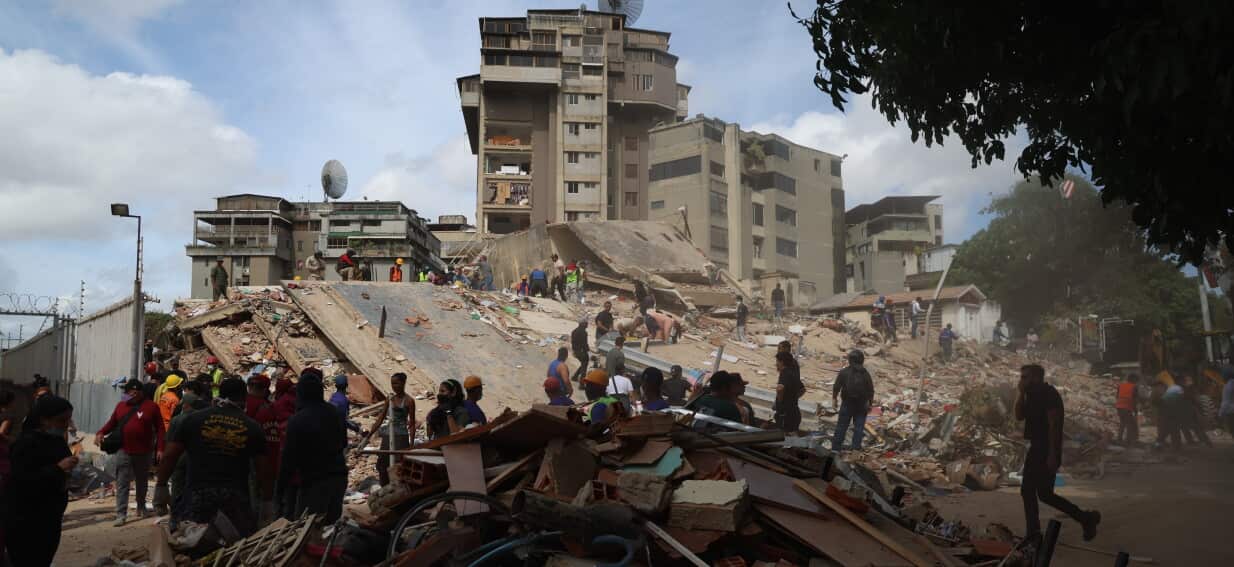
Outside the airport walls, the scale of the tragedy grew exponentially. In the coastal city of La Guaira, the tectonic shift acted like a giant hand crushing cardboard boxes. Dozens of residential buildings and hotels collapsed instantly, flattening structures into layers of concrete and trapped memories. In Caracas, residents fled swaying high-rises, rushing out into the streets to watch the dust clouds rise from neighborhoods like Altamira and Chacao. Entire apartment walls sheared away, leaving intimate domestic scenes—a dining room table, a television, a half-made bed—visible to the horrified onlookers below.
The true weight of a disaster is never found in the initial telemetry of the United States Geological Survey. It is found in the silence that follows. It is found in the frantic, one-bar cellphone calls that cut out mid-sentence because the cell towers have toppled. It is found in the emergency room of public hospitals and private clinics where over 700 injured people arrived covered in the gray dust of their own homes. At least 32 people did not survive the night, their lives cut short in a literal flash of shifting stone, with authorities warning that the number will inevitably rise as rescuers dig into the remains of places like the La Mar Suites hotel.
Acting President Delcy Rodríguez declared a nationwide state of emergency, closing schools, suspending non-essential work, and shutting down the shattered ruins of the Maiquetía airport. The main gateway to the country is gone for now, its runways intact but its heart broken.
But the real crisis lies in the minutes ticking away right now. In Falcon state, fifteen people are trapped inside a collapsed structure. They are breathing through a pocket of air that is running out, beneath tons of unstable concrete. Every passing hour is not a measurement of time; it is a measurement of survival. As more than twenty aftershocks continue to rattle the coast, emergency workers cannot use heavy machinery for fear of triggering a final, fatal collapse. They use their hands. They listen for the sound of a fingernail scratching against concrete, a faint cough, a human voice crying out from the dark.
Disaster forces us to confront our total vulnerability. We build massive, towering monuments of steel and concrete, buy tickets to cross oceans, and plan our lives months in advance, entirely forgetting that we live on a shifting crust of rock floating over a molten core. It takes less than a minute for all of it to crumble.
As the sun rises over the Caribbean coast, the residents of Caracas remain in the streets, wrapped in blankets, holding their pets, refusing to go back inside. They look up at the cracked facades of their homes, waiting for the earth to finally grow still.
Caracas Airport Terminal Damaged in Venezuela Earthquake
This video provides direct visual confirmation of the immediate aftermath inside the Simón Bolívar International Airport terminal, capturing the structural destruction and the chaotic atmosphere described in the narrative.