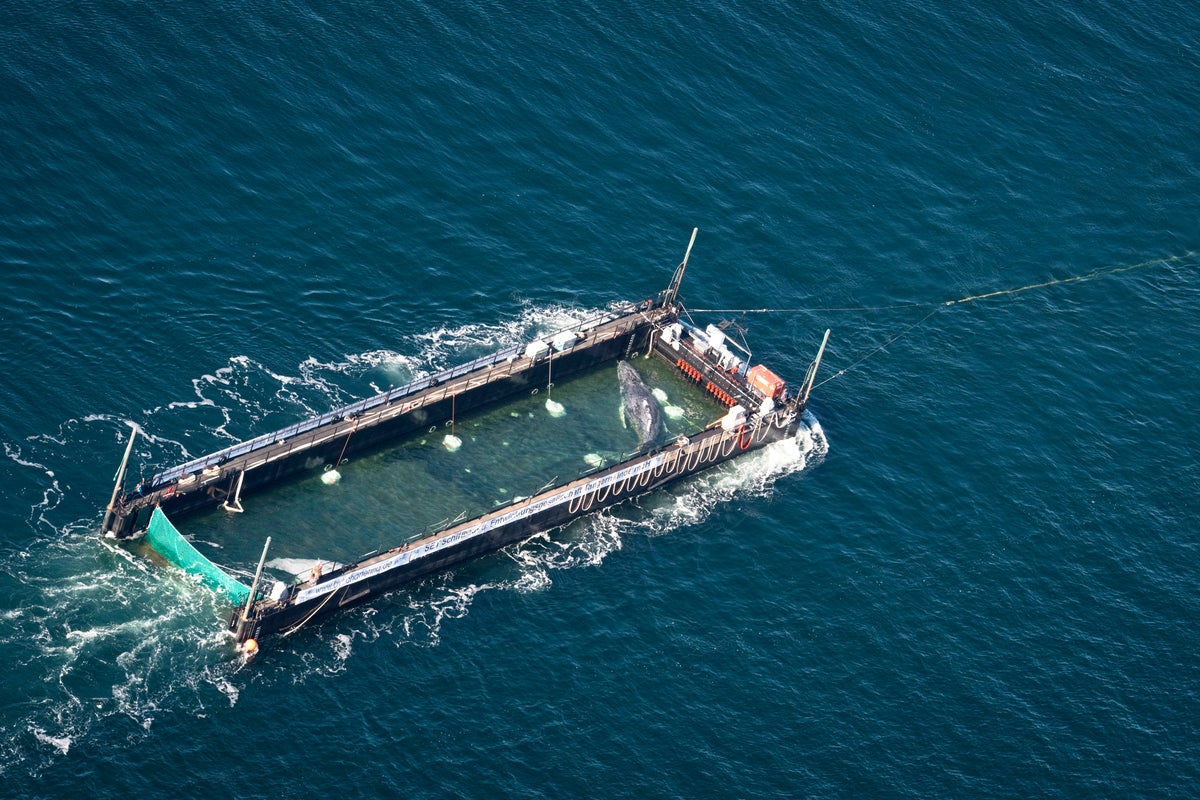
Timmy is finally going home. You've likely seen the headlines about the juvenile humpback whale that's spent the last few weeks in a location where no whale should ever be. It's a rescue mission that sounds like something out of a movie, involves a massive barge, and has a whole team of marine biologists holding their breath. This isn't just about moving a large animal from point A to point B. It's about a high-stakes logistics puzzle that tests the limits of what we can do to protect marine life when things go south.
The situation was dire. Timmy didn't just take a wrong turn; he ended up in a shallow, restricted waterway that made a natural exit nearly impossible. Most experts agreed that if he stayed, he wouldn't survive the stress or the lack of proper food. The decision to use a barge wasn't the first choice, but it became the only choice. Moving a whale over land or through shallow water on a floating platform is risky, expensive, and incredibly complex. But today, the journey back to the North Sea is officially underway. For another perspective, consider: this related article.
The Logistics of Moving a Humpback
How do you lift a multi-ton whale without hurting it? You don't just use a crane and a prayer. The team from British Marine Life Divers (BDMLR) and various port authorities had to coordinate a precision lift. They used a specially designed sling, soft enough to protect Timmy’s skin but strong enough to support his massive weight. One wrong move and you risk internal organ damage. Whales are designed to be supported by the buoyancy of water, not by gravity on a hard surface.
The barge itself had to be outfitted like a mobile ICU. We aren't talking about a flat piece of metal. It required a custom-built tank or a heavily padded area where Timmy could be kept wet and cool. Dehydration and skin cracking are massive risks during transport. Volunteers and vets are stationed on that barge right now, draped in waterproof gear, constantly dousing him with water and monitoring his heart rate. It’s a grueling, wet, and emotional job. Further reporting on this trend has been shared by Associated Press.
Why Timmy Ended Up So Far Off Course
Whales end up in the wrong places for a few reasons, and none of them are good. Sometimes it's a navigational error caused by solar flares affecting their internal compass. Other times, it's noise pollution from shipping and sonar that drives them into shallow bays where they get trapped. In Timmy’s case, he’s a juvenile. Think of him as a teenager who wandered too far from the group and realized too late that the tide was working against him.
The North Sea is his destination because that's where the deep water and the food are. The shallow coastal areas where he was found are death traps for a humpback. They can’t maneuver, they can’t hunt effectively, and the risk of boat strikes goes through the roof. Getting him back to the open ocean isn't just a "feel-good" story. It's a necessary intervention to correct a human-impacted environment that failed him.
The Risks of the Barge Journey
Moving a whale on a barge is the last resort for a reason. The vibration of the engine can stress the animal. The change in air temperature can be a shock. There's also the simple fact that a whale out of water is an animal in distress. Every minute Timmy spends on that barge is a minute his body is fighting against its own weight.
Experts are watching for "crush syndrome," where the weight of the animal restricts blood flow to the muscles, leading to a buildup of toxins. If the journey takes too long, these toxins can flood the system once he’s back in the water, causing heart failure. That’s why speed and stability are the names of the game right now. The barge operators are walking a tightrope between moving fast enough to end the ordeal and slow enough to keep the ride smooth.
What Happens When He Hits the North Sea
The release is the most critical part. They won't just dump him over the side. The barge will likely be submerged or a ramp will be used to let him slide back into the cold, deep water of the North Sea. Once he’s in, the team will track him using a satellite tag. This isn't just for curiosity. We need to know if he’s swimming in the right direction or if he’s disoriented.
If Timmy dives deep and starts heading north, the mission is a success. If he lingers at the surface or heads back toward the coast, the vets will have a very difficult night ahead of them. The next 24 hours after release are when we find out if all this effort actually worked.
Why We Spend Millions on One Whale
You might hear people ask why we spend so much money and manpower on a single whale. It’s a fair question when there are so many other problems in the world. But Timmy represents more than just one animal. He’s a sentinel. His struggle highlights the health of our oceans and the impact of our shipping lanes on marine migration.
Furthermore, every rescue like this provides data. We learn more about whale physiology and stress responses during these operations than we ever could from a textbook. This knowledge helps us better protect the entire population. Plus, frankly, we have a moral obligation. Most of the reasons these whales get lost—from climate change shifting prey patterns to acoustic interference—are caused by us.
Tracking Timmy's Progress
You can actually follow the updates from the BDMLR and local news outlets. They’re providing periodic pings on the barge’s location. Right now, the weather is holding, which is the best news we could ask for. Rough seas would make the transport nearly impossible and significantly more dangerous for the crew and the whale.
The goal is a release point far enough offshore that Timmy can immediately find the depth he needs. This isn't just about getting him to the North Sea; it's about getting him to a specific part of the North Sea where he has a fighting chance to rejoin a pod or at least find a steady supply of krill and small fish.
Keep an eye on the local marine traffic maps. You’ll see a slow-moving vessel with a lot of support boats around it. That’s the convoy. It’s a massive team effort involving the Coastguard, local divers, and specialized transport companies. If you're near the coast, stay back. Drones and private boats only add to the stress of an already traumatized animal. Let the pros do their work.
The best thing you can do is support the organizations that make this possible. Groups like the BDMLR rely almost entirely on donations and volunteers. They don't get massive government stipends for these missions. They do it because they're the only ones with the gear and the guts to try. When Timmy finally slips back into the deep blue, it'll be because a bunch of people decided that one life was worth the monumental effort of moving a mountain across the sea.