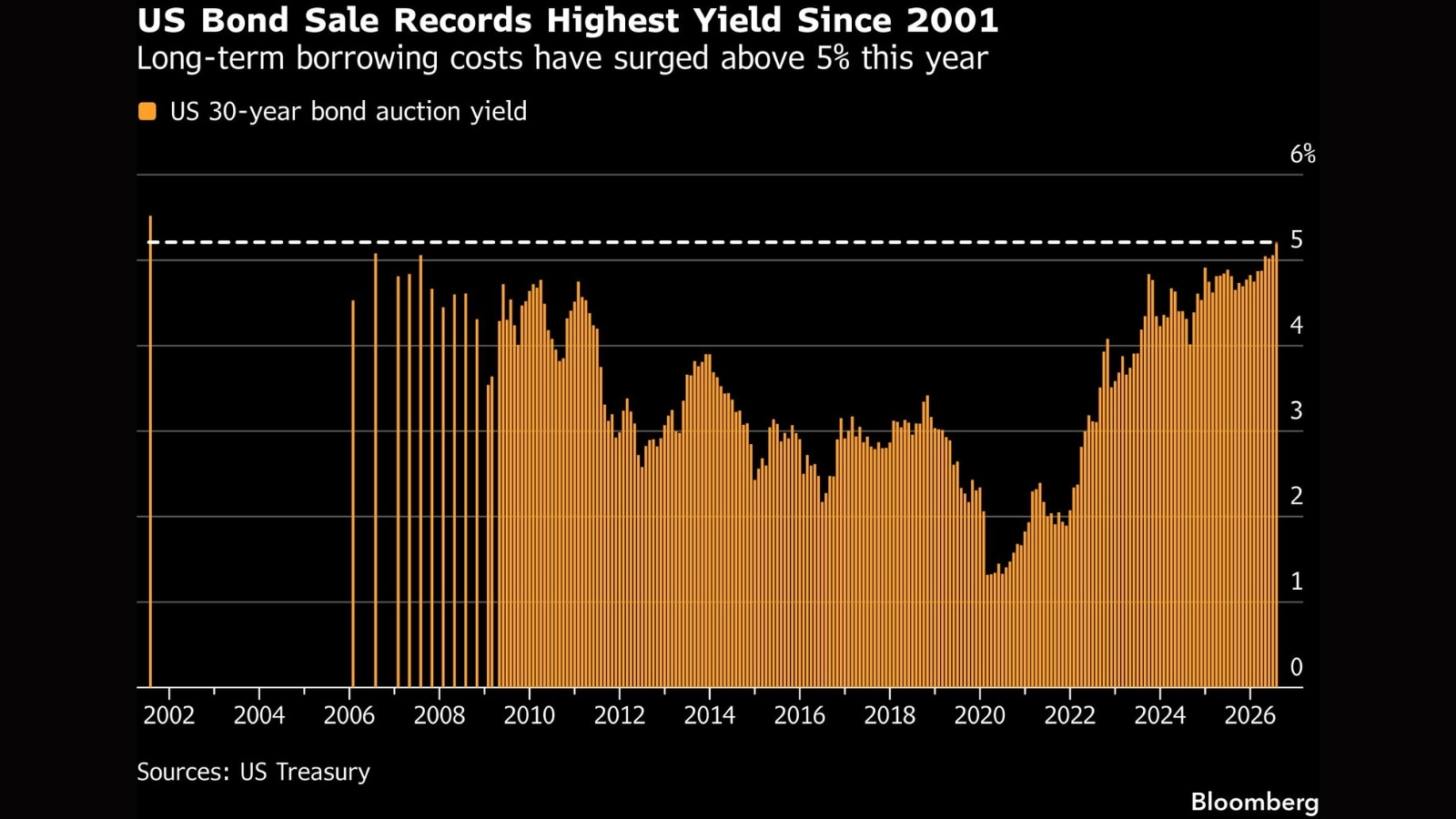
The arithmetic of American debt has crossed a psychological boundary. When the federal government issued thirty-year Treasury bonds at a yield touching 5.216 percent, it marked the costliest long-term debt sale since 2001. Wall Street analysts immediately framed the auction as a referendum on fiscal management. Yet reading this outcome merely as a routine market reaction misses the structural collision unfolding beneath the surface.
Treasury Secretary Scott Bessent faces an unforgiving matrix. Annual budget deficits tracking near two trillion dollars mean the supply of new government paper hits primary dealers at the exact moment global buyers are growing more selective. For months, financial media has concentrated intensely on the Federal Reserve's next move. That focus is misplaced. Washington's fiscal engine is driving the bus, and the bond market is quietly seizing the steering wheel. Don't miss our recent post on this related article.
The Mechanics of the Refunding Pressure
To understand why this auction matters, look past the headline yield and examine how liquidity moves through the primary dealer network. When twenty-five billion dollars in thirty-year paper clears at multi-decade high interest rates, it establishes a harsh benchmark for every downstream consumer loan, corporate bond, and mortgage in the economy.
Investors are demanding a thicker risk premium not because they expect imminent default, but because the sheer volume of issuance requires constant absorption. The Federal Reserve is no longer aggressively expanding its balance sheet to anchor long-term rates. Instead, private capital, foreign central banks, and domestic asset managers must fund the gap. To read more about the context here, The Motley Fool provides an excellent breakdown.
Consider a hypothetical mid-sized regional bank holding legacy municipal and corporate debt portfolios. As long-term government yields march upward, the liquidation value of those fixed-rate assets drops correspondingly. The thirty-year auction is not just a government receipt; it is an upward re-pricing of risk across the entire domestic financial ecosystem.
Decoding Washington's Coordinated Pivot
Market participants tracking the Treasury's quarterly refunding guidance noticed subtle shifts in tone. Officials have quietly left the door open to trimming long-bond issuance proportions down the road. Simultaneously, administrative maneuvers involving currency intervention designed to steady the Japanese yen signaled an acute awareness of cross-border capital flows.
If foreign partners must defend their own currencies, they often do so by liquidating reserve assets like US Treasuries. By stepping into currency markets for the first time in decades, the administration executed a defensive play aimed squarely at protecting foreign demand for American debt.
Bessent is attempting a high-wire act. He must manage surging borrowing costs without destabilizing the primary dealer banks that guarantee the government can always find a buyer. Yet every basis point higher on the long end increases the debt service burden on the federal budget, crowding out discretionary outlays and locking the Treasury into an expensive refinancing cycle.
The Vulnerability of Consensus Positioning
Financial institutions heavily invested in steepening yield curve bets are currently absorbing the brunt of this adjustment. Many macro funds positioned themselves for structural inflation and persistent curve steepening, assuming that long-term yields would continue drifting upward toward six percent without official resistance.
That consensus contains a blind spot. If the Treasury adjusts its issuance mix to favor shorter-duration bills while trimming long-bond supply, the scarcity effect at the long end could compress yields downward against prevailing market expectations.
Traders caught flat-footed by policy adaptations often discover that government issuers possess more administrative tools than textbook models suggest. Currency policy, auction scheduling, and cash balance management form an integrated triad. Bessent deployed all three levers within a single week, sending an unambiguous signal that the Treasury views the long end of the curve as a structural vulnerability rather than a passing market sentiment.
The Domestic Transmission Mechanism
Higher financing costs do not stay contained within Wall Street trading desks. When thirty-year borrowing benchmarks settle above five percent, corporate treasurers face a stark choice. They can lock in elevated coupon rates for long-term capital expenditure projects, or they can pull back on expansion plans altogether.
Real estate markets feel the friction immediately. Commercial property refinancing schedules, negotiated during a lower-rate era, now collide with a harsh reality upon maturity. Owners seeking to roll over debt find that net operating income no longer covers the updated debt service requirement at current Treasury benchmarks.
This environment separates disciplined balance sheets from overleveraged entities. Corporations holding substantial cash buffers and minimal near-term debt maturities can weather the adjustment phase with ease. Enterprises dependent on continuous short-term credit lines find their margins squeezed by the broader monetary gravity emanating from government auctions.
Navigating the Fiscal Realignment
Investors building portfolios around the assumption of passive governance are running acute risks. The historical anomaly of ultra-low interest rates is entirely in the rearview mirror. Washington is discovering that funding multi-trillion-dollar shortfalls requires continuous concessions to bondholders who hold all the cards.
As the Treasury prepares for upcoming quarterly refunding cycles, market participants should watch issuance sizes rather than headline inflation prints alone. The real constraint on American fiscal policy is no longer legislative gridlock; it is the sheer absorptive capacity of global debt markets. When the world's most powerful sovereign borrower has to pay twenty-five-year highs to finance its operations, the traditional rules of portfolio construction no longer apply.
The warning delivered by the bond market is clear. Ignoring the signal means mispricing the entire yield curve for the structural shift ahead.