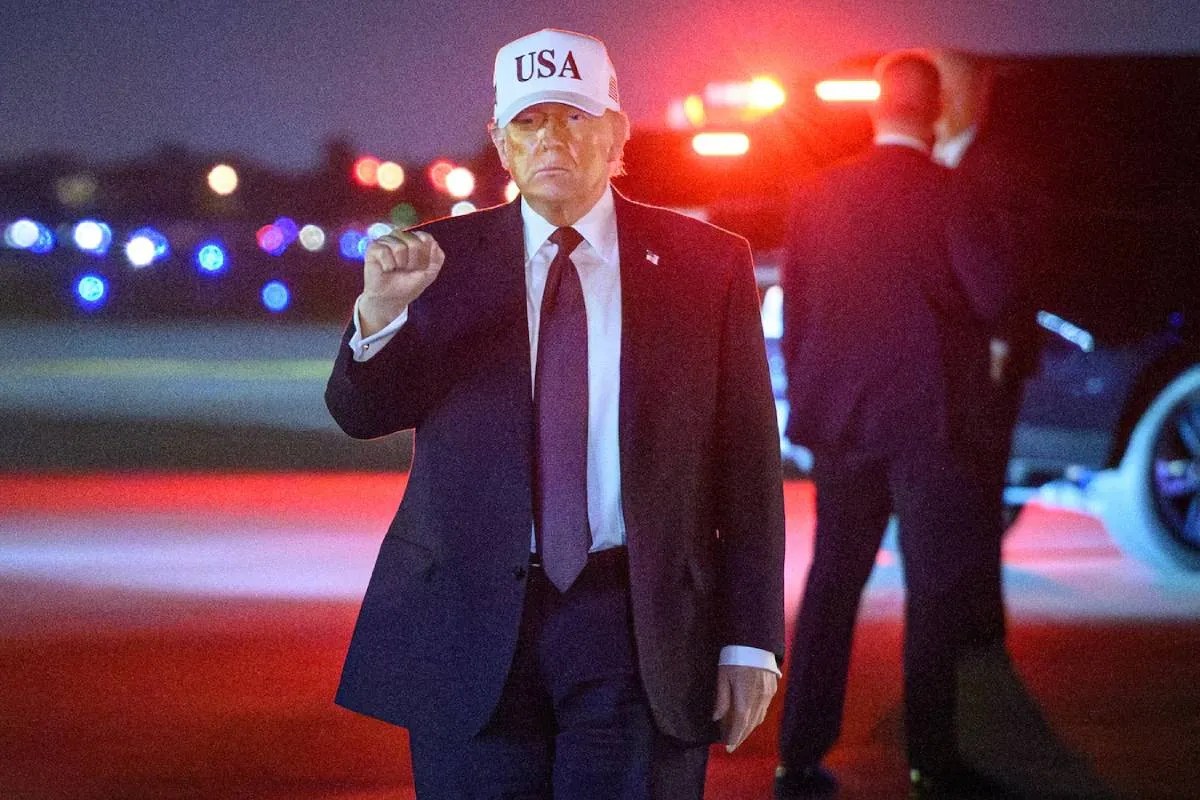
The mainstream media loves a "tough guy" narrative. It’s easy to sell. It’s loud. It fits perfectly into a 280-character soundbite. When Donald Trump issues a "straight ultimatum" to Tehran, the headlines scream about a Middle East in "shambles" or a "game-over" moment for the Islamic Republic. They tell you that a single post or a televised threat has fundamentally shifted the tectonic plates of Persian Gulf security.
They are lying to you. Or worse, they are lazy. Learn more on a related subject: this related article.
What we are witnessing isn't the brink of a new regional order. It is the continuation of a decades-old theatrical performance where both sides need the "threat" of the other to maintain domestic legitimacy. If you think Trump’s rhetoric is a precursor to a definitive resolution of the Iran problem, you haven't been paying attention to how power actually functions in the 21st century.
The Myth of the "Ultimatum" as a Tool of Change
In the world of high-stakes diplomacy, an ultimatum is only as good as the exit ramp it provides. The competitor narrative suggests that Iran is currently trembling, waiting for the axe to fall. This ignores the fundamental math of the Iranian regime's survival. Further journalism by Reuters explores similar perspectives on the subject.
For the IRGC (Islamic Revolutionary Guard Corps), American "maximum pressure" isn't a bug; it’s a feature. It justifies the securitization of the Iranian economy. It allows for the brutal suppression of internal dissent under the guise of national security. When Washington yells, the hardliners in Tehran get a raise.
The "lazy consensus" says that more pressure leads to a "better deal" or regime collapse. History suggests otherwise. Between 2018 and 2020, during the height of the previous administration's pressure campaign, Iran didn't crawl to the table. They accelerated their enrichment program and expanded their proxy network. They traded a seat at the global table for a survivalist's bunker, and they’ve grown quite comfortable in the dark.
The Real Cost of Rhetorical Warfare
Let’s look at the actual mechanics of "causing a stir" in the Middle East. When Trump threatens Iran, the first thing that moves isn't an aircraft carrier; it's the price of Brent Crude.
- Market Volatility: Speculators love a war of words. It drives up premiums.
- Defense Spending: It triggers massive procurement orders from Gulf allies who are sold the "protection" of the U.S. umbrella.
- The Status Quo Trap: By keeping the region in a state of perpetual "almost-war," you prevent the one thing that would actually stabilize it: normalized regional trade that makes conflict too expensive for everyone involved.
I have watched analysts burn through millions in consulting fees trying to predict "the big one"—the actual kinetic war between Washington and Tehran. It hasn't happened. Why? Because neither side can afford the bill. A full-scale conflict in the Strait of Hormuz would liquidate approximately $1.2 trillion in global trade value within the first 90 days. Neither a "transactional" president nor a cash-strapped theocracy is going to sign that check.
Why "Fixing" Iran is the Wrong Goal
Stop asking when Iran will "behave." It’s the wrong question. It assumes that the United States is a neutral arbiter of regional peace. In reality, the U.S. role is that of a frustrated manager of a chaotic portfolio.
The obsession with "ultimatums" misses the nuance of the Shadow Economy. Iran has spent forty years building a global network of front companies, oil smugglers, and informal banking systems (the hawala system). You cannot bomb a shadow. You cannot tweet away a smuggling route that runs through three different jurisdictions before it hits a refinery in Asia.
The real "shambles" isn't in the Middle East; it’s in the logic of Western policy. We apply 20th-century sanctions to a decentralized, 21st-century gray market. We expect a centralized surrender from a regime that has decentralized its survival.
Imagine a Scenario of "Total Silence"
Imagine a scenario where, instead of ultimatums, the U.S. simply stopped talking.
If the American "Satan" disappeared from the Iranian narrative, the regime would face its biggest threat yet: its own people, without the distraction of an external enemy. By providing the "Great Enemy," the U.S. provides the glue that holds the disparate factions of the Iranian government together. Every time a "tough" ultimatum is issued, it is a gift to the Supreme Leader. It is the oxygen they need to breathe.
The Mirage of Middle East "Turbulence"
The media wants you to believe the Middle East is a powder keg. It’s more like a series of controlled burns.
The Abraham Accords showed that the region's power players—the UAE, Saudi Arabia, Israel—are moving toward a pragmatic, economic-first reality. They are tired of the old ideological wars. When they hear Trump’s ultimatums, they aren't "panicking." They are calculating. They are hedging.
- Saudi Arabia: They are pivoting to Vision 2030. They need stability for their giga-projects. A war with Iran ruins the IPO of the century.
- The UAE: They are the region’s warehouse. You don’t set your warehouse on fire to prove a point to a neighbor.
- Israel: They are focused on the "Octopus Doctrine"—hitting the head (Tehran) through cyber and intelligence, not through the blunt instrument of a conventional American invasion.
The "chaos" is a distraction. The real movement is in the quiet bilateral talks happening in backrooms in Baghdad and Muscat. The real change is the gradual realization that the U.S. security guarantee is a volatile asset.
The Hard Truth About Deterrence
$D = R \times C \times W$
In the informal physics of geopolitics, Deterrence ($D$) equals the perceived Resources ($R$) multiplied by the Credibility of the threat ($C$) multiplied by the Will to execute ($W$).
If any of these factors is zero, deterrence is zero. Trump has the $R$. But after years of "forever wars," the American $W$ is at an all-time low. The Iranian regime knows this. They know the American public has no appetite for a ground war in the Zagros Mountains. Therefore, the "ultimatum" is viewed as a $0$ in the equation of actual power.
What You Should Actually Watch
Forget the social media posts. Watch the Tanker Trackers. Watch the offshore yuan settlements. Watch the dronification of proxy warfare.
These are the metrics of the real conflict. The "straight ultimatum" is just noise for the base. It’s a campaign rally held in the theater of foreign policy. It sells papers and generates clicks for "competitor" sites that don't want to do the hard work of analyzing supply chain resilience or the failure of the SWIFT banking ban.
The Actionable Reality
If you are an investor or a policy observer, stop reacting to the volume of the rhetoric.
- Hedge against the rhetoric, not the war. The volatility created by the words is tradeable. The actual war is a low-probability, high-impact event that most portfolios won't survive anyway.
- Look at the "Middle Powers." Countries like Turkey, India, and Qatar are the real brokers now. They are the ones facilitating the "nuance" that the big players ignore.
- Accept the Permanent Gray Zone. There is no "victory" over Iran. There is only the management of a permanent state of tension.
The competitor's article wants you to feel a sense of urgency and fear. It wants you to think we are at a turning point. We aren't. We are on a treadmill. The faster the U.S. runs with its rhetoric, the more the Iranian regime tightens its grip, and the more the regional status quo stays exactly the same.
The "shambles" isn't in Tehran. It's in the outdated playbook being used to analyze a world that has already moved on from the era of the "Big Man" ultimatum.
The next time you see a headline about a "deadly warning" or a "final ultimatum," do yourself a favor: check the price of oil, check the shipping lanes, and then go back to sleep. The show is loud, but the script hasn't changed in forty years.
Stop buying the theater. Start measuring the math.