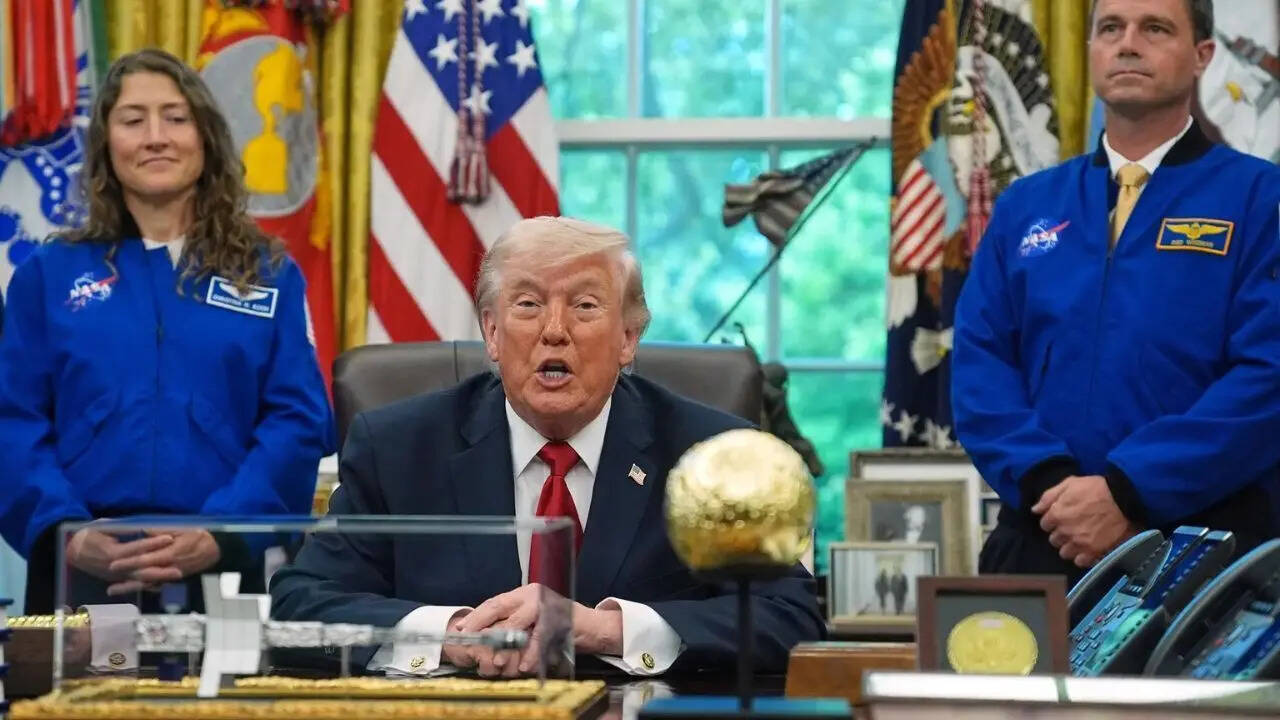
You don't usually see four people in blue flight suits standing awkwardly behind the Resolute Desk while the President of the United States muses about his own physical fitness for a lunar loop. But that's exactly what happened yesterday. Donald Trump hosted the Artemis II crew—Reid Wiseman, Victor Glover, Christina Koch, and Jeremy Hansen—to celebrate their return from the first crewed Moon mission in over half a century.
The meeting wasn't just a standard photo op. It turned into a quintessential Trump moment when he looked over at NASA Administrator Jared Isaacman and asked if a sitting president is actually allowed to go on a space mission. Isaacman’s response? "We can get working on it, Mr. President." Learn more on a related subject: this related article.
While it sounds like a joke, the question touches on a weird legal and logistical reality. There isn't a specific law saying a president can't go to space. But between the 25th Amendment and the sheer nightmare of Secret Service logistics in zero gravity, it’s a non-starter. Still, Trump didn't let that stop him from claiming he’d have "no trouble" making the cut. He told the room he’s "physically very, very good" and implies he’s smart enough to handle the technical rigors that usually take astronauts years to master.
The record-breaking reality of Artemis II
Before the conversation shifted to whether the Commander-in-Chief could fit in an Orion capsule, the focus stayed briefly on what this crew actually did. They didn't just "go to space." They smashed a distance record held by Apollo 13 since 1970. Further analysis by Al Jazeera delves into related perspectives on the subject.
The crew traveled 252,756 miles from Earth. That’s the farthest any human has ever been from home. They spent ten days in a spacecraft named Integrity, testing every life support system and heat shield detail required for the next big step: landing on the surface. They splashed down off the coast of San Diego on April 10, 2026, marking a flawless execution of a mission that many feared would be delayed by technical gremlins.
Can a President actually go to space
If Trump actually wanted to follow through on his "try it sometime" comment, he’d run into a wall of red tape and physics. NASA’s selection process is brutal. You aren't just looking at physical fitness; you're looking at specialized engineering knowledge and hundreds of hours in high-G simulators.
The biggest hurdle isn't the training, though. It’s the succession of power. If a president leaves the atmosphere, are they still "able to discharge the powers and duties" of the office? Communication lag is minimal at the Moon—about 1.3 seconds—but if things go sideways during reentry, the country can't have its leader out of commission.
Historically, we’ve seen politicians in space. John Glenn went back up at age 77 while serving as a Senator. But a sitting president? That’s a whole different level of risk that the military and the Secret Service would likely veto before the engines even primed.
The Isaacman factor and the new NASA
It’s telling that Trump directed his questions to Jared Isaacman rather than the astronauts themselves. Isaacman, the billionaire founder of Shift4 and the man behind the Inspiration4 private mission, is now the guy running NASA. His appointment was a clear signal that this administration wants the agency to run more like a private tech firm and less like a slow-moving government bureaucracy.
Trump took several swipes at the state of NASA before his tenure, claiming he found "grass growing on the runways" of their facilities. He’s positioning the Artemis success as a personal win for his "Space Force" vision. He even suggested that a lunar landing could happen before his term ends in 2029.
NASA’s official timeline targets late 2028 for Artemis IV, the mission meant to put boots back on the ground. Trump's "we have a shot at it" comment shows he’s pushing for that date to hold, despite his administration's simultaneous talk of slashing budgets for space science by nearly half. It’s a classic contradictory move: demand the moon but cut the funding for the tools needed to study it.
What happens now
The Artemis II crew is done with their debriefs, but their data is the foundation for Artemis III and IV. If you're following this, the next few months are about the hardware. Keep an eye on:
- Heat shield analysis: The Orion capsule Integrity is being stripped down to see how it handled the 5,000°F reentry.
- The 2028 deadline: Watch for whether NASA tries to accelerate the Artemis III schedule to meet the President's public "shot" at a landing.
- Budget battles: Congress is currently debating those proposed 23% cuts to NASA’s overall budget. If those pass, the 2028 landing date is basically a fantasy.
Don't expect to see a presidential motorcade heading to the launchpad for anything other than a viewing. Trump might think he’s a natural fit for a flight suit, but for now, the only people heading back to the Moon are the ones who spent three years training for it.