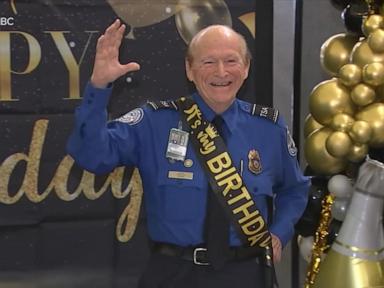
Feel-good news is the junk food of the American media diet. It tastes sweet, goes down easy, and offers zero nutritional value. Recently, the internet rallied behind the story of a 90-year-old TSA officer, hailing him as a beacon of work ethic and a testament to the "America Strong" spirit. It’s a charming narrative. It’s also a dangerous distraction from the structural rot within the aviation security industry and our broken understanding of labor.
We are conditioned to applaud the elderly worker. We see a nonagenarian in a blue uniform and we project our own values onto them: grit, loyalty, and a refusal to quit. But if you peel back the layers of sentimentality, you find a darker reality. This isn’t a story about the triumph of the human spirit. It is a story about the failure of workforce planning and a fundamental misunderstanding of what modern security requires. Don't miss our recent article on this related article.
The Myth of Experience in Repetitive Labor
The "lazy consensus" argues that older workers bring invaluable experience to the checkpoint. In many fields—law, medicine, engineering—that is true. In those sectors, $Experience = Wisdom$. But the TSA is not a think tank. It is a high-stress, high-volume physical environment that relies on pattern recognition, rapid reflexes, and sustained cognitive focus under extreme pressure.
In the world of security, there is a concept known as vigilance decrement. It’s the measurable decline in attention that occurs during a task that requires monitoring for infrequent signals. Research in cognitive psychology shows that the ability to maintain this level of focus doesn't just plateau; it declines with age. To read more about the history here, Business Insider provides an excellent summary.
When we celebrate a 90-year-old standing on a concrete floor for eight hours a day, we aren't celebrating "experience." We are celebrating a system that hasn't figured out how to automate the mundane or respect the physical limits of the human body. There is no secret "ancient wisdom" required to tell a passenger to take their shoes off or to spot a water bottle in a backpack. There is only the grueling, repetitive grind of the line.
The Economic Hostage Crisis
Let’s be brutally honest: Why is a 90-year-old still working at the airport?
The mainstream media wants you to believe it’s because he "loves the job." Maybe he does. But usually, when people work well into their tenth decade, it’s because the alternative is a terrifying void. Either the pension isn’t enough, the social isolation of retirement is unbearable, or the American healthcare system has made employment a prerequisite for survival.
By framing this as an inspirational "choice," we ignore the systemic failures of the labor market. We've turned "working until you drop" into a virtue to mask the fact that for many, it's a necessity. I have seen organizations lean on their oldest employees as a "moral example" to shame younger workers who demand better work-life balance or higher pay.
"If George can do it at 90, why are you complaining about a double shift?"
That is not leadership. That is exploitation disguised as a pep talk.
Security is Not a Social Club
The TSA’s primary mission is the prevention of catastrophic loss of life. It is a high-stakes barrier between the public and potential threats. If we were talking about a 90-year-old active-duty paratrooper or a 90-year-old neurosurgeon performing 12-hour operations, the public would be asking questions about competency and risk management.
Why do we give the TSA a pass?
It’s because we’ve stopped viewing the TSA as a serious security agency and started viewing it as a massive, bureaucratic jobs program. If the goal is truly "security," the physical and cognitive requirements should be as rigorous as those of any other frontline defense force.
Imagine a scenario where a crisis erupts at a checkpoint—a physical altercation, a sudden evacuation, or an active shooter. Does a 90-year-old have the physical capacity to respond? Can they move a crowd? Can they intervene in a physical struggle? If the answer is no, then they aren't a security officer. They are a greeter in a tactical vest.
The Innovation Stagnation
The persistence of the "old guard" in these roles highlights a massive stagnation in airport technology. We are still relying on human eyes to stare at screens and human hands to pat down travelers. This is a 20th-century solution to a 21st-century problem.
In Europe and parts of Asia, we see a shift toward CT (Computed Tomography) scanners that eliminate the need for passengers to remove liquids or laptops, paired with AI-assisted threat detection. This tech doesn't get tired. It doesn't have a "vigilance decrement." It doesn't need to be "America Strong."
By keeping the human element at the center of the checkpoint—and specifically by romanticizing the longevity of that human element—we remove the pressure to innovate. We are stuck in a loop of nostalgia while the rest of the world moves toward efficiency.
The Cost of the Feel-Good Story
Every time a major outlet runs a story about the "Oldest [X] in America," they are selling you a lie. They are selling the idea that the status quo is fine because the people inside the machine are smiling.
I’ve spent years analyzing organizational efficiency, and I’ve seen this play out in dozens of industries. Companies celebrate the "40-year veteran" because it’s cheaper than investing in new technology or training a new generation. They use these stories to build a brand of "loyalty" while their infrastructure crumbles.
If we actually cared about these workers, we wouldn't be cheering for them to stay in the terminal until they’re 100. We’d be asking why the job is so soul-crushing that we need to turn it into a hero’s journey just to make it palatable. We’d be asking why we haven't built a society where a 90-year-old's biggest worry is their garden, not whether a tourist in Lane 4 is hiding a pocketknife.
The Hard Truth of Personnel
If you want a secure, efficient airport, you don't need "America Strong" stories. You need:
- Strict Cognitive and Physical Standards: Security isn't an "everybody gets to play" industry. It requires peak performance.
- Automation of the Mundane: Get humans out of the business of looking for bottles of shampoo.
- A Redefinition of "Work Ethic": Moving away from the idea that "hours spent" equals "value provided."
Stop liking the videos. Stop sharing the articles. Every time you applaud a 90-year-old TSA officer, you are voting for a stagnant, inefficient, and arguably less safe aviation system.
It’s time to retire the "America Strong" trope and start demanding an "America Smart" reality. The checkpoint should be a place of cold, clinical efficiency, not a stage for a human interest story that serves only to make us feel better about a broken system.
Get the scanners working. Give the seniors their dignity back. Move the line.