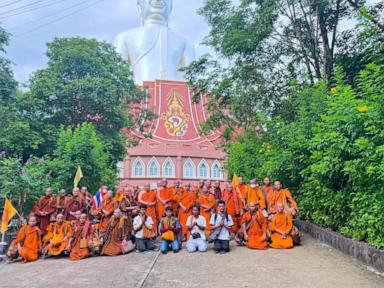
An eleven-year-old boy driving a pickup truck without permission struck a line of Buddhist monks on a religious pilgrimage in northeastern Thailand, killing at least eight people and leaving many others severely injured. The tragedy occurred in Mukdahan province as a group of 35 monks embarked on a 260-kilometer walk toward Ubon Ratchathani province. Within thirty minutes of their departure, the vehicle swerved wildly, slid completely off the asphalt, and plowed directly into the single-file procession. Five monks perished instantly at the scene, while three others succumbed to their injuries at a local hospital.
While the immediate horror centers on a child behind the wheel of a heavy vehicle, this incident exposes much systemic failures across rural Thailand. It brings together three distinct crises that the nation has long failed to address. Unregulated underage driving, a complete lack of pedestrian infrastructure along rural highways, and a persistent road safety epidemic that leaves vulnerable travelers entirely unprotected. Meanwhile, you can find related stories here: Why the Modi Takaichi Summit is a Massive Deal for Global Tech and Defense.
Chaos on the Margin of the Road
The pilgrimage was meant to be an act of quiet devotion. Surveillance footage captured by the Ruam Jai Mukdahan Rescue Association shows the monks moving orderly along the dirt shoulder, completely off the active driving lanes. Survivors recalled hearing the engine revving and seeing the truck lose balance before it veered directly into their path.
Rural Thai highways rarely feature sidewalks, barriers, or even paved shoulders. For pedestrians, religious pilgrims, and cyclists, the edge of the road is a high-risk zone. To explore the complete picture, check out the excellent analysis by TIME.
The physical mechanics of rural Thai transport rely heavily on high-clearance, modified pickup trucks. These vehicles are the economic backbone of agrarian families, used to haul everything from sugarcane to livestock. They are heavy, possess large blind spots, and require significant physical force and driving experience to control during a high-speed swerve. Placing an eleven-year-old child at the controls of such a machine on an open highway made a catastrophic failure almost inevitable.
The Normalization of Underage Driving
In provincial Thailand, children operating motor vehicles is an open secret. Law enforcement routinely overlooks pre-teens riding heavy motorcycles to school or moving farm equipment between fields.
This cultural tolerance stems from a mix of economic necessity and lack of rural policing. Parents frequently rely on older children to run errands or assist with agricultural transport when adult labor is stretched thin. The legal driving age for a car or truck in Thailand is eighteen, but on the backroads of Isan, enforcement is virtually non-existent until a tragedy occurs.
The boy took the family pickup truck without parental consent. This points to a deeper issue of vehicle accessibility. When keys are left within reach and children are routinely taught to drive early to help around the farm, the line between an authorized chore and a fatal joyride becomes blurred. The child is currently held in state custody, awaiting formal questioning alongside child protection officials. Under Thai law, criminal liability for a minor this young is heavily mitigated, shifting the legal and moral scrutiny squarely onto the guardians who failed to secure the vehicle.
The Carnage of Thai Highways
Thailand routinely ranks among the deadliest nations in the world for traffic fatalities. The World Health Organization estimates that thousands die annually on the country's roads, with a disproportionate number of these deaths occurring in rural provinces outside Bangkok.
| Road Safety Factor | Systemic Reality in Rural Thailand |
|---|---|
| Enforcement | Intermittent checkpoints focus on helmet compliance rather than underage unlicensed drivers. |
| Infrastructure | Highways lack physical separation between high-speed freight traffic and pedestrians. |
| Vehicle Scale | Large pickup trucks dominate local transit, increasing the lethality of single-vehicle accidents. |
The country has introduced numerous road safety campaigns, yet the death toll remains high. The underlying issue is not a lack of awareness, but a lack of structural accountability. Speed limits are rarely enforced on rural arterial roads, and secondary highways are designed exclusively to maximize vehicle throughput rather than protect local communities.
The Cost of Inaction
Religious walks are a common sight across Thailand during the Buddhist Lent and other holy periods. Monks rely on the hospitality of roadside communities for food and water as they practice spiritual discipline. This tradition is now directly threatened by unmanaged traffic conditions.
True accountability requires more than prosecuting a grieving family or detaining a traumatized child. It demands a hard look at how rural transport is managed. Until local police enforce strict penalties for parents who allow minors access to vehicles, and until highway departments build physical barriers to protect pedestrians on known pilgrimage routes, the road will remain a slaughterhouse.
The eight lives lost in Mukdahan were ended by a child, but they were failed by a system that treats road carnage as an acceptable cost of rural life.