In the hushed, velvet-draped halls of international diplomacy, silence usually carries more weight than noise. Leaders typically move through these spaces like ghosts, careful not to disturb the dust of long-standing alliances. But every so often, a single voice from across the ocean—raspy, loud, and unapologetically blunt—shatters the quiet. When Donald Trump turned his sights on the Pope, he didn't just spark a headline. He forced a choice.
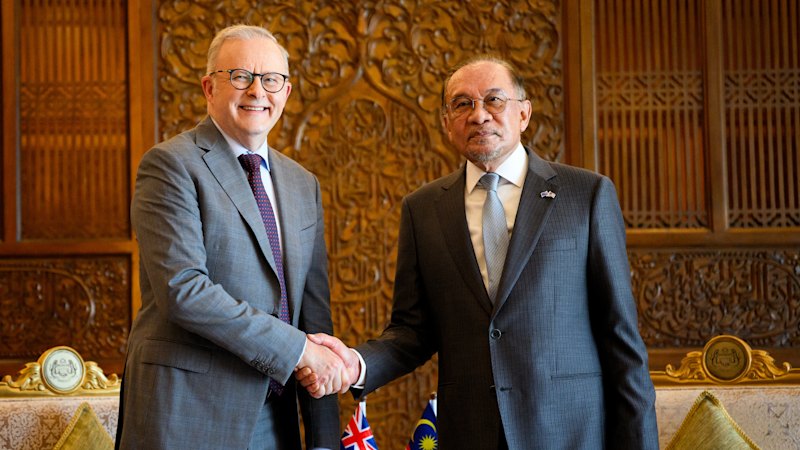
Anthony Albanese and Anwar Ibrahim do not share a timezone, a religion, or a history. One leads a secular, sun-drenched nation at the edge of the Pacific; the other steers a complex, diverse Southeast Asian powerhouse. Yet, in the wake of Trump’s criticism of the Vatican’s stance on global issues, these two men found themselves standing shoulder-to-shoulder. It wasn't about theology. It was about the thinning line between leadership and chaos.
Think about the local parish in a small Australian town or a community center in Kuala Lumpur. For the people sitting in those pews or chairs, the Pope isn't just a political figurehead. He is the anchor. When that anchor is mocked or dismissed as a "political player" by a former American president, the ripples don't stay in Washington. They vibrate through the floorboards of every home that values tradition over viral clips.
The Mechanics of Respect
Diplomacy is often treated like a game of chess, but it feels more like a communal tightrope walk. If one person jumps, everyone else wobbles.
When Albanese stepped up to defend the Pope, he wasn't just checking a box for the Catholic vote. He was defending the idea of the "global elder." In a world where every word is weaponized for a 24-hour news cycle, the Vatican represents one of the few remaining institutions that operates on a timeline of centuries, not seconds. To attack that institution is to attack the very concept of stable, long-term moral authority.
Anwar Ibrahim’s involvement adds a layer of profound irony and depth. As the leader of a majority-Muslim nation, his defense of the Catholic pontiff sends a message that transcends the typical "us versus them" narrative. He understands a truth that many in the West have forgotten: when the sanctity of one faith’s leadership is eroded, the protection for all faiths begins to crumble.
Imagine a village where the fences are being torn down one by one. You might not like your neighbor’s fence, but once it’s gone, the wind starts hitting your house a lot harder. Anwar and Albanese aren't just neighbors; they are the architects trying to keep the wind at bay.
The Invisible Stakes of the Tongue
The danger of the current political climate isn't just the policies—it’s the vocabulary. We have entered an era where "strength" is often confused with "insult."
Trump’s critique of the Pope usually centers on the idea that the Church is "too soft" on borders or "too focused" on climate change. To a certain segment of the electorate, this sounds like common sense. It feels like someone is finally saying the quiet part out loud. But look closer at the cost.
When a leader suggests that a spiritual authority is "out of touch," they are essentially saying that the values of compassion, mercy, and stewardship are secondary to the immediate needs of the state. It is a philosophy of the "now" over the "always."
Albanese and Anwar are betting on the "always."
The Australian Prime Minister’s support is grounded in a specific kind of pragmatism. Australia is a nation built on a delicate balance of multiculturalism and secularism. It works because there is an unspoken agreement to respect the pillars that others lean on. When an outside force tries to kick those pillars, the Australian response is a firm, quiet hand on the shoulder.
Why This Matters in Your Living Room
You might wonder why you should care about what three men in suits say about a man in a white robe. It feels distant. It feels like high-altitude theater.
But these shifts in rhetoric filter down into how we treat our own neighbors. If the highest levels of power decide that respect is optional, that civility is a weakness, and that spiritual leaders are just another target for a "burn," then that behavior becomes the new standard for the dinner table.
Consider a hypothetical family gathering. Two cousins disagree on politics. In the old world, there was a ceiling to how nasty things could get, because certain things—faith, elderly figures, communal history—were off-limits. They were the "common ground." Trump’s rhetoric effectively removes that ceiling. It suggests that nothing is sacred if it gets in the way of a winning point.
By standing up for the Pope, Albanese and Anwar are trying to reinstall that ceiling. They are arguing that even in a world of fierce disagreement, there must be a space for reverence.
The Weight of the Southeast Asian Perspective
Anwar Ibrahim’s position is particularly brave. In Malaysia, religion is not a private hobby; it is the fabric of identity. By defending the Pope, Anwar is demonstrating a "Holistic" (apologies, a complete and unified) vision of leadership. He is telling his constituents—and the world—that you don't have to be of a faith to respect the dignity of its leader.
This is the antidote to the "America First" style of isolationism. It is a recognition that we are all part of a messy, interconnected web. When Trump pulls a thread in Rome, the fabric bunches up in Canberra and Putrajaya.
The two leaders met and found that their concerns were identical. They weren't discussing the nuances of liturgy. They were discussing the preservation of global stability. They recognized that the Pope serves as a pressure valve for many of the world’s most vulnerable people. Whether it’s his advocacy for refugees or his calls for environmental protection, the Pope speaks for those who don’t have a seat at the G20 table.
To mock that voice is to silence the advocates of the poor.
The Friction of the Future
This isn't a story about a "game-changer" or a "pivotal" shift in policy. It is a story about friction.
The friction between the old world of slow, deliberate respect and the new world of fast, explosive outrage.
Trump represents the fire. He is the spark that wants to burn away the "old ways" to make room for something he considers more efficient and more nationalist. Albanese and Anwar are the water. They are trying to cool the temperature, to remind everyone that once you burn down these institutions, they don't just grow back.
There is a specific kind of exhaustion that comes with modern news. It’s the feeling of watching everything we once considered stable—the post-war order, the respect for the clergy, the civility of debate—being dismantled for the sake of a social media metric.
When you see two leaders from vastly different backgrounds find common ground, it’s a moment of clarity. It’s a reminder that the "common" in common ground isn't about being the same. It’s about sharing the same floor.
The Quiet Defiance
There was no grand ceremony for this alliance. There were no soaring orchestral swells. There was just a shared understanding between two men who realized that the world is getting louder and meaner, and someone has to be the first to say "enough."
The real stakes aren't in the next election. They are in the preservation of the invisible threads that keep us from falling into a total tribal war.
If we lose the ability to respect a leader like the Pope—regardless of whether we believe in his divinity or agree with his every word—we lose the ability to respect anyone who isn't "us."
Albanese and Anwar didn't just defend a man. They defended a boundary. They stood at the edge of the clearing and told the fire that it could go no further.
The next time a loud voice from a podium tells you that respect is a relic of the past, remember the two leaders who met in the quiet. They weren't looking for a fight. They were looking for the anchor. And they found it in the very place the rest of the world was being told to forget.
The world doesn't need more people who can shout down a Pope. It needs more people who understand why he’s there in the first place. Not as a politician, but as a reminder that some things are meant to last longer than a four-year term.
The shield isn't made of steel. It’s made of the words we choose not to say, and the people we choose to stand beside when the wind starts to howl.