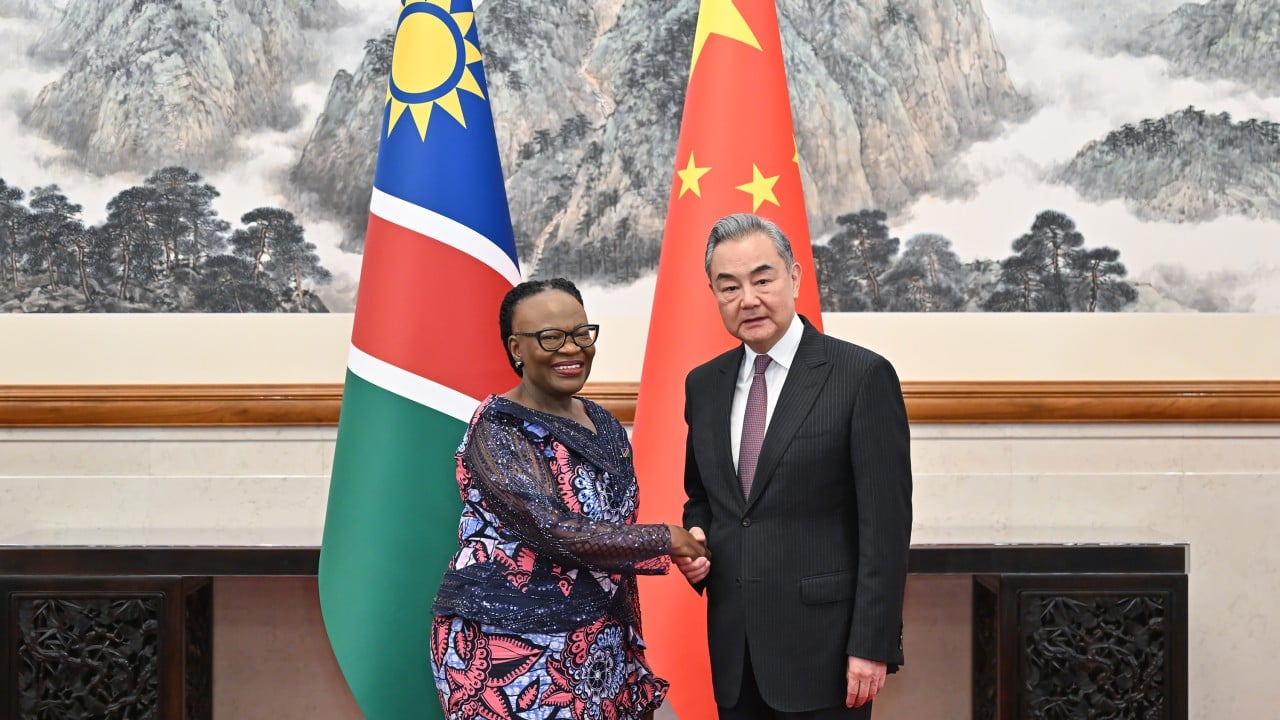
Geopolitics is often a theater of the obvious, and the recent coverage of China’s interest in Namibian uranium is a masterclass in missing the point. The "lazy consensus" suggests this is a simple play for energy security or a standard Belt and Road infrastructure project. It isn't. China isn't just buying dirt in the Namib Desert; they are vertically integrating the entire global nuclear fuel cycle while Western utilities are still trying to figure out how to fill out ESG reports.
If you think this is about "fuel rods," you’re already three steps behind. This is about the death of the spot market and the birth of a monopsony that could dictate the price of carbon-free baseload power for the next century.
The Myth of the Simple Supply Chain
Standard industry reporting treats uranium like oil. They assume that if you own the well, you own the energy. This is a fundamental misunderstanding of nuclear physics and global trade. Raw uranium ($U_3O_8$) is useless. To make it power a reactor, you need a sophisticated, multi-stage process: conversion, enrichment, and fabrication.
Most Western analysts focus on the mining. They point to the Husab and Rössing mines—massive operations controlled by China General Nuclear Power Group (CGN) and China National Uranium Corporation (CNUC)—as evidence of a resource grab. That's the surface level. The real "disruption" is that China is moving the value chain away from global hubs and into a closed-loop system that bypasses Western intermediaries entirely.
I’ve spent years watching commodity traders hedge against volatility, but you can't hedge against a vacuum. When China pulls Namibian ore directly into its domestic enrichment facilities to produce fuel assemblies for its Hualong One reactors, that supply never hits the market. It doesn't exist for you. It doesn't exist for Cameco. It doesn't exist for Kazatomprom.
Namibia Is the Laboratory for the Hualong One Export
The consensus view says China is securing fuel for its domestic "nuclear renaissance." Wrong. China is using Namibia as a vertical integration sandbox to prove they can sell a "Nuclear-as-a-Service" model to the rest of the world.
When a country like Egypt, Saudi Arabia, or Kazakhstan looks to build nuclear capacity, they face a fragmented nightmare. They have to buy technology from one place, fuel from another, and find someone else to handle the waste. China’s play in Namibia allows them to offer a "black box" solution.
- The Tech: The Hualong One (HPR1000) reactor.
- The Fuel: Guaranteed by the Namibian mines they own outright.
- The Finance: Backed by state-owned banks.
By controlling the fuel rod production pipeline at the source, China removes the "sovereign risk" argument that Western vendors use to justify their exorbitant prices. They aren't just selling a reactor; they are selling a 60-year energy guarantee. The West can't compete because the West doesn't own its fuel chain anymore. We sold it off in the name of "market efficiency" in the 1990s.
The Enrichment Trap
Let’s talk about the math that the "experts" ignore. To get $U^{235}$ to the $3-5%$ concentration needed for power plants, you need centrifuges. For decades, the world relied on Russia’s Tenex for a huge chunk of this. Since the geopolitical shifts of the mid-2020s, the West has scrambled to "re-shore" enrichment.
But while the US and Europe are arguing over subsidies for Centrus or Orano, China is quietly ensuring that the feedstock for those centrifuges is under their thumb.
Imagine a scenario where the global spot price for uranium hits $150 a pound. For a Western utility, that’s a crisis. For China, it’s an accounting entry. Because they own the Namibian mines, their "cost" is the cost of extraction—roughly $25 to $40 a pound. They are essentially operating on a different economic plane. They have de-commoditized uranium for themselves while leaving the rest of the world to fight over the scraps of the spot market.
The Failure of "Market-Based" Energy Security
People often ask: "Why doesn't the US just outbid China for Namibian assets?"
This question is flawed because it assumes the Namibian government is a rational economic actor in a free market. It isn't. The relationship between Windhoek and Beijing is built on "all-weather" diplomacy that includes infrastructure, telecommunications, and direct state-to-state lending.
Western mining companies operate under the tyranny of the quarterly earnings report. They cannot justify investing billions in a mine that might not see a return for fifteen years if the spot price dips. China doesn't care about the spot price. They care about the 2060 carbon-neutrality mandate. They are playing a game of Civilization while we are playing a game of Day Trading.
Why the "Nuclear Fuel Rod" Headline Is a Distraction
Focusing on "fuel rod production" is a localized distraction. The real story is the creation of a Sino-centric Nuclear Bloc.
In the next decade, we will see the emergence of a two-tier nuclear world.
- Tier 1: The Chinese Ecosystem. Stable prices, integrated supply chains, and rapid deployment.
- Tier 2: The Western Ecosystem. Volatile prices, aging infrastructure, and a constant scramble for fuel that is increasingly controlled by their primary strategic rival.
Namibia is the linchpin. It provides the volume necessary to make the Chinese system self-sustaining. The Rössing mine alone has been operating for nearly half a century; under Chinese ownership, its life is being extended not to sell to the world, but to fuel the expansion of the Hualong One.
The Environmental Irony
There is a delicious irony in the "lazy" environmental critique of these mines. Critics point to the water-intensive nature of uranium mining in a desert nation. They aren't wrong—uranium extraction requires massive amounts of desalinization.
However, China is solving this by building the very infrastructure they need to keep the mines running, effectively colonizing the industrial utility sector of Namibia. They aren't just mining uranium; they are building the power plants and the water pipelines that make the mining possible. It is a self-fulfilling industrial prophecy.
Meanwhile, Western NGOs spend their time lobbying against domestic mining in the US and Australia, effectively handing the keys of the green transition to Beijing. You cannot have a "Green New Deal" without uranium, and you cannot have uranium if you don't want to dig holes in the ground. China has no such cognitive dissonance.
Stop Asking About "Influence" and Start Asking About "Flow"
The question isn't whether China has "influence" in Namibia. That's a given. The question is how the flow of radioactive material is being re-routed.
Historically, yellowcake from Namibia would go to converters in France or Canada. Today, a growing percentage is headed straight to the East. This is a physical decoupling of the energy grid. If you are a Western policymaker thinking about "de-risking," you are already too late to the nuclear party. The fuel is gone. The rods are being cast. The silos are being filled.
The West’s obsession with "market-clearing prices" has blinded it to the reality of state-directed resource acquisition. While we were celebrating the "low cost" of imported fuel, China was buying the means of production.
Go ahead, keep writing articles about "partnerships" and "economic development" in Namibia. While you're polishing the prose, the ships are leaving Walvis Bay, and they aren't coming to your ports.
The era of the global uranium market is over. The era of the Chinese nuclear monopoly has begun.
Stop looking at the price ticker. Look at the map. Or better yet, look at the chemistry. Energy isn't what you buy; it's what you control. And right now, China controls the only fuel that matters for the next century of high-density power. The West didn't lose because it was outbid; it lost because it forgot that some things are too important to be left to the market.