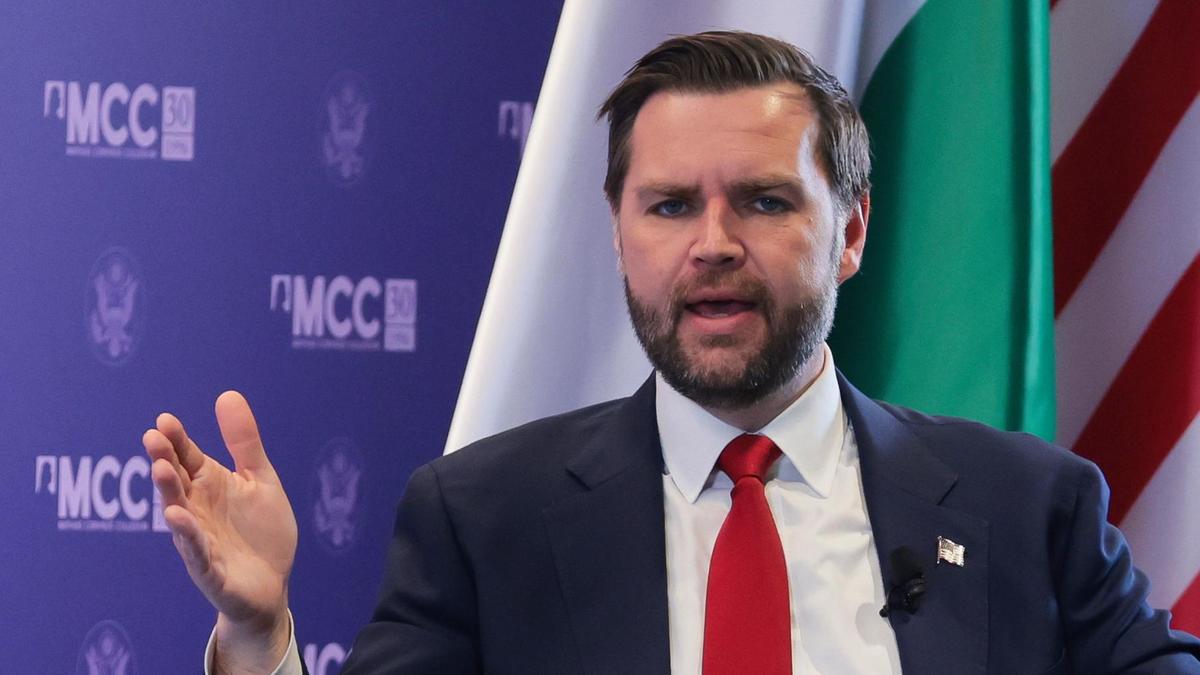
J.D. Vance has finally pulled back the curtain on why the Ukraine conflict remains the most stubborn knot in modern American foreign policy. It is not just about the lines on a map. It is about a fundamental breakdown in the mechanics of international leverage. While the headlines focus on the tactical "hardness" of the situation, the reality is a grim collision of frozen assets, depleted stockpiles, and a total absence of a shared definition of victory.
The Vice President’s recent admissions signal a shift from the optimistic rhetoric of 2022 to a cold, hard realism. Solving this crisis is not a matter of simply signing a check or delivering a new batch of long-range missiles. It requires untangling a web of European energy dependence, Russian endurance, and an American public that is increasingly skeptical of open-ended commitments. The conflict has become a grinding war of attrition where the side that blinks first loses more than just territory; they lose their standing in the global order.
The Friction of Asymmetric Goals
The primary reason this war is so difficult to resolve is that the participants are playing entirely different games. For Ukraine, the goal is total restoration of sovereignty. For Russia, the goal is the erasure of a Western-aligned neighbor. For the United States, the goal has fluctuated between "helping Ukraine win" and "preventing a wider NATO conflict."
When your objectives do not overlap, even in the margins, diplomacy has nowhere to take root. Vance’s assessment reflects the exhaustion of a Washington establishment that tried to bridge these gaps with money alone. Money buys time, but it does not buy a peace treaty when the aggressor views the conflict as existential.
The Industrial Base Crisis
We cannot ignore the physical reality of the situation. The West’s industrial base was not built for a prolonged artillery war in Eastern Europe. For decades, the U.S. focused on high-tech, precision strikes against insurgencies. Now, we are faced with a 1914-style trench war that eats through shells faster than factories can produce them.
- Production Gaps: European nations are struggling to meet their own defense needs, let alone sustain a foreign military.
- Logistical Bottlenecks: Moving heavy armor and ammunition across borders remains a slow, bureaucratic nightmare.
- Depleted Reserves: Every Patriot battery sent to Kyiv is one less battery defending American interests elsewhere.
This is the "hardness" Vance is talking about. It is the hard reality of empty warehouses and long lead times. You cannot negotiate from a position of strength when your cupboards are bare and your opponent knows it.
The Russian Resilience Factor
The original plan for ending this conflict relied heavily on economic warfare. The idea was simple: isolate Russia, crash the ruble, and force the Kremlin to the table. That plan failed.
Russia did not collapse. Instead, it pivoted its entire economy toward a war footing. By strengthening ties with China, India, and Iran, Moscow found ways to bypass sanctions and keep the lights on. They are currently producing more hardware than they were before the invasion. This resilience has fundamentally changed the math of the conflict. If the Russian economy can withstand the combined weight of Western sanctions, the primary non-military lever for peace has been broken.
The Problem of Frozen Assets
There is a growing push to seize $300 billion in frozen Russian central bank assets to fund Ukraine’s reconstruction. While this sounds like a logical move, it is a diplomatic landmine. Seizing those assets could trigger a massive flight from the U.S. dollar by other nations who fear they might be next. If the "nuclear option" of finance is used, it might solve a short-term funding gap while permanently damaging the global financial system. This is a risk that many in the current administration—and certainly in a potential Vance-led foreign policy—are terrified of taking.
European Fractures and the Burden of Proof
Europe is not a monolith. While the Baltic states and Poland see this as a fight for their lives, nations further west are feeling the sting of high energy prices and deindustrialization. The German economy, once the engine of Europe, is sputtering.
Vance’s skepticism of the current strategy is rooted in the "burden sharing" debate that has haunted NATO for years. If the United States is providing the lion's share of intelligence, hardware, and funding, what happens when the American taxpayer decides they have had enough? The conflict is "hard" to solve because the coalition supporting Ukraine is built on shifting sand.
The Geography of the Stalemate
Look at the map. The front lines have barely moved in over a year. We are seeing a repeat of the Korean War’s static phase, but without an armistice in sight. The terrain in the Donbas is uniquely suited for defense, making any offensive operation incredibly costly in terms of human life.
Neither side has the combat power to achieve a decisive breakthrough. Without a breakthrough, there is no pressure to negotiate. Instead, we see a cycle of "symbolic" victories that do nothing to change the strategic reality on the ground. It is a meat grinder that consumes resources and produces only grief.
The Strategic Pivot to Asia
While the world watches Ukraine, the Pacific is simmering. One of the unspoken reasons why the Ukraine conflict is so difficult to manage is the looming shadow of China. Every dollar and every hour spent on the Dnieper River is a dollar and an hour not spent in the South China Sea.
Vance and the "Realist" wing of the GOP argue that the U.S. is overextended. They see the Ukraine conflict not just as a tragedy, but as a distraction from the primary threat to American hegemony. This internal American debate makes the conflict even harder to solve because the "will to win" is being divided between two different hemispheres.
The Fatigue of the Electorate
Public opinion is the ultimate currency in a democracy. In 2022, the blue and yellow flag was everywhere. In 2026, the sentiment is different. People are asking why billions are going abroad while domestic infrastructure crumbles and inflation persists. This is not isolationism; it is prioritization.
The political difficulty of sustaining a war effort without a clear end date cannot be overstated. When a leader like Vance calls a problem "hard," he is often signaling that the political cost of the current path has become too high to ignore.
The Absence of a Diplomatic Off-Ramp
For a peace deal to work, both sides need a way to claim victory. Putin cannot go home empty-handed without risking his grip on power. Zelenskyy cannot trade land for peace without facing a revolt from his own people and military.
This is the ultimate paradox. The only way to stop the fighting is a compromise that both sides currently find unacceptable. Usually, in such a situation, an outside power would force the issue. But the U.S. has boxed itself in by promising to support Ukraine "for as long as it takes." That phrase, while morally clear, is a diplomatic disaster. It removes the urgency for negotiation and gives the adversary a target to outlast.
The Nuclear Shadow
We must acknowledge the elephant in the room: Russia is a nuclear-armed state. Any escalation that threatens the Russian state's existence risks a catastrophic escalation. This reality limits the types of weapons the West can provide and the types of operations Ukraine can conduct. This "ceiling" on the conflict ensures it remains a slow, agonizing crawl rather than a swift resolution.
The Logistics of Peace
Even if a ceasefire were signed tomorrow, the "hard" work would just be beginning.
- Demining: Ukraine is now the most heavily mined country on earth. Clearing the land will take decades.
- Repatriation: Millions of refugees are settled in Europe. Will they return to a devastated landscape?
- Security Guarantees: Who will guarantee the peace? If Ukraine isn't in NATO, what stops Russia from trying again in five years?
These are not peripheral issues. They are the core of the problem. A peace treaty that doesn't answer these questions is just a pause before the next war.
Vance’s assessment isn't just a commentary on the difficulty of the task; it is a warning. The era of easy solutions and moral clarity is over. We are entering a period where every choice is bad, and the least-bad option is the only one left on the table.
The hard truth is that the Ukraine conflict might not have a "solution" in the traditional sense. It may simply be something that has to be managed, endured, and eventually contained, long after the world's attention has moved on to the next crisis. The difficulty lies in accepting that reality without losing our humanity or our strategic standing in the process.