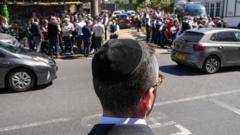
The mirror in the hallway doesn’t lie, but it can certainly help you hide.
David stood before his reflection on a Friday afternoon, the low winter sun of North London bleeding through the window. In his right hand, he held a circular piece of navy suede—his kippah. In his left, a battered cotton baseball cap with a generic logo he’d bought from a high-street chain three days prior.
For thirty years, the kippah had stayed pinned to his thinning hair, an unremarkable fixture of his identity as he walked the streets of Golders Green. It was as much a part of him as his glasses or his wedding ring. But today, the weight of the fabric felt different. It felt like a target.
He placed the baseball cap over the suede. He adjusted the brim. Suddenly, he was just another middle-aged man heading to the shops. He was anonymous. He was safe.
He was heartbroken.
The Anatomy of an Atmosphere
The streets of Golders Green usually hum with a specific kind of predictable energy before the sun dips low enough to signal the start of Shabbat. There is the frantic rush for challah, the scent of chicken soup beginning to waft from open windows, and the rhythmic clicking of heels on pavement as families hurry toward the synagogue. It is a neighborhood built on the bedrock of visibility. To be Jewish here isn't just a private belief; it is the very architecture of the community.
But this week, the architecture cracked.
Following the targeted attack on the heart of the neighborhood, the air has curdled. Violence has a way of rewriting the map of a city. A park bench is no longer just a place to sit; it’s a vantage point for a threat. A narrow alleyway isn’t a shortcut; it’s a trap. When a community is told, through the blunt instrument of an assault, that their presence is an affront, the psychological response isn't always a roar of defiance. Sometimes, it is a quiet, agonizing retreat into the shadows.
Statistics will tell you that hate crimes are up. They will provide percentages and bar charts that track the rise of antisemitism across the UK. But numbers are cold. They don't capture the tremor in a mother's hand as she checks the locks on her front door for the fourth time. They don't explain why a teenager decides to wear a hoodie over his school uniform to hide the emblem on his blazer.
The Invisible Tax
There is a hidden cost to living under the threat of "incidents." Call it an emotional tax. Every time David walks out of his door, he has to perform a mental calculation that his non-Jewish neighbors simply don't have to consider.
Who is behind me? Why is that car idling at the curb? If I turn this corner, is there a clear exit?
This hyper-vigilance is exhausting. It erodes the soul. When you spend your day scanning for exits, you stop looking at the sky. You stop noticing the bloom of the cherry blossoms or the way the light hits the brickwork of the kosher bakeries. You become a prisoner of your own survival instincts.
The attack in Golders Green wasn't just an act of physical harm; it was an act of psychological displacement. It aimed to make the residents feel like guests in their own homes—guests who had overstayed their welcome and should probably keep their voices down.
The Shabbat Table of Shadows
Inside the homes, the ritual of the Friday night meal continued. The candles were lit. Two flames flickering against the gathering dark. But the conversation around the table has shifted.
Usually, the talk is of school grades, neighborhood gossip, or the latest political headache in Westminster. Now, the questions are more existential. A ten-year-old asks why there are police vans parked outside the synagogue. An elderly grandfather, who remembers a different era of European history, sits in a silence that is far too loud.
"We are fine," Sarah tells her children, her voice a shade too bright. She serves the soup, the steam rising to meet her tired eyes. "We are safe here. This is London."
She says it to convince herself. She says it because the alternative—admitting that the fabric of her reality has been torn—is too much to bear. She thinks about the baseball cap sitting on the peg in the hallway. She thinks about the way people looked at her in the supermarket when she spoke Hebrew on the phone. It wasn't a look of hatred, necessarily. It was a look of "othering." A sudden, sharp realization that she was different, and that difference was now dangerous.
The Geometry of Fear
Fear doesn't travel in a straight line. It curves and loops. It settles in the stomach and stays there.
Consider the geography of a neighborhood under siege. For the people of Golders Green, the "safe zone" is shrinking. It used to be the whole of London. Then it was the borough. Now, for some, it is the few blocks between their front door and the shul.
The security guards standing outside the Jewish primary schools are a necessity, but they are also a tragedy. They are a physical manifestation of a broken promise. The promise was that in a modern, pluralistic society, you shouldn't need a reinforced gate to learn your alphabet.
But the guards are there. They wear high-visibility vests that scream "Watch out." They are the gatekeepers of a community that is simultaneously trying to be open to the world and protected from it. This is the paradox of the modern Jewish experience in the West: the desire to integrate completely while being forced to insulate desperately.
The Choice of the Hat
Back in the hallway, David reached for the door handle.
He felt a sudden flash of shame. His father hadn't hidden his identity, even when things were lean and the rhetoric in the newspapers was ugly. His grandfather had survived things that David only saw in black-and-white documentaries. And here he was, in 2026, putting on a cheap hat because he was afraid of a teenager with a grudge or a radical with a point to prove.
He took the cap off.
He stared at it. It was a flimsy thing. Polyester and false promises. He looked at his kippah. It was just fabric. It had no magical properties. It couldn't deflect a blow or stop a slur.
But it was his.
The decision to hide is never just about safety. It’s about the slow surrender of the self. Every time you tuck away a symbol of who you are to avoid a confrontation, a small piece of your dignity withers. You aren't just protecting your head; you are shrinking your spirit to fit into a space that someone else has defined for you.
David put the baseball cap on the shelf.
He stepped out into the crisp evening air. He felt the cold wind on his ears and the familiar, slight pressure of the kippah on the crown of his head. He walked down the street toward the synagogue.
His heart hammered against his ribs. His eyes darted toward a group of men standing near the bus stop. He felt the impulse to look down at the pavement, to make himself small, to disappear into the gray London twilight.
He didn't.
He looked up. He nodded to a neighbor. He kept his pace steady.
The Weight of Being Seen
The Shabbat after an attack is the hardest one to observe. It is the one where the prayers feel heavier and the silence between them feels more fragile. But it is also the most vital.
Community isn't found in the moments of ease. It is forged in the moments when staying visible feels like an act of rebellion. Golders Green is not a collection of buildings or a set of census data. It is a collective refusal to be erased.
As the sun disappeared completely, leaving only the orange glow of the streetlamps, the neighborhood began to glow from within. Behind a thousand curtains, candles were burning. The light didn't care about the threats scrawled on walls or the violence of the previous Tuesday. It just did what light does. It occupied the space. It refused to be dark.
David reached the doors of the synagogue. He saw the security team, their faces taut, their eyes scanning the street. He saw his friends, some of whom were wearing hats, some of whom were not. There was no judgment. Everyone was navigating their own private map of courage and caution.
He stepped inside. The hum of voices rose to meet him—the ancient, stubborn melody of a people who have spent centuries learning how to walk through the fire without becoming the ash.
He took his seat. He didn't need the baseball cap anymore. The roof of the sanctuary was enough. For now, the world outside was a blur of shadows and uncertainty, but here, under the warm yellow light of the chandeliers, he was exactly who he was supposed to be.
The mirror in the hallway was miles away. Here, there was no need to hide. There was only the breath in his lungs, the neighbor by his side, and the terrifying, beautiful necessity of being seen.