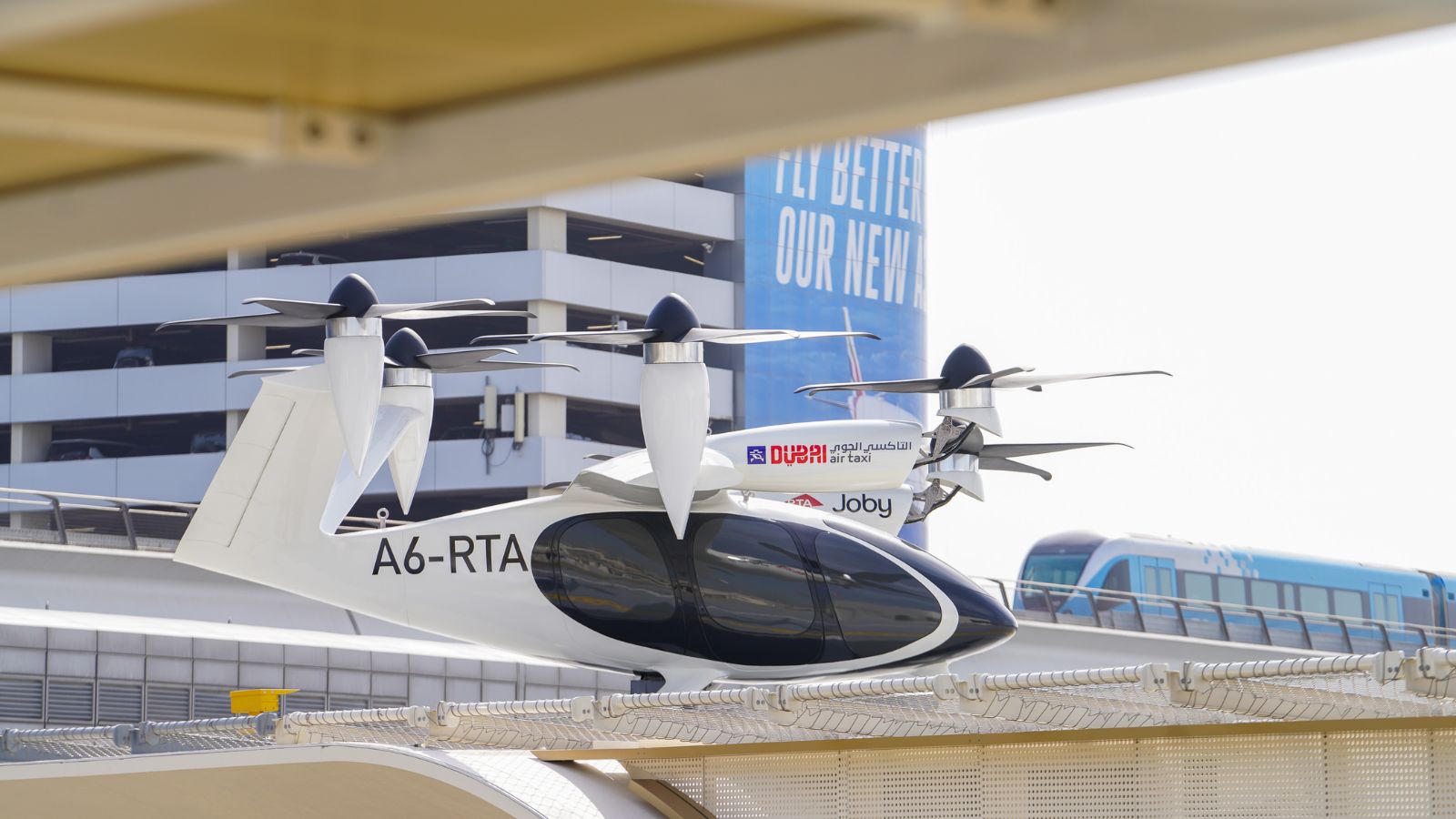
The inauguration of Dubai’s first dedicated vertiport near Dubai International Airport (DXB) represents a shift from speculative aviation to a structural reconfiguration of urban transit. While traditional ground transportation operates on a two-dimensional grid constrained by static infrastructure and congestion-induced latency, Advanced Air Mobility (AAM) introduces a vertical vector that decouples transit time from surface-level density. This specific installation is not merely a terminal; it serves as the foundational node for a multimodal network designed to compress the "first-last mile" gap for high-value travelers. To understand the impact of this development, one must look past the novelty of flight and analyze the operational constraints, energy requirements, and the economic friction this infrastructure seeks to eliminate.
The Tri-Node Operational Framework
The success of a vertiport depends on its ability to manage three distinct operational phases: the Airside Interface, the Energy Management Core, and the Landside Integration.
1. Airside Interface and Throughput Dynamics
The Dubai vertiport near DXB is engineered for high-frequency Electric Vertical Take-off and Landing (eVTOL) operations. Unlike helicopters, which require significant clear zones due to noise and rotor downwash, eVTOLs utilize Distributed Electric Propulsion (DEP). This allows for a smaller physical footprint.
- The TLOF and FATO: Every vertiport requires a Touchdown and Lift-Off (TLOF) area and a Final Approach and Take-Off (FATO) area. In high-density environments like the airport district, these must be optimized for rapid turnaround.
- Sequencing Logic: The proximity to one of the world's busiest international hubs introduces complex airspace management requirements. The vertiport operates under a "nested" airspace protocol, where eVTOL corridors must be deconflicted with heavy commercial jet departure and arrival patterns.
2. The Energy Management Core
Battery energy density remains the primary bottleneck for AAM. The Dubai installation must function as a localized microgrid.
- Rapid Charging Infrastructure: To maintain a high utilization rate, aircraft cannot sit idle for long durations. The infrastructure requires megawatt-scale charging stations capable of replenishing battery levels within a 10-to-15-minute window—the "turnaround buffer."
- Thermal Regulation: Dubai’s ambient temperatures frequently exceed 40°C. High-power charging generates significant heat, which degrades lithium-ion battery health and reduces efficiency. The vertiport’s cooling systems are as critical as the chargers themselves, requiring specialized liquid-cooling loops for both the charging cables and the aircraft interfaces.
3. Landside Integration and Multimodal Sync
The value of an air taxi is negated if the transition to ground transport is inefficient. By placing the vertiport near DXB, the planners are targeting the "Time-Value of Money" demographic.
- Physical Connectivity: The station acts as a bridge between the Dubai Metro, the airport terminals, and private car services.
- Digital Integration: The backend logic must synchronize flight arrival data with ground-based ride-hailing algorithms to ensure zero-wait transitions.
The Economic Utility Function of eVTOL Transit
To quantify why this infrastructure matters, we must apply a cost-benefit analysis based on the Value of Time (VoT). For a corporate traveler or high-net-worth individual, the "cost" of a 45-minute commute from DXB to Palm Jumeirah during peak congestion is not just the fuel or fare, but the opportunity cost of that time.
The Transit Time Equation
Let $T_{total}$ be the total journey time.
$$T_{total} = T_{access} + T_{wait} + T_{flight} + T_{egress}$$
In traditional ground transport, $T_{flight}$ is replaced by $T_{drive}$, which is highly sensitive to external variables (accidents, construction, peak hours). In the eVTOL model, $T_{flight}$ is a constant. The efficiency of the Dubai vertiport is measured by its ability to minimize $T_{access}$ and $T_{wait}$. By locating the station at the airport, $T_{access}$ is effectively neutralized for arriving passengers.
Scaling the Revenue Model
Initial operations will likely follow a premium pricing strategy to recoup the high capital expenditure (CAPEX) of the vertiport and the aircraft. However, the path to mass-market viability requires a transition from a bespoke service to a "seat-share" model. The unit economics depend on:
- Load Factor: Maintaining an average occupancy of at least 75% across all missions.
- Utilization Rate: Ensuring each aircraft performs at least 15 to 20 missions per day.
- Maintenance Cycles: Reducing the cost per flight hour through modular battery swaps and simplified electric motor maintenance.
Navigating the Regulatory and Noise Bottlenecks
While the physical station is complete, the operational "go-live" is dictated by the General Civil Aviation Authority (GCAA). The regulatory framework focuses on two non-negotiable variables: safety and acoustic footprint.
Acoustic Management in Urban Canyons
Urban Air Mobility is only viable if it is socially acceptable. Helicopter operations are restricted in many cities due to high-decibel noise profiles. eVTOLs, through DEP, shift the noise frequency to a range that is more easily dissipated by the urban environment. The Dubai vertiport serves as a testbed for measuring these acoustic signatures in a real-world desert environment, where sound carries differently due to heat-induced air density changes.
Air Traffic Management (ATM) Integration
The integration of unmanned and piloted eVTOLs into the existing ATM system is a staged process.
- Phase 1: Piloted operations along fixed "corridors" with dedicated altitudes.
- Phase 2: Dynamic routing with advanced deconfliction algorithms.
- Phase 3: Fully autonomous operations managed by a digital flight service provider.
Dubai’s strategy bypasses the legacy infrastructure issues faced by cities like London or New York by building "greenfield" corridors specifically for these aircraft, reducing the risk of mid-air conflict with existing general aviation.
Strategic Constraints and System Vulnerabilities
It is a mistake to view the vertiport as a flawless solution. Several systemic risks could impede the rollout.
1. The Resilience of the Charging Grid
A fleet of 20 eVTOLs charging simultaneously at 1MW each places a 20MW load on the local power grid. This requires either massive battery energy storage systems (BESS) on-site or a significant upgrade to the utility substation. If the grid cannot support the instantaneous demand, the "turnaround buffer" expands, the utilization rate drops, and the business model collapses.
2. Weather-Induced Groundings
While Dubai does not face frequent snow or ice, it does contend with sandstorms and extreme wind shears. Low visibility and the abrasive nature of sand on electric motors and sensors could lead to higher-than-expected maintenance intervals or service cancellations. The vertiport must include sophisticated local weather sensing (LIDAR and RADAR) to provide micro-climate data for safe takeoff and landing.
3. Public Perception and Price Sensitivity
If the price point remains significantly higher than a luxury ground transfer (e.g., a chauffeur-driven Tesla), the volume required for network effects will never materialize. The vertiport risks becoming a "vanity asset" rather than a utility if the throughput does not move beyond the elite tier of travelers.
The Structural Realignment of Dubai’s Geography
The location of this first vertiport near the airport is the opening move in a larger geographic strategy. By connecting DXB to other planned hubs in Dubai Marina, Palm Jumeirah, and Downtown, the city is effectively "shrinking" its geography.
A 25-kilometer journey that currently takes 45 to 60 minutes will be compressed into a 10-minute flight. This compression changes real estate valuations. Areas that were previously considered "too far" from the airport become prime locations for residents who prioritize global connectivity.
The vertiport is the anchor for a new class of "aerotropolis" development. It signals that Dubai is moving away from a dependence on asphalt-based expansion. The technical success of this first station will be judged not by the first flight, but by the reliability of the charging cycles and the seamlessness of the passenger transfer over the first 10,000 operations.
Operators must now focus on the "Service Level Agreement" (SLA) of the vertiport itself—treating it as a high-throughput data center for physical objects. The priority for the next 24 months is the hardening of the ground-to-air data links and the stress-testing of the charging infrastructure under peak summer thermal loads. Without these technical foundations, the vertical dream remains a low-volume novelty.