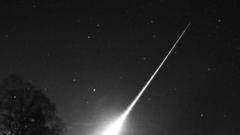
The internet just fell in love with another shaky, low-resolution doorbell camera clip of a green streak in the sky. Local news stations are running it on a loop. Twitter is losing its collective mind over "the once-in-a-lifetime event."
They are lying to you.
Every time a bright fireball—a bolide—crosses a populated area, the media industrial complex kicks into a predictable gear of manufactured wonder. They treat these events as mystical anomalies. They aren't. They are the background noise of a chaotic solar system. If you think seeing a meteor is a rare spiritual omen or a "lucky catch" for your DashCam, you’ve been conditioned by a press that values clicks over orbital mechanics.
The Myth of the Rare Event
Let’s start with the math that the "Breaking News" anchors conveniently ignore. Roughly 44,000 kilograms of meteoric material hits Earth every single day. Most of it is dust. Some of it is the size of a marble. A significant chunk of it is large enough to produce a brilliant light show.
The only reason these videos are "trending" more often isn't because the sky is falling; it's because we have turned the planet into a panopticon of cheap CMOS sensors. Between Ring doorbells, Tesla Sentry cameras, and the sheer density of smartphones, we are finally just seeing what has been happening for 4.5 billion years.
The competitor articles love to use words like "mysterious" or "unexplained." There is nothing unexplained about a piece of space junk or a chondrite hitting the upper atmosphere at $72,000$ kilometers per hour. The friction causes the air to ionize, creating a plasma trail. That’s it. It’s physics, not magic.
Why Your Doorbell Camera is a Terrible Scientific Tool
We are drowning in data but starving for information. These viral clips are practically useless for actual planetary defense or astronomical study.
I’ve spent years looking at "fireball reports," and 99% of what the public uploads is garbage. A single camera angle tells us nothing. Without a secondary or tertiary perspective from a known geographic coordinate, we can’t calculate a trajectory. We can’t find the landing site. We can't determine the mass.
- Saturation: Most consumer cameras have tiny sensors that "blow out" the brightness. The meteor looks like a massive glowing orb when it’s actually the size of a grapefruit.
- Frame Rates: Cheap cameras record at variable frame rates. This makes timing the velocity of the object a guessing game.
- Compression: By the time that video hits TikTok, the compression artifacts have stripped away the spectral data that tells us what the rock was actually made of (nickel, iron, or silicates).
If you actually cared about the science, you wouldn’t be sharing a 15-second clip on Facebook. You’d be calibrated with the Global Fireball Observatory or using specialized hardware like All-Sky cameras that utilize fish-eye lenses and precise UTC timestamping.
The Green Flame Fallacy
"Look at the eerie green glow! Is it an alien ship?"
No. It’s nickel. Or oxygen.
People see a color in a meteor video and immediately jump to sci-fi tropes. In reality, the colors are a result of the atmospheric gases being heated and the elements in the rock vaporizing. Green usually indicates the presence of nickel—common in iron-nickel meteorites—or the excitation of atmospheric oxygen atoms.
The media plays into this "alien" narrative because it drives engagement. It’s a cheap tactic. By framing these events as "mysterious," they actively de-educate the public. We should be talking about the Kulik effect or the Poynting-Robertson effect, but instead, we’re debating whether the "light in the sky" is a sign from the heavens.
Stop Reporting Every Fireball
The "People Also Ask" section of search engines is a graveyard of scientific illiteracy.
- "Will the meteor hit my house?" (Statistically, no. Your neighbor's driving is a bigger threat.)
- "Is it a sign of the end times?" (It’s a sign that the solar system is a messy place.)
When every minor bolide is treated as front-page news, we suffer from "Crisis Fatigue." When a real threat comes—something on the scale of the 2013 Chelyabinsk event—people will be too desensitized by a diet of doorbell camera clips to take the necessary precautions.
The Chelyabinsk meteor wasn't dangerous because of the rock itself; it was dangerous because of the shockwave. People ran to their windows to look at the pretty light, only for the glass to explode inward seconds later because the sonic boom hadn't caught up yet. Over 1,200 people were injured because they didn't understand the lag between light and sound.
If you see a bright flash, get away from the windows. Don't grab your phone to record it for clout.
The Amateur Meteor Hunter Industrial Complex
There is a growing subculture of people who use these viral videos to go "meteor hunting." They see a flash, check the comments, and drive out to a field hoping to find a rock worth thousands of dollars.
Here is the cold, hard truth from someone who has been in the trenches: you probably won't find it.
The "dark flight" phase of a meteor—the part where it stops glowing and falls to earth—is heavily influenced by high-altitude winds. A rock can drift miles away from its projected path. Unless you have a dedicated radar track from the National Weather Service (which sometimes picks up falling meteorites as "clutter"), you are just walking through a forest looking for a burnt-looking pebble that is likely buried six inches underground.
The Cost of the Click
Every time a major news outlet publishes a story titled "Amazing Footage of Meteor," they are stealing oxygen from actual scientific breakthroughs. We are currently landing probes on asteroids (OSIRIS-REH) and crashing ships into them to test planetary defense (DART). Those are the stories that matter.
A dashcam video from a commute in Ohio is not a story. It’s a distraction.
We’ve become a society that prefers the spectacle of the event over the substance of the reality. We want the 1080p glow, not the orbital debris data. We want the "wow" factor, not the "why."
If we want to actually advance as a space-faring species, we need to stop gawking at the sky like cavemen seeing lightning for the first time. The meteor didn't "cross the sky" for your entertainment. It’s a ballistic projectile in a cosmic shooting gallery, and we are the target.
Put the phone down. Learn the physics. Stop being impressed by common occurrences.
The next time you see a "fireball" trending on your feed, remember: you’re not looking at a miracle. You’re looking at a poorly compressed video of a rock doing exactly what gravity told it to do. If that’s enough to blow your mind, you aren't paying enough attention to the actual universe.

:max_bytes(150000):strip_icc()/emergingmarketeconomy.asp-FINAL-9eeea54899d645a49ac9a913ee986371.png)

