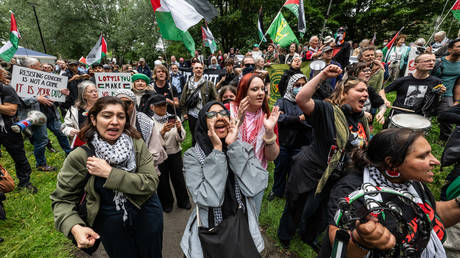
The United States Treasury Department officially designated Palestine Action as a Specially Designated Global Terrorist organization, mirroring a controversial British precedent and setting a profound legal hazard for civil disobedience. By weaponizing financial sanctions and counterterrorism architecture against a direct-action network, Washington and London have permanently altered the boundaries between political dissent and violent extremism. The decision freezes any assets held by the group within American jurisdiction and imposes sweeping prohibitions on citizens or entities conducting transactions with affiliated individuals.
For years, the network focused its efforts on disrupting the supply chain of Elbit Systems, Israel’s largest defense electronics manufacturer, staging break-ins, occupying factory roofs, and spray-painting equipment. While those tactics involved extensive property destruction and occasional physical confrontations with law enforcement, the leap from criminal mischief and vandalism to a formal global terrorism designation represents a seismic shift in state power. Recently making news lately: What Everyone Gets Wrong About the Silence Surrounding Mojtaba Khamenei.
The Mechanics of Transnational Proscription
Understanding why this designation matters requires looking past the rhetoric and examining the legal machinery. Traditional counterterrorism frameworks target organizations that employ indiscriminate violence against civilians to achieve political, religious, or ideological goals. Palestine Action operated differently, explicitly targeting industrial infrastructure, military assets, and corporate offices associated with foreign military supply chains.
When the British government first proscribed the network under the Terrorism Act, it crossed a Rubicon. It marked the first time a direct-action civil disobedience campaign was categorized alongside transnational militant networks like the Islamic State. The Trump administration's decision to adopt this classification institutionalizes a new doctrine articulated by Secretary of State Marco Rubio, who has signaled an international pivot toward targeting what Washington defines as far-left extremist networks. Further information into this topic are explored by Reuters.
The financial ramifications are immediate and absolute. Under the Specially Designated Global Terrorist framework, anyone deemed to be providing material support, services, or symbolic reinforcement to the network faces catastrophic legal exposure. Banks immediately lock accounts, payment processors sever ties, and even secondary sympathizers risk criminal prosecution. This strategy cuts off the financial oxygen of a movement, but it also establishes a chilling blueprint for how governments can legally strangle political opposition without needing to prove an intent to cause mass casualties.
The Slippery Slope of Political Labeling
Civil liberties organizations have warned that stretching counterterrorism laws to cover property destruction creates an autocratic template. When breaking into a military base to splash paint on an aircraft is legally equated with orchestrating bombings or assassinations, the legal system loses its proportionality.
Consider the hypothetical example of an environmental coalition blocking an oil pipeline or a labor union occupying a corporate headquarters to protest wage theft. Under the expansive logic now endorsed by both British and American authorities, prosecutors possess the discretionary tools to rebrand those militant labor or environmental tactics as acts of domestic terror. The threshold shifts from protecting human life to safeguarding corporate and military infrastructure from disruption.
This expansion of state power occurs precisely when public trust in institutional checks and balances is fraying. Governments facing fierce domestic opposition to foreign policy decisions find themselves uniquely incentivized to criminalize the most disruptive fringes of that opposition. By painting activists with the terrorist brush, state actors effectively delegitimize the underlying political grievance regarding arms exports and geopolitical alliances.
The Legal Battlefield Ahead
The designation arrives at a critical juncture, as the core legality of the original British ban winds its way toward the UK Supreme Court. Co-founders like Huda Ammori have continuously argued that the network's objective has always centered on halting military actions they view as catastrophic, operating as an emergency brake against state-sanctioned violence rather than terrorizing the general public.
Even as courts in London weigh whether the proscription represents a proportionate interference with human rights, the White House intervention seeks to preempt judicial relief. By locking the network into international sanctions lists, the maneuver ensures that even if domestic courts eventually find the local ban flawed, the global financial chokehold remains intact.
The battle lines no longer exist solely in the courtrooms or on the roofs of defense contractors. They define a changing global order where the tools built to fight clandestine armies are turned inward against citizens with spray cans and sledgehammers.


