The air changes first. It loses its movement. Outside, in the sweeping valleys of upstate New York, the wind moves across the grass and over the limestone ridges, free and indifferent. But the moment you slip beneath the surface, the atmosphere thickens. It smells of wet stone, ancient decay, and a heavy, unyielding dampness that clings to the skin like wool.
To most people, a cave is a geological anomaly. A line item in a tourist brochure or a brief, claustrophobic segment on the evening news. We read the headlines—Man rescued after getting trapped in New York cave—and we scroll past. We treat it as an isolated incident, a bizarre mistake made by an eccentric hobbyist.
We are wrong.
Beneath the surface of our predictable, paved world lies a labyrinth of fracture lines and subterranean voids. Entering them is not merely a hobby; it is a negotiation with an environment that does not recognize human vulnerability. When that negotiation fails, the universe shrinks down to the size of a man’s chest, and time begins to run backwards.
The Geography of Panic
Consider a man named Lukas. He is a composite of the souls who willingly choose the dark, driven by the quiet obsession of exploration. Lukas is experienced. He carries three independent light sources, wears a heavy-duty helmet, and understands the physics of a vertical drop. He is not reckless. Yet, reckless is the word the world will use when the earth shifts.
It happens in a space called a squeeze.
In the limestone networks of New York, particularly around the Schoharie County region, caves are not grand, vaulted cathedrals. They are tight, muddy, twisting capillaries carved out by thousands of years of acidic groundwater. To move through them, you cannot walk. You must crawl. Sometimes, you must exhale completely, emptying your lungs to flatten your ribcage enough to slide through a gap no wider than a laptop screen.
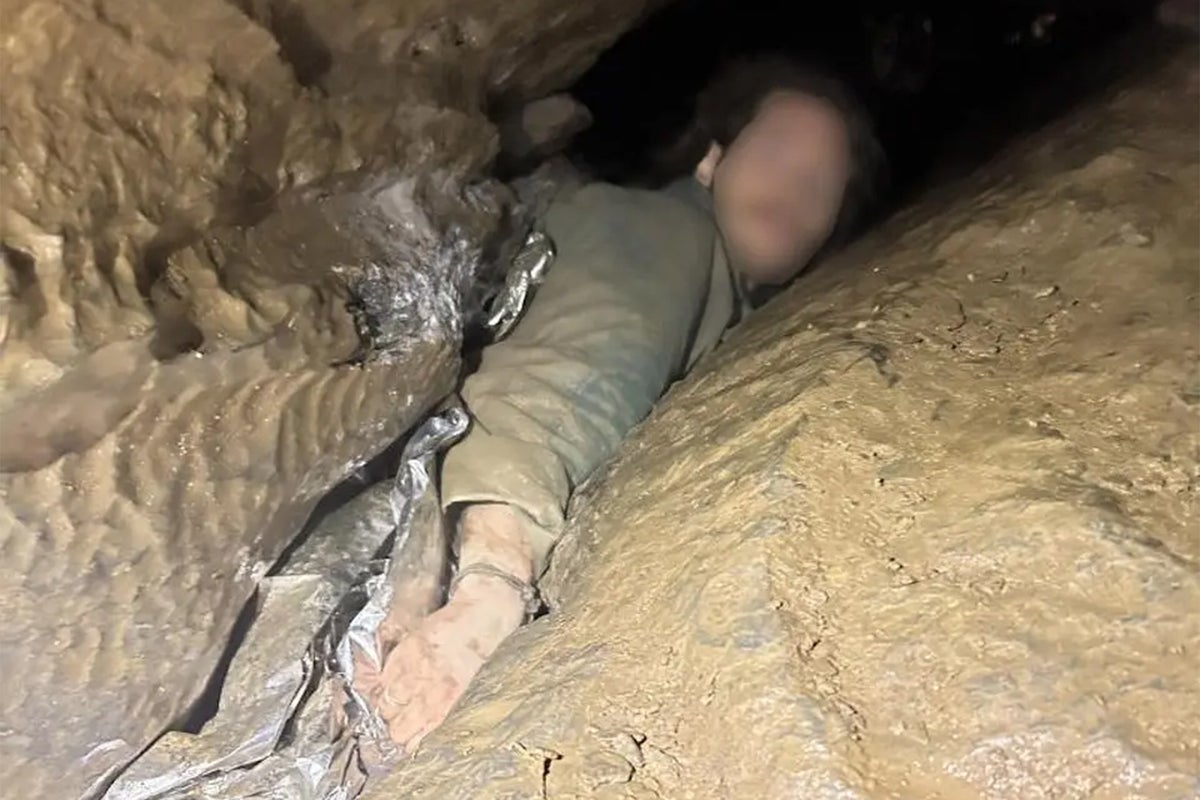
Lukas slides in. He is prone, his left cheek pressed against the cold, wet mud of the cave floor. His right arm is pinned ahead of him; his left arm is tucked against his flank. This is the standard technique for navigating a tight bedding plane.
Then, he stops.
His jacket fabric snags on a jagged thumb of calcite. He tries to back up, but his boots find no purchase on the slick, angled rock behind him. He pushes forward, but the ceiling dips by a mere two inches. Two inches is the difference between a passage and a tomb. He tries to take a deep breath to calm his racing pulse, but the expansion of his own chest locks him tightly against the roof of the chamber.
The earth has him.
In that specific moment, psychology overrides intellect. The human brain is hardwired for the open horizon. When that horizon is replaced by five hundred tons of solid stone pressing against your shoulder blades, the nervous system rebels. The heart rate spikes. Adrenaline floods the bloodstream, demanding a fight-or-flight response. But there is nothing to fight, and nowhere to fly.
This is where the real danger begins. The physical trap is only half the crisis; the mental spiral is the true killer. Hyperventilation increases the volume of the chest, wedging the body deeper into the rock. Panic causes sweat, which rapidly cools in the 42-degree dampness of the cave, inviting hypothermia.
The Invisible Network
While Lukas lies in the dark, measuring his life in shallow, ragged breaths, a silent mechanism activates above ground.
We often take for granted the invisible safety nets that undergird our society. We assume that when things go wrong, an anonymous entity called "The Authorities" will simply arrive and fix it. But cave rescue is not like calling an ambulance. A standard paramedic cannot fit into a twelve-inch fissure. A traditional fire department winch cannot navigate a three-hundred-foot twisting shaft.
Instead, the call goes out to a highly specialized, deeply insular community of volunteers. These are people who spend their weekends in the mud, mapping the unknown. They are engineers, teachers, geologists, and mechanics. They are the only people on earth who look at a terrifyingly narrow hole in the ground and see a workplace.
The logistics of a underground rescue are a nightmare of physics and human endurance.
First, there is the communication breakdown. Radio waves do not penetrate solid limestone. To establish contact with a trapped caver, rescue teams must manually run miles of rugged single-wire telephone lines through the mud, wrapping them around stalagmites and securing them against falling rock.
Consider what happens next: a team of rescuers must enter the same treacherous passage that claimed the victim. They carry heavy gear, medical supplies, and extraction equipment through spaces where a normal person would experience a panic attack just standing at the entrance. They must operate in shifts, because the grueling physical labor of moving a immobile human body through a subterranean maze exhausts a person in less than an hour.
The Anatomy of an Extraction
The rescue effort becomes a slow, deliberate choreography. Every move is calculated in centimeters.
If the caver is wedged tight, traditional pulling can cause severe spinal injuries or dislocation. The rescuers must use specialized techniques. Sometimes, this involves applying a slick, non-toxic lubricant to the rock faces and the victim's clothing. Sometimes, it requires the careful use of small, non-explosive expansion tools to micro-fracture the offending rock without causing a catastrophic collapse of the ceiling.
Hours dissolve. In the cave, there is no day or night, only the relentless ticking of the rescuers' watches and the steady, maddening drip-drip-drip of water from the ceiling. Lukas’s core temperature is dropping. His muscles are cramping violently from the forced immobility. The rescuers speak to him constantly, their voices a fragile tether keeping him anchored to reality. They tell him about the weather outside. They tell him about the coffee waiting at the staging area. They lie to him about how close they are to getting him out, because hope is a metabolic necessity in the dark.
The physical strain on the rescue party is immense. To haul an unconscious or exhausted person up a vertical pit requires a complex system of pulleys, ropes, and mechanical ascenders. Every anchor point must be drilled into the living rock. If a single bolt fails, both the victim and the rescuer plunge into the void.
But the real problem lies elsewhere. It is the exhaustion of the human spirit.
When you have been in the dark for twelve, eighteen, or twenty-four hours, the mind begins to play tricks. The shadows cast by headlamps distort into monstrous shapes. The sound of distant rushing water starts to sound like human voices screaming. Both the rescued and the rescuer must fight the creeping illusion that they have always been down here, and that the surface world of sunshine, traffic, and warm beds was merely a dream they once had.
The Return to the Light
The breakthrough, when it comes, is rarely cinematic. There is no sudden, triumphant burst of strength. There is only the agonizingly slow inching of a body through stone, a painful centimeters-at-a-time progression until the squeeze widens into a crawlway, and the crawlway expands into a cavern where a man can finally stand upright.
When the rescue team finally brings the victim to the cave entrance, the transition is jarring.
The air hits first. It smells of pine, dirt, and ozone. Even in the middle of the night, the darkness of the surface world feels blindingly bright compared to the absolute, terrifying void of the deep earth. The eyes struggle to adjust to the horizon. The legs, unaccustomed to the flat stability of the ground, shake violently.
The crowd gathered at the trailhead—the reporters, the anxious family members, the curious locals—sees a man on a stretcher, covered in thick, orange-brown mud, looking pale and bewildered. They see a headline wrapped up in a neat bow. They see a lucky survivor.
They do not see the permanent shift in the man's internal geography.
Long after the mud has been washed from the gear, long after the rescue ropes are coiled and hung back in the garage, the cave remains. It sits beneath the houses, beneath the highways, a vast, silent empire of stone that doesn't care about human ambition or human fear.
A man who has been claimed by the earth and given back never looks at the ground the same way again. He knows what lies beneath the grass. He knows the fragility of the cage of bones we carry inside us, and how easily it fits into the cracks of the world. He walks a little lighter on the pavement, always aware of the heavy, silent dark waiting just a few inches below his feet.