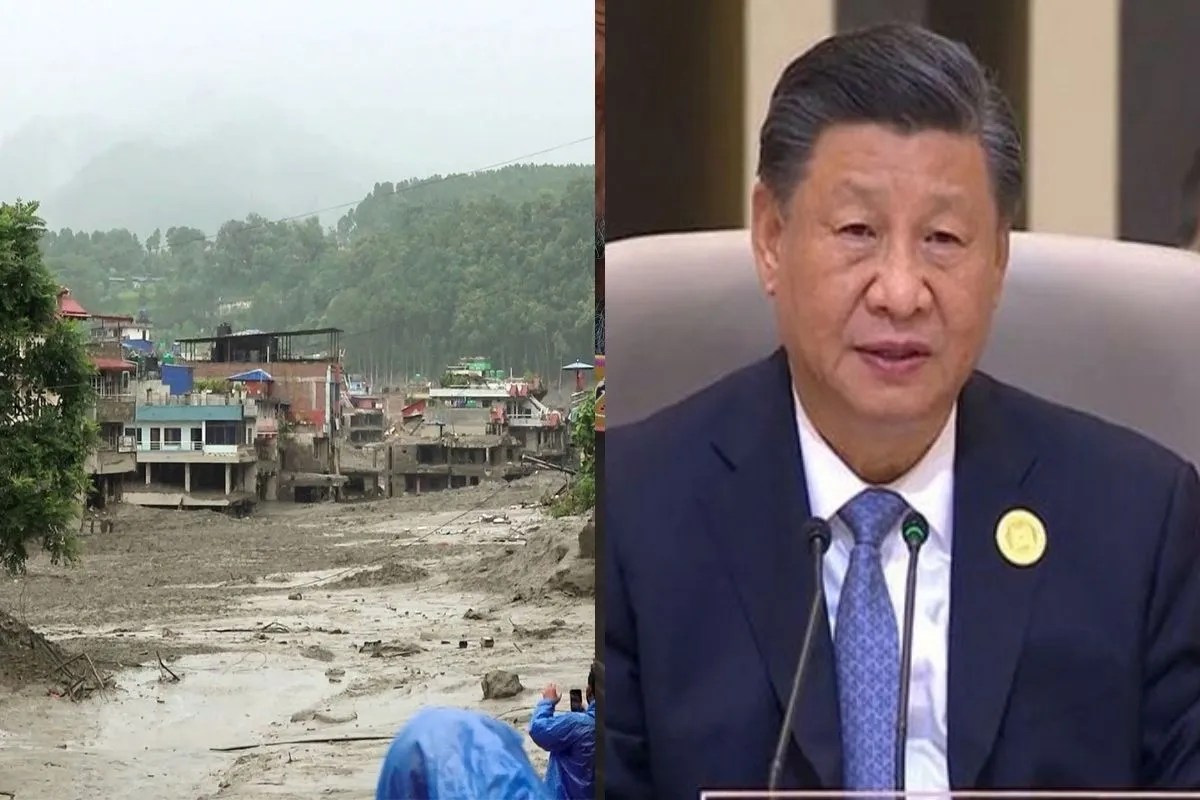
The stones do not warn you when they decide to fall. High above the valleys of Rasuwa, where the air thins into a crystalline silence and the white teeth of the Himalayas bite into the clouds, a massive lobe of ancient ice and granite simply let go. It was a roar that sounded less like an earthquake and more like the sky tearing down the middle. Millions of tons of debris plunged into the narrow gorges below, obliterating trails, erasing homes, and turning the tranquil Bhotekoshi river system into a churning, gray monster of mud, timber, and sorrow.
Consider what happens next in the physics of catastrophe. When a mountain collapses into a gorge, it rarely just splashes and passes. It acts as a massive, jagged cork. Across the border on the Tibetan side, at the confluence where the Chhochen and Purepu rivers meet, that avalanche of rock choked off the natural flow of water, locking millions of tons of liquid behind a temporary, unstable wall of earth.
This is what hydrologists call a barrier lake, though to the families camping on the muddy banks downstream in Nepal, it is better understood as a ticking clock.
By Thursday morning, monitors from China's Ministry of Water Resources calculated that the trapped pool had swollen to a staggering two million cubic meters. Worse still, meteorological forecasts predicted another three million cubic meters—roughly the volume of twelve hundred Olympic swimming pools—would cascade into the basin over the following three days. The natural dam was already weeping, spilling over its jagged edges. Every drop added weight to an earthen wall that was hanging by a thread.
In Kathmandu and across the lower districts, survival is a delicate calculation of downstream geography. When the first flash flood hit, water levels in the Trishuli river system rose by nearly nine meters in less than thirty minutes. Imagine sitting in your kitchen, hearing a sound like an approaching freight train, and having half a minute to decide which precious belongings to leave behind before the floorboards turn into a rapid. Hundreds of lives were swallowed in those initial moments, and nearly a thousand souls remained unaccounted for as rescue helicopters buzzed futilely through thick mountain mists.
Now, the crisis demanded an unprecedented cross-border race against time. Water does not respect national boundaries, and political lines drawn on maps mean very little to a surging wall of debris. Recognizing the shared danger, Chinese authorities deployed specialized engineering units to the remote border sector near Gyirong Port. Operating drones, conducting aerial 3D modeling, and analyzing the fracture points of the shifting mud walls, these technical teams scrambled to understand how the impending overflow would behave.
The primary mitigation strategy is agonizingly straightforward yet dangerously difficult to execute: carve an artificial drainage channel into the debris dam before the pressure becomes catastrophic. Engineers like Chen Hanxiao calculated the precise width and depth required to let the excess water bleed off safely, preventing a sudden, catastrophic structural blowout. Yet, every hour spent drilling into the loose sediment is a gamble. Landslides continue to dust the ridges, and aftershocks of falling rock threaten the lives of the very engineers trying to save the valleys below.
Down in the villages, the human response to this invisible threat is a mixture of exhaustion and stubborn resilience. Local shopkeepers who spent their life savings building small lodges for trekkers now stare blankly at fields of gray silt where living rooms used to stand. They do not need complex scientific papers to understand climate volatility in the roof of the world. They can see it in the receding snowpacks, the sudden violent storms, and the way the ancient mountains seem to be losing their grip.
As rescue operations near the border had to be temporarily halted due to the imminent threat of the barrier lake breaching, a heavy, tense quiet settled over the valleys. People packed light bags, moved their livestock to higher pastures, and watched the color of the river from the safety of the ridges. They waited for word from the peaks above, knowing that the mountain always has the final word.