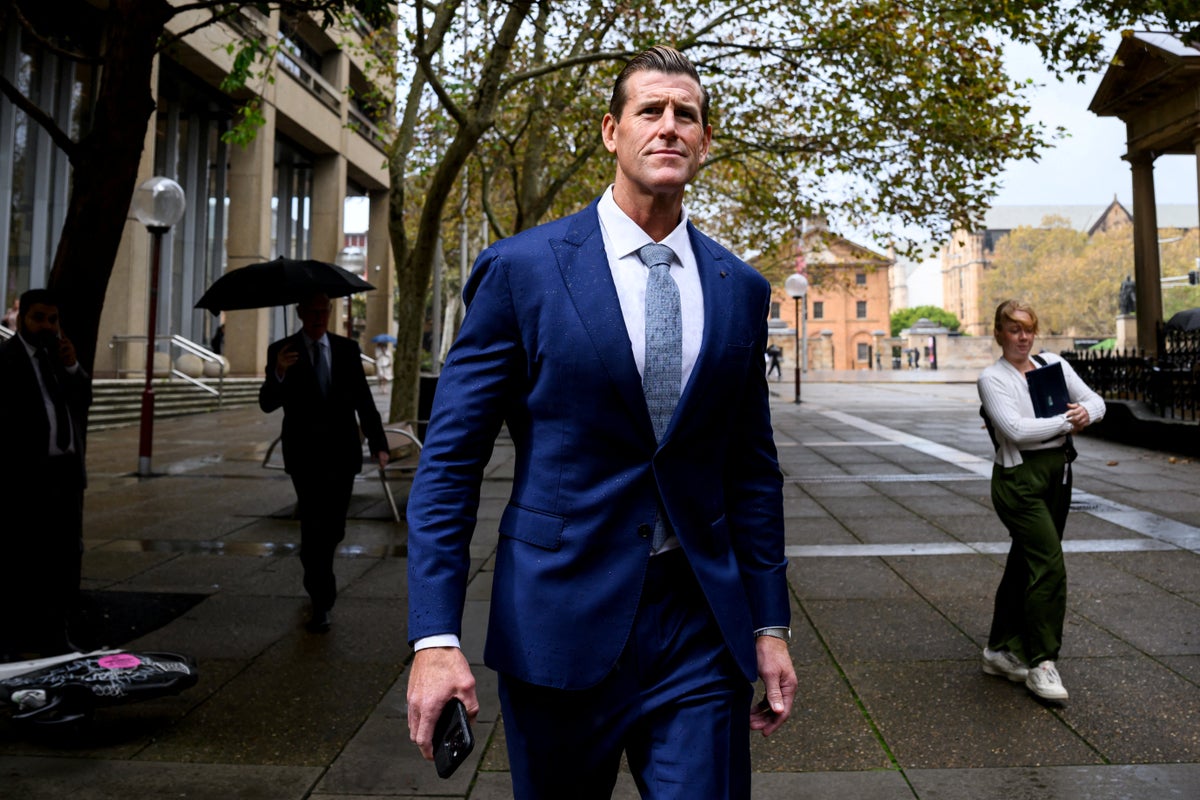
The medal is a small thing. It is a cross of bronze, supposedly cast from the metal of Russian cannons captured at Sevastopol. It weighs next to nothing in the palm of a hand, yet for Ben Roberts-Smith, it became an anchor that could either moor a man to history or drag him to the bottom of a dark, silent sea.
To understand the fall of a titan, you have to understand the height from which he started. For years, Roberts-Smith wasn’t just a soldier. He was the archetype. Towering at six-foot-four, with a jawline that looked etched from granite and a record of bravery that seemed scripted by a Hollywood ghostwriter, he was the face of Australian heroism. When he walked into a room, the air changed. He was the living embodiment of the "Anzac legend," a modern-day Achilles who had stared into the sun of the Afghan desert and hadn't blinked.
But the desert has a way of swallowing secrets.
The Silence of Uruzgan
Imagine the heat of a valley in Uruzgan province. It is a dry, suffocating warmth that tastes of iron and fine, powdery silt. The silence there is heavy. It isn't the peaceful silence of a library; it is the vibrating, electric silence of a place where every rock could be a trigger and every shadow could be a threat. This is where the narrative of the "perfect soldier" began to fray at the edges.
The allegations that eventually surfaced weren't minor infractions. They weren't the result of a soldier losing his temper in the heat of a skirmish. They were cold. They were calculated. They involved claims of a man kicked off a cliff, of prisoners executed in the dirt, of a culture within the Special Air Service Regiment (SASR) that had curdled into something unrecognizable to the public back home.
Roberts-Smith stood before the world and denied it all. "I am proud of my service," he said. He didn't just say it; he lived it. He leaned into the identity of the warrior-protector. He sued for defamation, betting his entire legacy on the idea that his word—the word of a Victoria Cross recipient—would outweigh the whispers of his brothers-in-arms and the muddy reality of the battlefield.
He lost that bet.
The Courtroom as a Battlefield
The civil trial wasn't just a legal proceeding. It was an autopsy of a myth. For months, the Federal Court of Australia became a makeshift war zone where the weapons were memory and testimony rather than rifles and grenades.
The defense didn't just suggest mistakes were made. They painted a picture of a man who operated above the law, driven by a sense of invincibility that only a nation's highest honors can provide. They spoke of "Person 4" and "Person 11"—the anonymous soldiers who had once fought beside him and were now forced to testify against him. There is a specific kind of agony in that. To have the men you trusted with your life in a firefight stand in a well-lit room and call you a murderer.
Consider the emotional cost of that betrayal—not just for Roberts-Smith, but for the SASR itself. These units thrive on a brotherhood that is supposed to be unbreakable. When that bond snaps, it doesn't just break; it shatters into thousands of jagged pieces that cut everyone involved. The public watched, fascinated and horrified, as the polished armor of the Australian Defence Force was stripped away to reveal something visceral and deeply uncomfortable.
We want our heroes to be simple. We want them to be the "good guys" who do the "hard things" so we don't have to think about what those hard things actually entail. Roberts-Smith gave us that simplicity for a decade. He was the poster boy. He was the guest of honor. He was the man we pointed to when we wanted to feel good about our place in the world.
The trial forced us to look at the cost of that comfort.
The Logic of the Unthinkable
When a soldier is accused of such acts, the immediate reaction from the public is often a mixture of disbelief and defensive anger. How could he? After everything he did for us? But there is a logic to the unthinkable. War is not a movie. It is a persistent, grinding trauma that reshapes the neural pathways of the human brain. When you spend years in a cycle of deployment, where the lines between civilian and combatant are blurred by the shifting sands of an insurgency, the moral compass can lose its true north.
This is not an excuse. It is a diagnosis.
The allegations against Roberts-Smith suggested a man who had become a law unto himself. In the heat of the Afghan summer, far from the oversight of Canberra or the eyes of the media, the power of life and death is a heavy thing to carry. If you carry it long enough, you might start to believe it belongs to you. You might start to believe that the rules of the world you left behind no longer apply in the dust of a compound in Darwan.
The tragedy of the situation lies in the duality of the man. It is entirely possible for a soldier to be genuinely brave—to have earned that Victoria Cross through legitimate, selfless heroism—and to also be capable of darkness. Humans are not monoliths. We are capable of holding incredible light and profound shadow at the same time. The Australian public struggled with this. They wanted him to be either a saint or a monster.
The truth, as it usually does, sat uncomfortably in the middle.
The Echo of the Verdict
When the judge finally handed down the ruling, the impact was a physical thing. The finding that the allegations of four murders were "substantially true" didn't just ruin a man’s reputation; it punctured a national ego. It forced a reckoning with the way Australia views its military history and its contemporary heroes.
Roberts-Smith resigned from his corporate job. He retreated from the public eye. But the ghost of the trial remains. It lingers in the way we talk about the SASR. It lingers in the way we look at medals.
There is an invisible stake here that goes beyond one man’s legal fees or his place in a museum. It is the question of what we ask of our soldiers. We send young men and women into the most chaotic, dehumanizing environments imaginable and then expect them to return and fit perfectly into a polite society that has no concept of what they’ve seen. We ask them to be wolves on our behalf, and then we are shocked when they develop a taste for blood.
The Roberts-Smith saga is a cautionary tale about the dangers of the pedestal. When we turn a human being into a symbol, we stop seeing the human. We ignore the cracks until the whole statue falls over.
The Silence Returns
Today, the Victoria Cross remains in his possession, though its luster is gone. It sits in a box, or on a shelf, or perhaps in a safe. It is still bronze. It still weighs almost nothing.
But for those who followed the trial, for the families in Afghanistan who lost loved ones, and for the soldiers who broke their silence to tell a truth that broke their hearts, that medal is now infused with the weight of something else. It carries the weight of the questions we are still afraid to answer.
The desert eventually covers everything. The footprints in the dust are blown away by the wind. The compounds are rebuilt or abandoned. But the stories we tell ourselves—the ones about who we are and what we are capable of—those are harder to bury.
The silence has returned to Uruzgan, but in the halls of power and the quiet corners of pubs across Australia, the echo of that fallen pedestal is still ringing. It is a reminder that no amount of bronze can ever truly cover the cost of a soul lost in the heat of a war that everyone wanted to forget.
He stands by his service. He holds to his pride. He remains, in his own mind, the hero we asked him to be. And in that delusion, perhaps, lies the greatest tragedy of all.