The United States government is preparing to host a live, for-profit cage-fighting event on the South Lawn of the White House this Sunday, June 14. Billed as "UFC Freedom 250," the seven-fight mixed martial arts card coincides precisely with Flag Day and President Donald Trump’s 80th birthday.
While the administration frames the event as an official kickoff for the nation’s upcoming semiquincentennial celebrations, a major legal battle has erupted in Washington over the privatization of federal landmarks. A lawsuit filed by the Public Integrity Project seeks an emergency injunction to halt the event, characterizing it as a corrupt misuse of public land for private corporate gain. In response, the Department of Justice urged a federal judge to dismiss the suit, mockingly suggesting that critics simply "avert their gazes" if they object to the transformation of the executive residence into a sports arena. In related developments, take a look at: The Myth of the Telegram Honey Trap and the Real Mechanics of Modern Signal Warfare.
The brewing legal standoff exposes a much larger, unprecedented shift in how public property, federal regulations, and corporate partnerships intersect at the highest level of government.
The Infrastructure of a South Lawn Spectacle
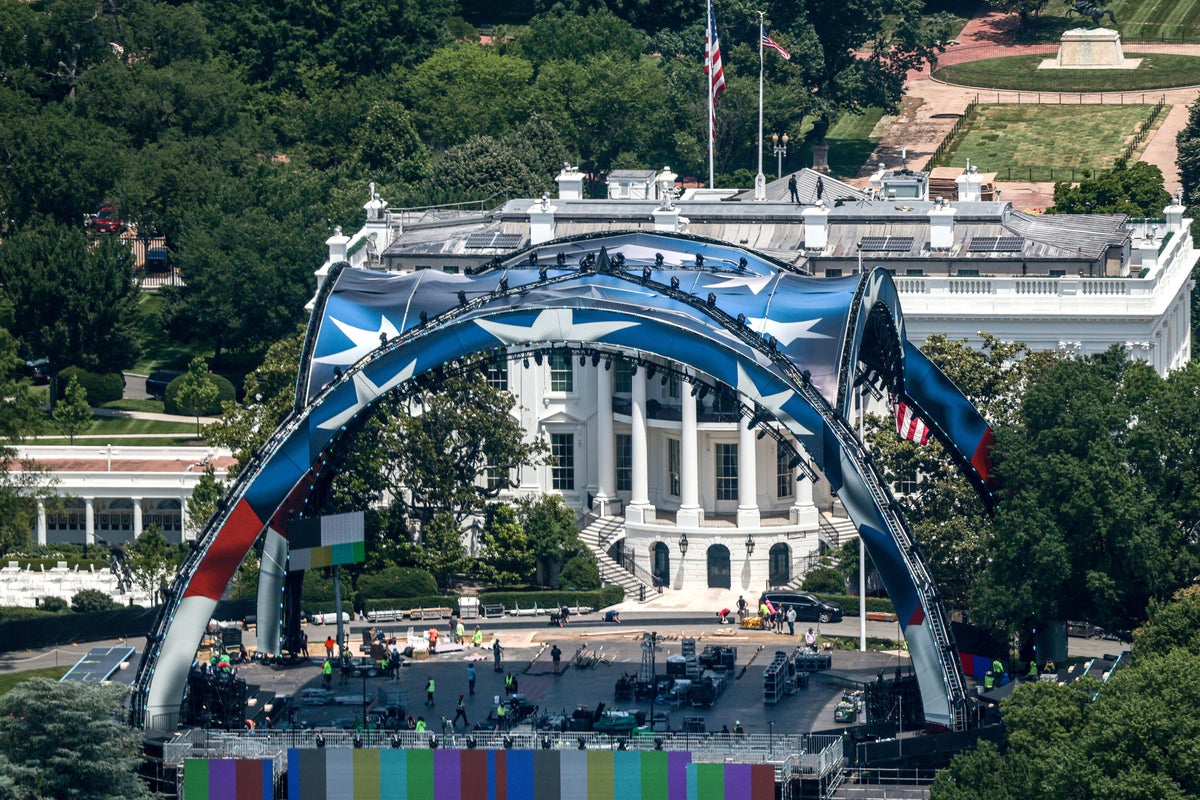
The physical reality of what is currently being built outside the Oval Office defies historical precedent. Crews are completing a massive, temporary 5,000-seat stadium dubbed "the Claw," which encircles an octagon-shaped fighting cage just steps from the Executive Residence. NBC News has provided coverage on this important subject in extensive detail.
The scale of the operation extends well beyond the White House gates. The administration has authorized the Ultimate Fighting Championship (UFC) to host ceremonial weigh-ins and fighter face-offs at the Lincoln Memorial. Huge broadcast screens are rising on the Ellipse to accommodate an expected overflow crowd. The UFC plans to distribute up to 85,000 free tickets to the public to fill these surrounding areas, transforming the historic core of the nation's capital into a giant fan zone.
To execute a project of this magnitude on federal parklands, the administration bypassed standard bureaucratic hurdles. Under standard National Park Service regulations, commercial sporting events are strictly prohibited on the White House grounds and adjacent historic monuments. Furthermore, permanent or major temporary structures on the South Lawn typically require explicit congressional authorization and exhaustive environmental impact reviews.
The legal mechanism making the fight possible is a temporary National Park Service rule enacted in June 2025. This loophole explicitly permits special events planned and executed by executive departments or the Semiquincentennial Commission to celebrate the 250th anniversary of American independence. The plaintiffs in the current federal lawsuit argue that the administration is misusing this exemption, pointing out that "UFC Freedom 250" is planned, branded, and executed by a private corporation rather than the federal government.
The Synergy of Ultimate Fighting and Executive Power
The commercial architecture behind the event reveals an intricate web of personal, political, and financial relationships. UFC Chief Executive Dana White has been a vocal surrogate and close ally of the president for decades. By granting White's promotion exclusive, unfettered access to the White House and the Lincoln Memorial, the administration provides a private sports entity with a priceless promotional backdrop.
The financial stakes extend to major corporate media players. The event's broadcast partner, Paramount Skydance, will distribute the fight night via its streaming platform, Paramount Plus, charging viewers a subscription fee to watch the live matches.
The lawsuit alleges that the corporate windfall directly benefits the president's circle and allies, while exploiting public infrastructure funded by taxpayers. The financial motivations are further complicated by public disclosures indicating the president holds personal investments in TKO Group Holdings, the UFC’s parent company.
Even within the mixed martial arts community, the event has drawn sharp philosophical criticism. Ultimate Fighting Championship competitor Bryce Mitchell publicly questioned the ethics of the arrangement, arguing that the federal government is stepping far outside its constitutional mandate. Mitchell observed that while the event is an undeniable marketing victory for the UFC, utilizing public tax dollars and administrative resources to host cage matches compromises the integrity of federal institutions. The government is designed to protect rights, not produce commercial entertainment.
The Legal Defense and the Balance of Harms
In its legal brief filed in the U.S. District Court for the District of Columbia, the Department of Justice mounted a aggressive defense centered on the concept of laches—the argument that the plaintiffs waited too long to file their challenge. The government noted that the White House first announced its intention to host the event nearly a year ago, finalized the date months ago, and has engaged in highly visible construction for weeks.
The Justice Department emphasizes that an emergency injunction days before the opening bell would cause severe financial and logistical harm. Millions of dollars have already been spent on production, flights, and security. Fourteen professional fighters have spent months cutting weight and training for a career-defining showcase. Disrupting the event at the eleventh hour, the government argues, would unfairly punish ticketholders, workers, and athletes over what it describes as the idiosyncratic aesthetic preferences of a few political activists.
District Court Judge Amit Mehta is tasked with weighing these competing arguments. Mehta, an Obama appointee with a history of presiding over complex, high-profile cases involving executive overreach, must decide if the technical violations of park service rules justify shutting down a multi-million dollar production on the eve of showtime.
The Privatization of Public Monuments
The fight over "the Claw" is not an isolated incident. It is part of a broader, systemic push to commercialize federal spaces. The same legal teams are currently locked in litigation over the ongoing construction of a controversial, permanent East Wing ballroom, which has proceeded despite fierce resistance from historic preservationists and budget watchdogs.
By dismissing critics with the phrase "avert their gazes," the administration signals a fundamental reinterpretation of public property. Monuments and historic grounds are no longer viewed merely as shared civic spaces held in trust for the public. Instead, they are treated as valuable branding assets to be deployed in tandem with corporate partners.
The long-term danger of this precedent sits in the grey area it creates for future administrations. If a temporary rule tied to a national anniversary can transform the White House into a pay-per-view sporting venue, the boundary between state power and corporate entertainment is permanently erased. Future administrations will find it exceedingly difficult to deny similar access to other corporate entities, turning the nation’s symbolic core into an ongoing series of sponsored activations.
The immediate outcome rests in federal court. If Judge Mehta denies the injunction, the fighters will walk out of the Oval Office this Sunday night, stepping into a cage built on historic soil to the sound of a paying crowd. The spectacle will be broadcast worldwide, cementing a new reality where the highest levels of executive governance and corporate sports entertainment are entirely indistinguishable.