The park bench was never just a piece of painted wood. In the cinematic winter of 1992, it was a boundary line between the comfortable warmth of a Manhattan holiday and the freezing neglect of a city that had looked right through a human being. Wrapped in tattered woolen layers, covered in the grey-brown feathers of the only creatures that didn’t turn away from her, sat a character who would define the hidden emotional architecture of a generation.
Brenda Fricker played her without a drop of cheap sentiment. She didn't beg for the audience's pity. Instead, she demanded our attention.
With the passing of the Dublin-born actress at the age of 81, a specific kind of artistic honesty leaves the stage. Fricker was an artist who specialized in the rough edges of maternal love and the quiet ache of isolation. She didn't possess the polished, artificial sheen of the Hollywood elite, and she didn't want it. Her face carried the geography of real life, marked by lines earned through laughter, sorrow, and an uncompromising dedication to showing people as they actually are. Irascible. Broken. Defiant. Beautiful.
To understand the depth of what we have lost, one must look past the holiday reruns and look at the extraordinary weight she carried into every frame she occupied.
The Weight of a Mother’s Hand
Long before she was feeding birds in Central Park, Fricker was rewriting the rules of cinematic devotion in the rain-slicked streets of Ireland. In the 1989 masterpiece My Left Foot, she took on the role of Bridget Fagan Brown, the fierce matriarch to Christy Brown, a man born with severe cerebral palsy into a fiercely poor, sprawling Dublin family.
The script could have easily fallen into the trap of predictable melodrama. A lesser actress might have played Bridget as a saint, a soft-spoken martyr enduring the trials of poverty with a perpetual, tragic smile. Fricker chose a different path. She gave Bridget bone-deep exhaustion. She gave her grit.
Consider the sequence where a young Christy attempts to write the letter 'A' on the floor with a piece of chalk gripped between his toes. The room is thick with tension, the father's skepticism hanging heavy in the air. Fricker’s character does not offer empty words of encouragement. She watches with an intensity that feels almost physical. Her eyes hold the entire universe of a mother’s hope, balanced precariously against the terrifying fear of disappointment. When the chalk completes the shape, her reaction is not a theatrical outburst of joy, but a quiet, trembling release of breath.
It was a performance forged in reality. Fricker understood the unspoken language of working-class survival. She knew that love in those environments is rarely expressed through grand speeches; it is proven through the scrubbing of floors, the hoarding of pennies in a coal tin, and the refusal to let the world dictate the worth of your child.
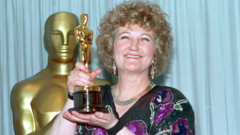
The Academy of Motion Picture Arts and Sciences recognized the fierce truth of that performance, awarding her the Oscar for Best Supporting Actress. When she took the stage, she didn't deliver a rehearsed, polished monologue of false humility. She thanked the real-world mothers who spent their lives doing the invisible work. She remained, as always, anchored to the ground.
The Symphony of the Unseen
Then came the transition that puzzled industry insiders but delighted millions. To go from an Academy Award-winning dramatic triumph to a slapstick family comedy sequence might have seemed like a misstep to purists. But Fricker saw something else in the script of Home Alone 2: Lost in New York. She saw a human soul hidden beneath a pile of rags.
Children watching the film in theaters were initially terrified of her. She was the monster in the attic, the urban legend come to life. Yet, within the span of a single conversation in the orchestra loft of Carnegie Hall, Fricker transformed that terror into a profound lesson in empathy.
The dialogue between her character and a young Kevin McCallister is the actual engine of the movie. It shifts the film from a cartoonish romp about traps and thieves into a meditation on trust, regret, and the fear of a broken heart.
"I was a lot like you," she tells the boy, her voice carrying the dry, cracked texture of someone who hasn't spoken to a human being in years. She explains how she fell in love, how that love ended, and how she decided that it was safer to hide away from the world than to risk being hurt again.
It is an extraordinary scene. Around them, the high-culture wealth of New York continues its festive chatter, entirely oblivious to the two outcasts hiding above the rafters. Fricker balances the absurdity of her pigeon-covered costume with an emotional gravity that grounds the entire movie. She taught an entire generation of children a simple, devastating truth: the people we are trained to ignore are often the ones carrying the heaviest stories.
The Mirror of Solitude
The tragedy of great character actors is that the public often confuses the performance with the person, or worse, assumes the actor remains immune to the very hardships they depict. In her later years, Fricker spoke with a bruising candor about her own life, revealing that the isolation she portrayed so vividly wasn't entirely foreign to her.
She lived quietly in Dublin, accompanied by her beloved dogs. In a series of remarkably honest interviews that caught the public off guard, she spoke about the reality of aging alone. She talked about the silence of the winter holidays, noting how she would turn off the lights and let the days pass, finding comfort in her own routine rather than pretending to participate in a communal joy she didn't feel.
There was no self-pity in these admissions. She wasn't asking for the world to come knocking on her door. She was simply refusing to lie. In an era where every public figure is expected to perform a permanent state of curated happiness, her willingness to say, "Yes, I am alone, and yes, it can be hard," was a radical act of authenticity.
It changed the way people viewed her legacy. The Pigeon Lady wasn't just a character from a beloved childhood movie anymore; she became a symbol for the millions of elderly individuals who navigate the modern world in absolute silence. Fricker used her own platform to shine a light on that neglect, reminding us that the holiday season is often a cruel amplifier of loneliness.
An Uncompromising Exit
The career of Brenda Fricker spanned decades, encompassing brilliant turns in British television dramas like Casualty, independent Australian cinema, and intense theatrical productions. Yet, her impact cannot be measured by a list of credits or the height of a trophy.
Her genius lay in her refusal to compromise on the truth of human flaws. She understood that human beings are messy, contradictions wrapped in skin, often difficult to love but always deserving of dignity. She didn't clean up her characters for the comfort of the audience. If a character was supposed to be tired, you saw the dark circles under her eyes and felt the stiffness in her joints. If a character was angry, that anger had teeth.
Now, the curtain falls. The news of her death at 81 brings a predictable wave of nostalgia, with social media feeds filling with clips of bird seed scattered on snowy pavement and an golden turtle dove ornament handed over as a token of eternal friendship.
Those clips are wonderful, but they only scratch the surface of what she gave us. Brenda Fricker did something far more difficult than making us smile during the holidays. She forced us to look at the margins of our own world. She challenged us to see the brilliance in the impoverished mother, the humanity in the homeless woman, and the value in the quiet spaces of a solitary life.
The next time winter settles over the city, and the wind whips through the trees of a public park, look closer at the figures huddled against the cold. Look at them with the clarity and the fierce compassion that Brenda Fricker spent a lifetime demanding from us.
She has left the bench, but the lesson remains.