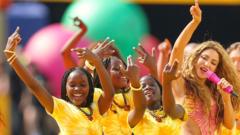
FIFA finally got its American-style spectacle, but the real story of the World Cup final halftime show wasn't the corporate grandeur. It was the calculated mechanics of global street culture rescuing a billionaire sports entity from its own sterile ambitions.
When Spain faced Argentina at the MetLife Stadium in New Jersey, the governing body of football gambled on a historic shift. For the first time, the tournament paused its gold-standard sporting narrative for an Americanized, Super Bowl-style pop concert. Traditionalists recoiled. They argued that the sport does not require the artificial hydration of pop anthems to retain its essence. Yet, as the stadium erupted to the opening notes of the tournament anthem, "Dai Dai," the ideological war vanished beneath a relentless avalanche of rhythm.
At the center of this cultural pivot stood global superstar Shakira and Afrobeat heavy hitter Burna Boy. But the true engine of the performance belonged to a group of young performers who, only years ago, had no predictable path out of the marginalized Katwe neighborhood in Kampala, Uganda.
The Triplets Ghetto Kids stole the largest broadcast event on Earth.
Ten-year-old Sierra summarized the experience to journalists as "very, very, very, very, very good," a quote that circulated as a heartwarming snippet of pure innocence. Behind that child’s hyperbole lies a complex operational reality. The entertainment industry routinely drafts hyper-viral, organic creators to inject authenticity into massive corporate productions. The strategy works because the contrast is so stark. On one side you have FIFA, an institution weighed down by decades of bureaucratic scandals and clinical branding. On the other side you have a group of children whose entire choreographic vocabulary was built on survival, community, and unmanufactured delight.
The Viral Algorithm That Built a Bridge to New Jersey
The journey from the dust of Kampala to the polished grass of New Jersey did not happen through traditional scouting networks. It happened because the entertainment industry now relies on algorithmic lightning to find its structural reinforcements.
Shakira discovered the troupe after watching an improvised dance clip they recorded to her track "Zoo," featured in the animated film Zootopia 2. The singer did not simply admire the clip; she recognized a distinct currency that money cannot engineer. The modern pop machine understands that audiences have developed a profound immunity to highly polished, over-rehearsed studio dance squads. We look at them and we see the labor, the corporate casting calls, and the sterile direction. The Ghetto Kids offer the exact opposite. Their movement is fluid, polyrhythmic, and punctuated by expressions of unfiltered ecstasy that defy the choreography of western pop factories.
Founder Dauda Kavuma, a former math teacher who was orphaned as a child, built the Inspire Ghetto Kids Foundation in 2007 out of raw necessity. He knew the streets of Kampala because he had lived on them. He understood that for a child facing systemic poverty, dance is not a hobby. It is a shield against despair. The foundation currently manages approximately 60 vulnerable or orphaned children, utilizing the revenues generated from international performances to fund housing, nutrition, healthcare, and formal schooling.
Consider the mathematics of their ascent. A video filmed on a smartphone in a Ugandan alleyway accumulates millions of views on TikTok and Instagram. It gets picked up by a multi-platinum Colombian artist. Within months, those same children are sharing a backstage area with Lionel Messi and Lamine Yamal. This rapid hyper-mobility presents a unique set of challenges that traditional child stars rarely face. The cultural gap between the daily realities of Katwe and a high-security holding room at MetLife Stadium is vast. Navigating it requires immense mental fortitude from the children and meticulous protective care from their managers.
The Double-Edged Sword of Global Exposure
Western media loves a modern fairy tale. The narrative of the impoverished child rescued by the benevolent hand of a pop icon is a reliable ratings driver. Industry veterans know that this framing intentionally obscures the uneven transactional nature of the arrangement.
"Never give up... pray to God. Listen to your parents, education is first, that's all," Sierra remarked following the performance, highlighting the grounded philosophy drilled into the troupe by Kavuma.
The wisdom is necessary because the global stage is fickle. The entertainment ecosystem treats viral talent as a renewable resource, often burning through high-energy performers before moving on to the next digital trend. For the Ghetto Kids, the main defense against this cycle is their structural independence. They are an NGO first and an entertainment act second. Every high-profile gig, including their previous breakthrough on Britain’s Got Talent or their collaborations with Chris Brown, serves as a capital injection for their broader community mission in Uganda.
The industry must confront an uncomfortable truth regarding how it values African art. For decades, major international sporting events treated non-Western performers as decorative opening-act filler. By placing the Ghetto Kids and Burna Boy directly into the prime-time slot of the final, FIFA acknowledged that the center of gravity in global pop culture has shifted toward the Global South. The infectious energy of Afrobeat and traditional street dance styles provided the emotional anchor for an event that frequently threatened to become an over-sponsored luxury convention.
The physical demands of a stadium production are brutal. The children underwent rigorous technical rehearsals under heavy lights, adjusting their expansive street style to fit the precise sightlines of television cameras and the acoustic challenges of an open-air sports arena. They had to maintain their signature spontaneity while hitting rigid technical marks.
The success of the World Cup final experiment ensures that halftime concerts are now a permanent fixture of global football tournaments. Future organizers will undoubtedly try to replicate the magic of this inaugural show by booking increasingly complex, multi-million-dollar pop sets. They will likely miss the fundamental lesson of the New Jersey stadium. You can hire the finest lighting designers in the world, build the most elaborate stages, and deploy the most advanced sound systems available to modern engineering. None of it matters if the performance lacks a soul. The billion-dollar sports apparatus did not elevate the children from Kampala; the children from Kampala gave the billion-dollar sports apparatus a fleeting moment of genuine humanity.