You have walked past them a thousand times.
On damp garden paths, clinging to rough stone walls, or half-buried beneath the mulch of a neglected flowerbed, they exist in plain sight. Most people see only a moving piece of debris—a stray pine needle, a tiny fragment of dry leaf, or a random speck of dust shifting across the concrete.
Stop. Look closer.
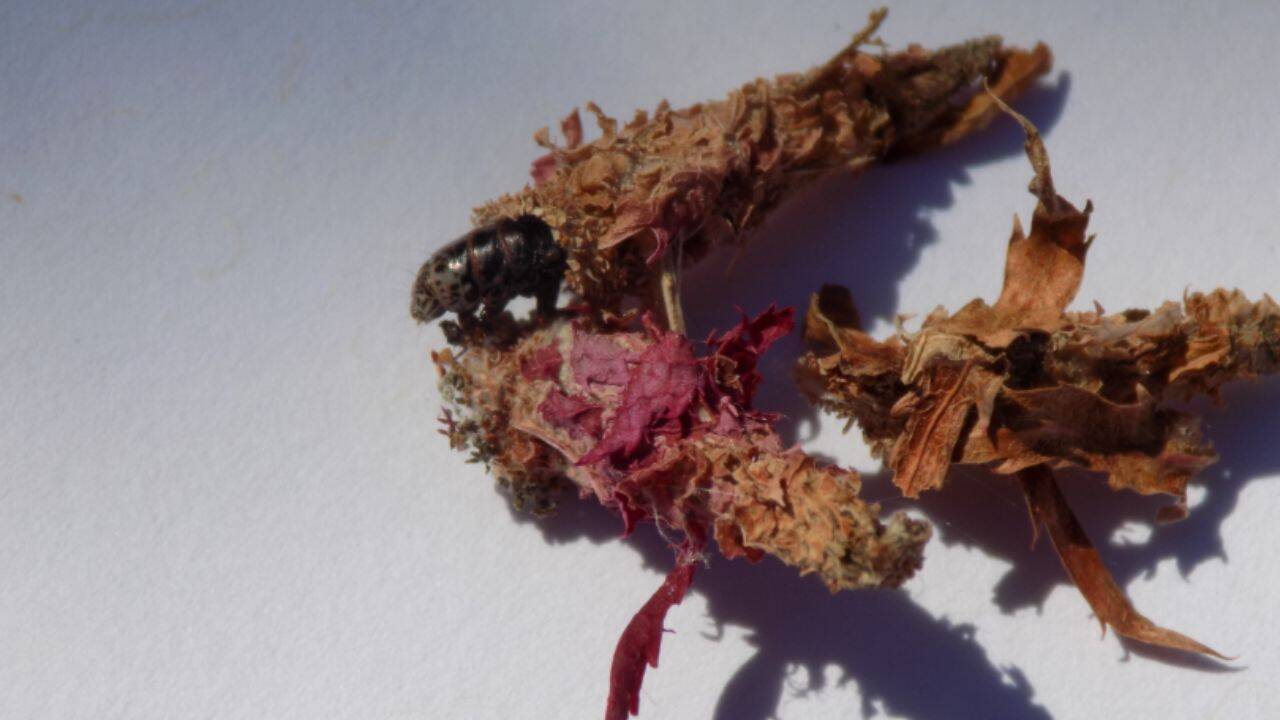
Beneath that camouflage beats a tiny, frantic life. This is the bagworm moth caterpillar, an architect of the micro-world that builds a mobile fortress before it even learns how to navigate the hazards of a lawn.
Consider what happens next: a creature no longer than a fingernail constructs a sanctuary entirely out of silk and foliage, locking itself inside a snug, tapered cone. It does not build for comfort. It builds because the alternative is extinction.
The First Thread
Life begins high on a branch, hatched from a cluster of eggs left behind by a female who never truly left her own shell. Almost immediately, the newborn larva faces a hostile environment. Birds wheel overhead, ants march with predatory purpose, and sudden gusts of wind threaten to cast it into the void.
It responds with chemistry.
From specialized glands near its mouth, the tiny caterpillar spins a thread of silk tougher than steel by weight. It binds fragments of leaves, twigs, and bark together, weaving a protective sleeve around its soft abdomen.
Imagine wearing your house on your spine. Every step requires dragging the dead weight of your own home across hostile terrain.
This is not a metaphor. For the bagworm, the case is an anatomical extension. It anchors its tail end to the interior lining of the silk tube, leaving its head and thoracic legs free to protrude from the front door. It walks forward while hauling its entire shelter behind it, a miniature hermit moving through an urban jungle of grass blades.
The Anatomy of Defense
Why go to such lengths?
Nature is relentlessly hungry. To a passing robin or bluejay, a bare caterpillar is a soft, protein-rich snack. But a bagworm inside its organic armor looks like nothing more than random yard waste. Predators pass it by, deceived by the masterclass in mimicry.
When danger strikes—a shadow falling over the leaf, or the heavy vibration of a passing foot—the response is instantaneous. The caterpillar retreats entirely within, pulling the flexible collar of the silk bag tightly shut.
Inside, the environment is humid, dark, and safe.
Yet this mobile architecture comes with a heavy tax. Energy spent dragging a heavy load is energy not spent on growth. Every fragment of leaf added to the exterior must be carefully measured, bitten to size, and secured with fresh silk threads. The case grows as the animal grows, expanding in a widening cone that mirrors the shape of its occupant.
We forget how fragile survival is. We walk through manicured parks, entirely unaware of the silent, desperate engineering projects unfolding inches from our shoe leather.
The Trap of Stability
There is a strange tragedy written into the biology of the bagworm, particularly among the females.
While male bagworms eventually undergo complete metamorphosis, sprout wings, and abandon their cases to seek out mates in the twilight air, the females take a different evolutionary path. They never leave. They pupate, mature into wingless, legless adults that resemble pale grubs, and remain inside the very silk homes they built as larvae.
They live their entire lives within the walls of their childhood architecture.
When mating occurs, the male must insert his abdomen through the open bottom of the female's case. The eggs are laid inside that same protective chamber. When the next generation hatches, they must chew their way out of the maternal tomb to begin the cycle anew.
Security has a ceiling. The very walls that protect against the outside world eventually become a boundary that cannot be crossed.
The Human Mirror
Why does this tiny insect captivate us? Because beneath the microscopic scale, the narrative feels uncomfortably familiar.
We all build bags.
We construct identities, routines, and physical spaces designed to shield us from the unpredictable storms of existence. We pull our professional achievements, our social circles, and our habits around us like a tailored silk cone, hoping that the world will mistake our armor for our actual worth.
Sometimes, the load gets too heavy. We drag our past mistakes, our accumulated debris, and our defensive postures across every room we enter, wondering why moving forward feels so exhausting.
The bagworm does not question its burden. It simply grips the next twig, anchors its silk, and pulls.
Look down the next time you walk through the garden. If you spot a small, leaf-shrouded cone twitching against the grain of the wind, do not brush it aside. Recognize the immense, quiet labor required just to stay alive in a world that wants to consume you.
The architecture holds. For now.