Water keeps its own counsel.
When you stand on the bank of a sprawling midwestern river, watching the current churn a muddy brown, you are looking at a surface that surrenders nothing. You see the ripples. You see the drifting autumn leaves caught in a temporary eddy. You do not see the ancient machinery moving silently in the dark. You do not see the ghosts.
Consider what happened on a sharp, biting morning in 2007.
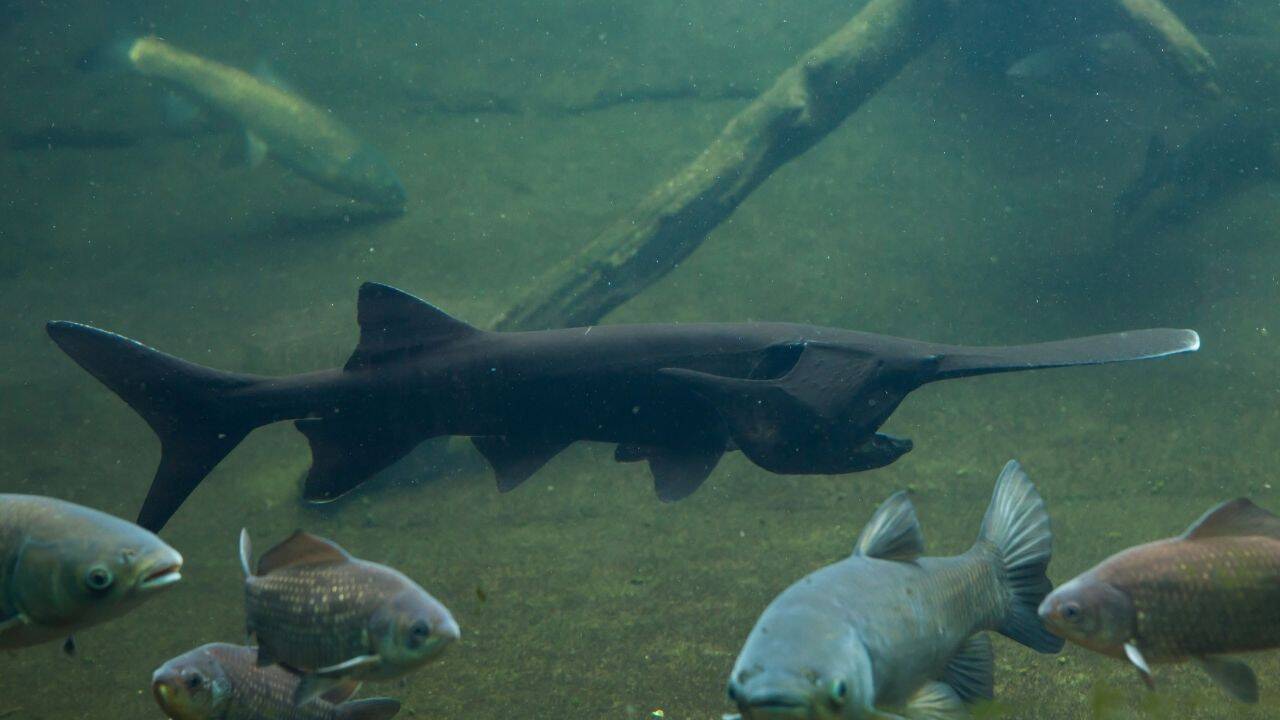
Biologists were out on the water, working with heavy nets and low-humming motorboats. Their hands were calloused, smelling of river mud and cold neoprene. They hauled up a creature that looked less like a fish and more like an artifact from a forgotten epoch. It had a long, paddle-shaped snout, a slate-gray body, and an ancient, unblinking eye.
It was a paddlefish. A living fossil. A survivor of a lineage that predated the dinosaurs.
They weighed it. Eighty-seven pounds.
In the grand, frantic calculus of human life, an 87-pound fish is a data point. A line on a clipboard. A note in a field journal filed away in some university basement. The researchers measured its length, tagged its fin with a small, discreet identifier, and lowered it back into the green-black depths. The splash faded in seconds. The river swallowed it whole. The men packed up their gear, drank lukewarm coffee from dented thermos cups, and drove home to their families.
Life marched on. Empires wobbled. Economies crashed and rebuilt. Children grew into adults.
And down there, in the cold pressure, the paddlefish kept swimming.
Time works differently underwater. Down there, there are no calendars. No glowing smartphone screens reminding you of unanswered emails. There is only the eternal push of the current, the seasonal shift of water temperature, and the endless, rhythmic sweep of that bizarre snout sensing the microscopic pulses of zooplankton in the gloom.
Eighteen years.
Think about what you did over the last eighteen years. You changed jobs. You fell in love, perhaps. Maybe you lost someone who mattered. You aged. Your joints started to ache when the humidity dropped. Your face gathered lines of worry and laughter.
The fish just swam.
It swam through spring floods that turned the river into a roaring highway of debris. It swam through blistering summer droughts where the water thinned and warmed. It swam through freezing winters when a crust of ice sealed the surface from the sky.
And it grew.
Not much. Growth slows down when you are already a giant of your domain. But it ate. It filtered the microscopic life of the river through its massive gills, day after day, night after night, in a silent, unbroken meditation of survival.
Then, eighteen years later, the nets came up again.
Biologists—perhaps younger now, perhaps carrying the gray hair of their own passage of time—pulled that same tagged creature from the water. They checked the old serial number against weathered logbooks. They hoisted it onto the scale.
Ninety-eight pounds.
Eleven pounds gained across nearly two decades. A slow, agonizingly patient accumulation of life.
We live in an era obsessed with velocity. We want our internet fiber-optic fast. We want our wealth compounded quarterly. We want our self-improvement packaged into thirty-day challenges. We look at our own lives and panic if we aren't scaling some invisible mountain every single month. We demand drastic transformations. We demand reinvention.
The paddlefish teaches us a different kind of math.
It reminds us of the power of simply enduring. Of staying in the current. Of eating, breathing, and moving forward, even when the progress is so minuscule that it takes twenty years of history to measure it on a scale.
Most of us are terrified of stagnation. We confuse stillness with death. We run ourselves ragged trying to prove our worth through constant, visible motion. Yet, the oldest, most resilient things on this planet are remarkably quiet. They don't announce their growth. They don't post about their milestones. They just absorb the nutrients of their environment and let the years stack up like rings on a hidden tree trunk.
When that 98-pound fish was slipped back into the current, it didn't celebrate. It didn't pause to marvel at its own longevity. It gave a single, powerful flick of its broad tail and vanished into the murky green, leaving the researchers standing on the deck of their boat, staring down at the water in a kind of hushed reverence.
They had gone out to catch fish. Instead, they had caught a glimpse of eternity.
The river is still flowing. The current is still cold against the scales. Somewhere down in the dark, an ancient shape moves through the silt, heavier by eleven pounds, carrying a little piece of human history strapped to its fin, swimming steadily toward whatever comes next.