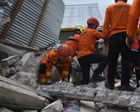
When the rescue of 84-year-old Paulina Pobi made headlines, the narrative centered on a miracle. Found alive after three days buried under the bamboo remains of her home in the village of Nitunglea, her story serves as a convenient focal point for an otherwise grim report from the Indonesian island of Flores. While onlookers celebrate the human spirit, the reality of the 7.7-magnitude earthquake that struck on Saturday is far less miraculous and significantly more systemic.
The survival of a paralyzed elderly woman in a collapsed structure is not a triumph of disaster response. It is a statistical anomaly that masks the profound failures in how remote communities endure the Pacific Ring of Fire. Pobi survived because her family, operating under the mistaken belief that she had already been evacuated, eventually returned to their home to search. Her rescue was a private act of persistence, not the result of a coordinated government relief operation.
Infrastructure across this region remains dangerously ill-equipped for seismic events of this magnitude. When the earth shifts, the bamboo and timber housing common in rural Flores tends to compress rather than shatter. This specific material quality likely prevented Pobi from being crushed instantly. However, the same topography that defines the island—steep, mountainous, and prone to geological instability—also serves as a barrier to aid. A landslide triggered by the initial tremor effectively isolated Nitunglea, turning a village into a pocket of silence while the official death toll climbed toward 73.
The delay in reaching survivors highlights a recurring flaw in disaster management. Official agencies report that nearly 400 tonnes of supplies have been distributed, yet these figures often obscure the granular reality on the ground. Aid is easy to count when it arrives at a port or a main regional center; it is notoriously difficult to track when it must navigate destroyed roads and blocked mountain passes. Relying on military aircraft and ships is a reactionary measure, used only after the window for immediate life-saving has begun to close.
Thousands of aftershocks have rattled the region since the primary quake. At least 86 of these were intense enough for residents to feel, creating a state of perpetual psychological trauma. Nearly 60,000 people remain displaced, many huddled in temporary shelters or simply sitting in the open, terrified to return to what remains of their property. For these survivors, the primary issue is not just physical survival, but the total dissolution of their daily safety. When shops and grocery stores begin to reopen amidst the wreckage, it is a sign of economic desperation rather than stability.
Experts have known for decades that the seismic geography of Indonesia requires a decentralized response framework. A centralized agency like the BNPB can facilitate massive logistics, but it cannot replace the immediate, local capacity needed to pull a person from rubble within the first forty-eight hours. By the time regional officials were coordinating search efforts, families were already digging through the debris of their own lives.
The focus on a single survivor is an effective way to generate headlines, but it diverts attention from the 900 people injured and the thousands who lost everything. The "miracle" label is a comfortable sedative for a public that prefers stories of individual fortune over the difficult systemic changes required to protect vulnerable populations in one of the most volatile regions on earth. If the cycle of tragedy is to be broken, the discourse must shift from the one person who survived against the odds to the many who were never afforded that same chance.