Saltwater stings. It finds every micro-abrasion on your knuckles, every tired muscle fiber, and it settles in with a stubborn bite. I remember the weight of the old timer's hand on my shoulder back in the late nineties, pointing out toward the Atlantic horizon off Miami Beach where the water flattened out into an empty, glaring blue.
Nothing out there. Just miles of sand. Underwater desert.
We had taken our slice of the ocean and paved it with indifference. Decades of dredging, anchoring, and coastal construction had turned vibrant, undulating ecosystems into flat, lifeless expanses. Fish had nowhere to hide. Coral had nowhere to anchor. The sea, for all its terrifying magnitude, was starving for architecture.
Then came the winter of 1998.
(Note: The following historical account of the 1998 deployment is drawn from marine conservation archives and local fisheries data.)
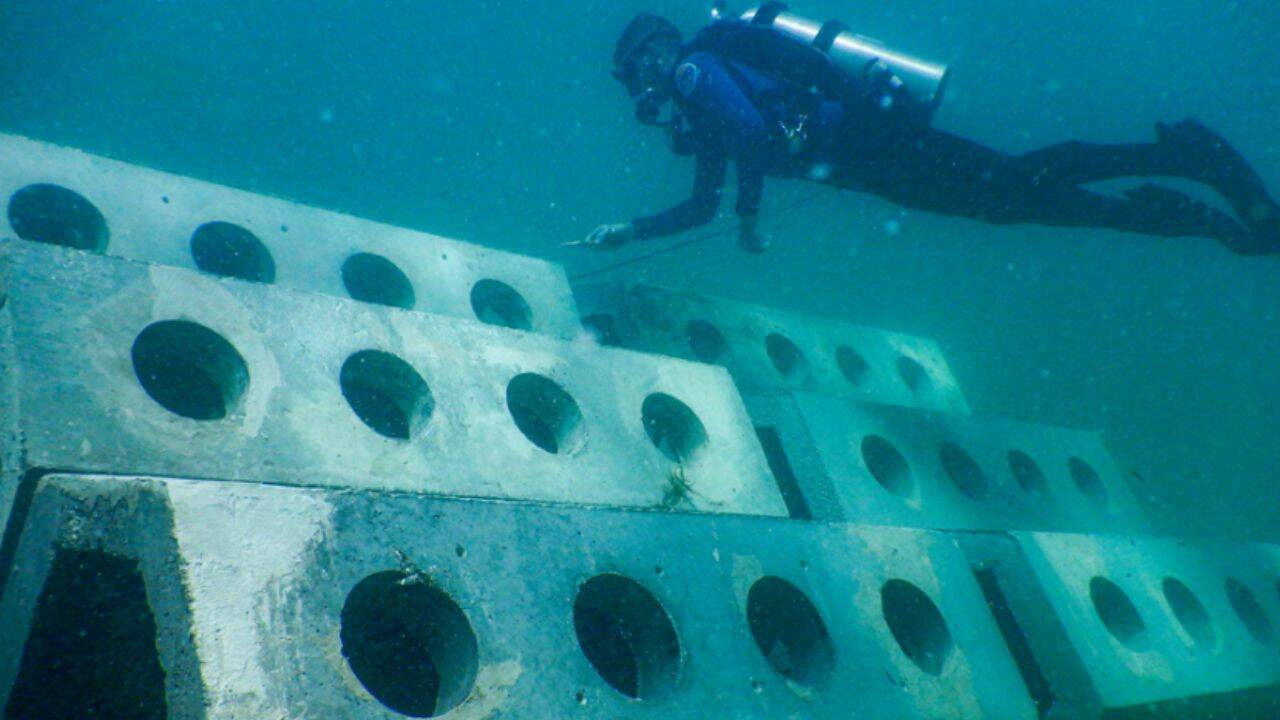
Cranes groaned against the salt air. Barges hauled heavy, uncompromising shapes to the drop zone. Twelve artificial reefs, weighing tons apiece, slipped beneath the surface and settled into the dark sediment three miles offshore.
Skeptics laughed. They looked at the limestone blocks, the salvaged bridge materials, and the specialized concrete pyramids and called them garbage dumps disguised as conservation. Bureaucrats shrugged. Fishermen grumbled that the government was just dropping oversized paperweights into the deep.
They were wrong.
Consider what happens next when you give nature a foothold.
Within months, the sterile concrete began to soften. Microscopic algae arrived on the currents, painting the gray slabs in velvety rusts and greens. Barnacles staked their claim. Spores settled. A city was rising in the dark, built not with mortar and ambition, but with time and tide.
By the turn of the century, the transformation defied expectation.
Local fish numbers skyrocketed. Species richness, that complex biological metric of how many different kinds of life can share a single neighborhood, multiplied beyond initial baseline projections. Groupers found shadowed archways to call home. Snapper swarmed the vertical columns like winged insects around a streetlamp. Schools of baitfish spun silver ribbons through the artificial alleyways, drawing barracuda, sharks, and pelagic wanderers that had abandoned these depleted shores generations ago.
It was a resurrection.
Think of an artificial reef not as a manufactured object, but as a scaffold for survival. In a marine environment stripped of natural hard bottom habitats, a flat sandy bottom is a desert highway where prey has nowhere to duck from predators. Drop a three-dimensional maze of concrete onto that plain, and you change the physics of the neighborhood. You create current breaks. You create feeding stations. You create safety.
(As a hypothetical scenario to illustrate the ecological chain reaction, imagine a single juvenile Goliath grouper drifting past a barren sandbar—doomed, exposed, exhausted. Now drop that same fish into the 1998 deployment zone. Within ten feet, it finds a jagged limestone cave. Within a week, it has a territory. Within a decade, that two-pound juvenile is a three-hundred-pound leviathan guarding its domain.)
The local charter captains noticed first. They stopped burning extra fuel running twenty miles further offshore to find a decent bite. The fish were right there, hovering over the sunken monuments. Divers began trading the distant keys for the local blue, discovering vibrant ecosystems thriving just a short boat ride from the neon strip of South Beach.
Science validated the intuition. Long-term monitoring of those twelve original structures proved that artificial reefs do not merely attract fish from other areas; they boost overall biomass. They are nurseries. They are population multipliers.
Yet, we remain stubbornly slow to learn our own lessons.
We still look at the ocean as an infinite sink, a place that can absorb endless punishment without consequence. We still build seawalls that destroy the very shorelines they claim to protect. We still forget that if you build the foundation, life will figure out how to fill the rooms.
The twelve reefs off Miami Beach are still down there. They are older now, heavily encrusted with stony corals and gorgonians, looking less like human engineering and more like ancient ruins swallowed by the deep. Generations of marine life have been born, hunted, spawned, and died within their labyrinthine walls.
Out on the water tonight, the surface is black and smooth as glass. Underneath, in the absolute quiet of the Atlantic, a thousand silver eyes are blinking in the shelter of concrete we dropped twenty-eight years ago, waiting for the tide to turn.