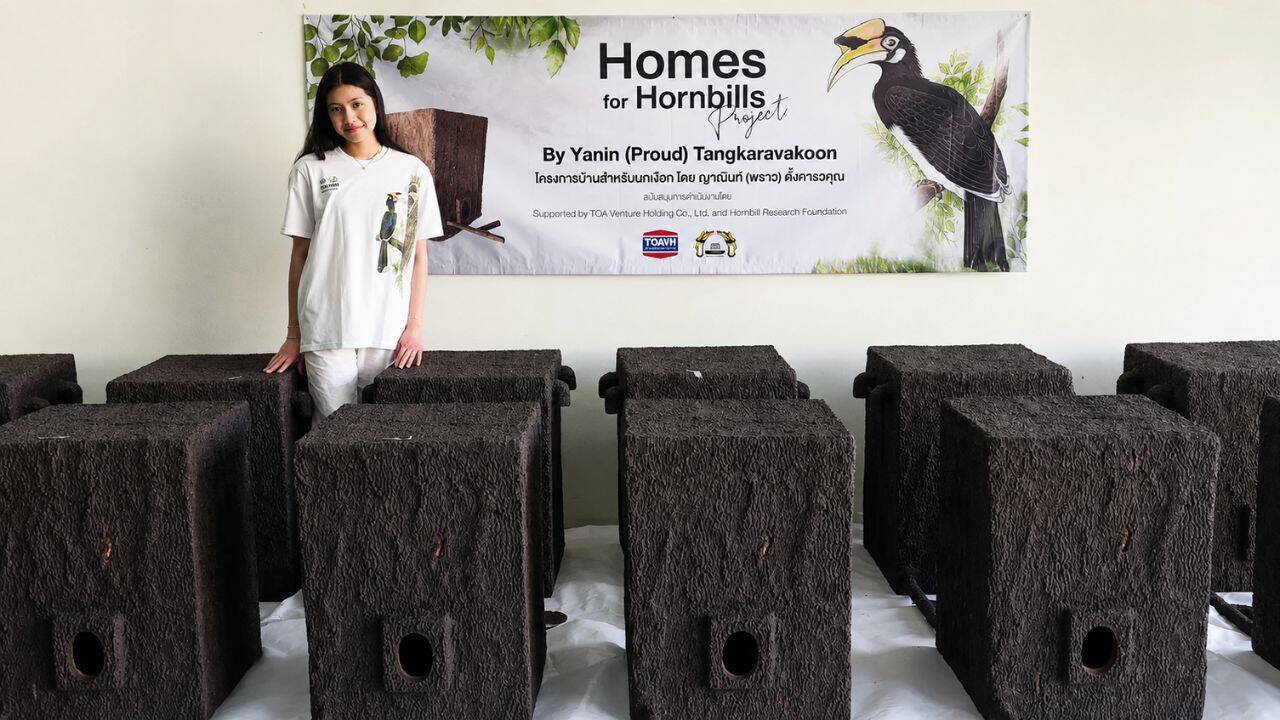
Big conservation problems usually get massive budgets, slow committees, and very little action. While adults sit in air-conditioned rooms arguing over policy, teenagers are actually fixing things. Take Korn, a 17-year-old student from Thailand who looked at a dying bird population and a pile of garbage, then decided to solve both at the same time.
Hornbills are struggling. These large, distinct birds depend on mature tree hollows to raise their chicks. Deforestation has stripped away their natural nesting sites, leaving breeding pairs with nowhere to go. Most conservationists try to plant trees, which is great, except trees take decades to grow. Hornbills don't have decades. They need a home right now.
Instead of waiting for a forest to sprout, this young Thai innovator looked at discarded plastic water jugs and packaging materials sitting in local landfills. He realized that modern waste has properties nature can't replicate easily. It is durable, weather-resistant, and entirely free.
The Reality of Hornbill Conservation
If you've never spent time deep in the tropical forests of Southeast Asia, you might not grasp how fragile these ecosystems are. Great hornbills and their smaller cousins act as the farmers of the jungle. They eat massive amounts of fruit across wide territories, flying miles a day and dropping seeds everywhere they go. When hornbills disappear, the forest composition changes completely. Trees that rely on them for seed dispersal stop growing.
The trouble is that finding a natural nest hole isn't just about stumbling across an old tree. The cavity has to be high enough off the ground to deter predators like snakes and civet cats. It needs the right internal dimensions for the female, who walls herself inside the nest using mud and droppings during the entire incubation period, leaving only a tiny slit for the male to pass food through.
Building artificial hornbill nests from plastic isn't just a craft project. It requires an understanding of avian biology, thermal dynamics, and structural engineering. If an artificial nest gets too hot under the tropical sun, the chicks cook. If it lets water pool inside, the eggs drown.
Korn tested various polymer compositions and thicknesses. He figured out how to insulate the plastic containers using local organic materials so the internal temperature mimics a real tree trunk. He designed ventilation channels to keep the air moving. That level of detail separates a science fair gimmick from a real ecological intervention.
Why Plastic Upcycling Beats Traditional Methods
We hear plenty about plastic recycling programs, but most of them are inefficient or outsourced to places that burn them. Turning single-use plastics into structural wildlife habitat bypasses the broken municipal recycling stream entirely.
Traditional artificial nests are often carved from heavy wood or cast in concrete. Wood rots quickly in tropical humidity and is heavy to haul up a fifty-foot tree. Concrete is entirely too heavy for forest canopy deployment and bakes in the sun.
Plastic is lightweight. Volunteers can carry three or four artificial hornbill nests on their backs while trekking through dense brush. Hoisting them into the canopy requires pulleys and ropes, but keeping the weight low makes the installation safer for everyone involved.
What Goes Into Building a Nest
You can't just slap a plastic tub on a branch and call it a day. The process demands patience and field testing.
- Sourcing high-density polyethylene containers that won't degrade under harsh ultraviolet radiation.
- Molding the interior with rough textures so young birds can grip the walls when they start flapping their wings.
- Coating the exterior in non-toxic, earthy paints to camouflage the structure from poachers and predators.
- Creating a modular entry slit that mimics the exact dimensions wild hornbills prefer.
Local wildlife authorities have taken notice. When a teenager out-innovates multi-million dollar conservation grants using trash, people pay attention. Field biologists started monitoring these plastic nests, recording breeding pairs moving in, laying eggs, and successfully raising chicks.
Taking Action in Your Own Backyard
You don't need to live in Thailand or worry about tropical rainforests to make a difference. Every local ecosystem has a specific bottleneck holding back its wildlife. Maybe it's a lack of bat boxes, native pollinators starving because of manicured lawns, or amphibians losing wetland breeding pools to local runoff.
Look at the waste stream in your own community. Plastic bottles, broken pallets, and scrap metal are often viewed as nuisances when they could be raw materials for habitat restoration.
Stop waiting for someone else to fix the environment. Conservation starts the moment you stop complaining about a broken system and start building a better alternative with whatever is right in front of you. Go find a problem, grab some tools, and get to work.