The desk lamp hums. Outside, the night settles over a Florida estate with the heavy, unblinking stillness of a swamp. Inside, an eighteen-year-old sits surrounded by textbooks, perhaps scrolling through a feed or finishing an assignment on political theory. He is tall, impossibly tall, navigating the awkward, ordinary threshold between adolescence and whatever comes next.
He is eighteen. He likes soccer. He keeps his head down.
And somewhere thousands of miles away, across oceans scarred by rhetoric and transactional bloodlust, a digital broadcast flickers to life. A studio light hits a polished desk. A banner rolls across a screen in Arabic and English, bearing a crude digital calculation: a ten-million-dollar bounty. Attached to the price tag is his face.
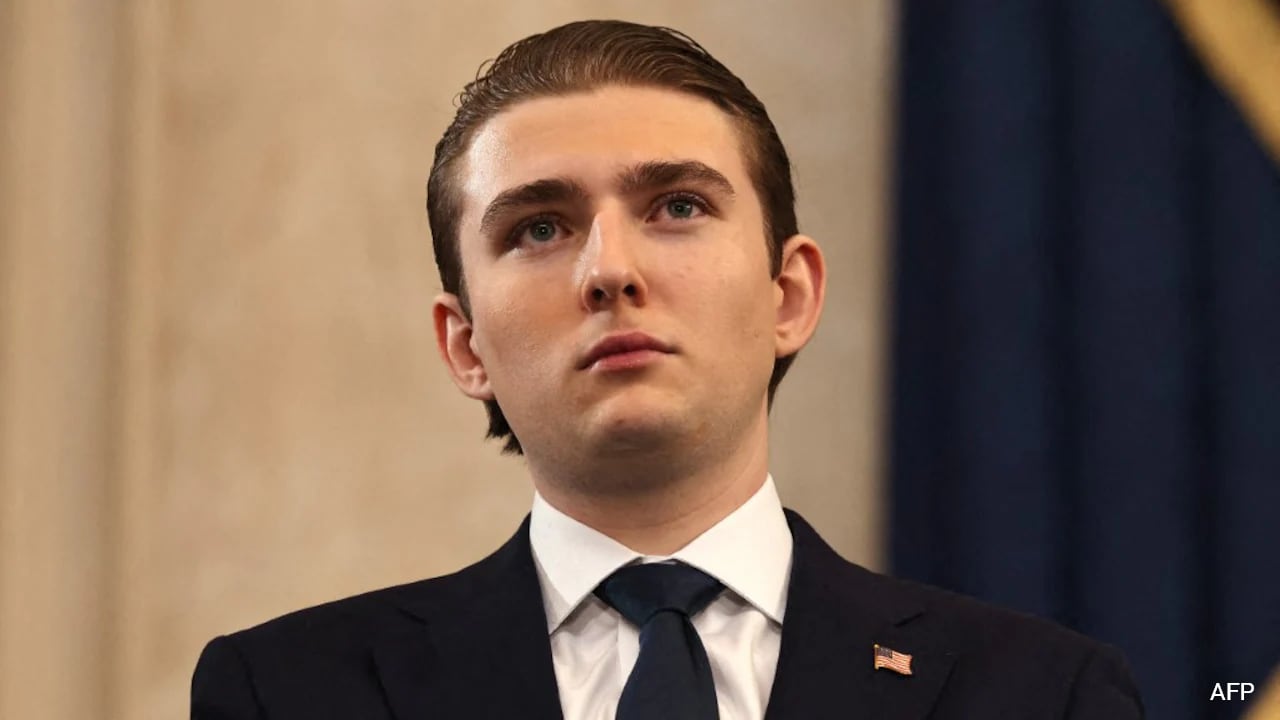
Barron Trump.
We live in an era where the collateral damage of power has expanded its radius to include the innocent bystanders of bloodline. For years, the children of public figures have occupied a strange, unwritten demilitarized zone. They were the punchlines late at night, occasionally the targets of clumsy op-eds, but they were rarely dragged onto the international chessboard as tactical leverage. That unwritten treaty has just been shredded.
Consider the mechanics of modern digital intimidation. It does not require an army. It requires only an algorithm, an internet connection, and a desperate desire for visibility. When state-affiliated or extremist media networks in Tehran broadcast threats featuring the youngest son of the American president-elect, they are not merely engaging in political posturing. They are weaponizing ubiquity. They are transforming an ordinary college student into a geopolitical hostage, reducing a human life to a bargaining chip in a game played by men who will never look him in the eye.
The footage itself is chillingly pedestrian. It relies on the cheap aesthetics of a low-budget action movie—grainy stock footage, ominous sound design, a red crosshair superimposed over high-school photographs and college campus snapshots. It looks fake until you remember the internet has no firewall against malice. A threat made on a screen can summon a knife in the real world.
Fear is a quiet thing. It does not always arrive with sirens. Sometimes it is just the sudden realization that every walk across a quad, every casual trip to a coffee shop, every open window carries an invisible asterisk.
How do you protect someone whose existence is entirely unchosen?
This is the central tragedy of modern celebrity and political lineage. Barron Trump did not run for office. He did not draft executive orders, sign legislation, or step behind a podium to incite a crowd. His primary offense was simply being born into a family whose name acts as a lightning rod for the world's collective rage. Every public figure knows the bargain: you trade your privacy for influence. But children do not sign that contract. They are handed the pen by birthright and told to navigate the fallout.
The broadcast from Iran is a symptom of a broader, sickening rot in our global discourse. We have abandoned the ancient, fragile social contract that sought to shield non-combatants—specifically children—from the direct crossfire of political vengeance. When the boundaries between politicians and their families dissolve, we enter a state of total ideological warfare where no one is a civilian anymore.
Look at the silence that usually follows these announcements. It is not a peaceful silence; it is the held breath of a security apparatus scrambling behind closed doors. Secret Service details are adjusted. Routes are altered. The geometry of a young man's daily life is compressed, narrowed down to armored vehicles and secure corridors. The world shrinks until it is just a cage made of precaution.
There is a profound cruelty in watching a generation grow up under the glare of digital crosshairs. We have digitized the village square, but instead of sharing news, we have armed the mob. Every smartphone is a potential surveillance device. Every social media comment section is a potential radicalization incubator.
Yet, beneath the terrifying headlines and the diplomatic posturing, there is a stark human reality that deserves our attention. It is the reality of a teenager trying to study while his name is trending on foreign news networks for all the wrong reasons. It is the stark, sobering reminder that political hatred does not stop at the ballot box. It trickles down, finding the softest targets, testing the limits of how much cruelty a family can be forced to endure.
We must ask ourselves what kind of world we are normalizing when a ten-million-dollar bounty on a teenager’s head is treated as just another news cycle. If we shrug and scroll past, if we accept this as the inevitable tax of high office, we are surrendering the last remnants of our collective humanity.
The lamp still hums in the Florida night. The books are still open. The world outside is loud, angry, and unpredictable, filled with voices that wish him harm for sins he never committed. But inside that room, the fight to hold onto a normal life continues, quiet and defiant, against an encroaching storm.