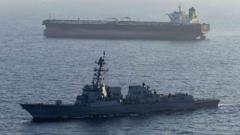
When the Islamic Revolutionary Guard Corps launched multiple ballistic missiles toward regional installations at 5:45 p.m. ET, standard news wires immediately framed the event through the tired lens of sudden escalation. This reading misses the structural mechanics at play. An analysis of the recent missile volley targeting American positions in Jordan and surrounding nodes reveals not an erratic provocation, but a calculated stress-test of multi-layered air defense economics.
To evaluate this event properly, observers must strip away political theater and look at three core variables: kinetic expenditure ratios, warning-time telemetry, and signaling doctrine within asymmetric attrition conflicts. Expanding on this topic, you can also read: The Anatomy of State Capture: Peru Under Fujimori.
The Cost Function of Modern Interception
The central reality of the recent strike is the stark economic asymmetry governing modern missile defense. When a state actor fires ballistic assets across international borders, the defending coalition relies on high-tier interceptor batteries. Each successful interception—as confirmed by United States Central Command—requires the expenditure of precision-guided counter-air assets whose unit costs dwarf the production cost of the incoming threat vectors.
This creates a structural vulnerability independent of tactical success. Even when a defense network achieves a 100% interception rate, the long-term cost function heavily favors the aggressor. The recent operation serves as a recurring data point in a broader war of attrition designed to measure supply chain depth. Tehran does not need ordnance to impact physical targets to achieve strategic value; it forces the continuous burn of finite interceptor inventories maintained by Western coalition partners in theater. Observers at BBC News have provided expertise on this trend.
Telemetry and the Myth of the Surprise Attack
Describing the volley as an attempted surprise attack misunderstands the physics of modern long-range rocketry. Solid and liquid-fueled ballistic missiles launched from western Iran toward the Levant or the Arabian Peninsula must traverse high-altitude arcs detectable by space-based infrared early-warning systems within seconds of ignition.
The timeline of the event indicates several operational realities:
- Boost-phase detection: Overhead persistent infrared satellites immediately register the thermal plume of multi-stage missile boosters.
- Vector calculation: Ground-based radar networks instantly compute ballistic trajectories, narrowing down the target footprint long before re-entry.
- Post-launch window: Defenders possess a functional window ranging from several minutes to upwards of ten minutes depending on the precise launch azimuth, rendering true tactical surprise nearly impossible against fortified positions.
Given these variables, the operation functioned less as an effort to achieve tactical surprise and more as a systems diagnostic. The launchers served as active probes designed to map radar illumination frequencies, response latencies, and battery reloading cycles under live-fire conditions.
The Signaling Matrix in Post-Pause Operations
The timing of the volley immediately follows a declared pause in direct exchanges, turning the operation into a distinct diplomatic signal executed through kinetic means. In state-level deterrence theory, intermittent strikes following a declared de-escalation window represent a mechanism for testing internal command-and-control cohesion within rival military hierarchies.
The Islamic Revolutionary Guard Corps operates with a degree of operational autonomy from conventional diplomatic apparatuses in Tehran. Striking out during a delicate diplomatic posture signals internal friction or a deliberate strategy by hardline factions to establish a new baseline of acceptable friction. By forcing an immediate return to high-readiness postures across regional command nodes, the orchestrators of the strike tested the speed at which American forces transition from a posture of watchful waiting back to active combat operations.
Strategic Implications for Regional Asset Distribution
The reliance on fixed installations in Jordan and neighboring countries creates an enduring vulnerability when facing state actors capable of massing ballistic missile fires. Fixed military infrastructure operates at a permanent disadvantage against mobile TEL (Transporter Erector Launcher) systems hidden within mountainous interior terrain.
Defenders face a narrow set of strategic choices moving forward:
- Decentralizing tactical air assets to reduce the surface area and value concentration of single-base targets.
- Accelerating the deployment of directed-energy or alternative low-cost interception mechanisms to alter the current unfavorable cost-per-kill ratio.
- Shifting the deterrent threshold from reactive terminal defense to preemptive disruption of launch infrastructure at the source.
The recent volley demonstrates that the baseline of regional instability has shifted permanently toward automated, high-tempo missile exchanges. The metric of success is no longer whether an attack can be prevented entirely, but how efficiently a coalition can absorb repeated low-cost provocations without exhausting strategic inventories.