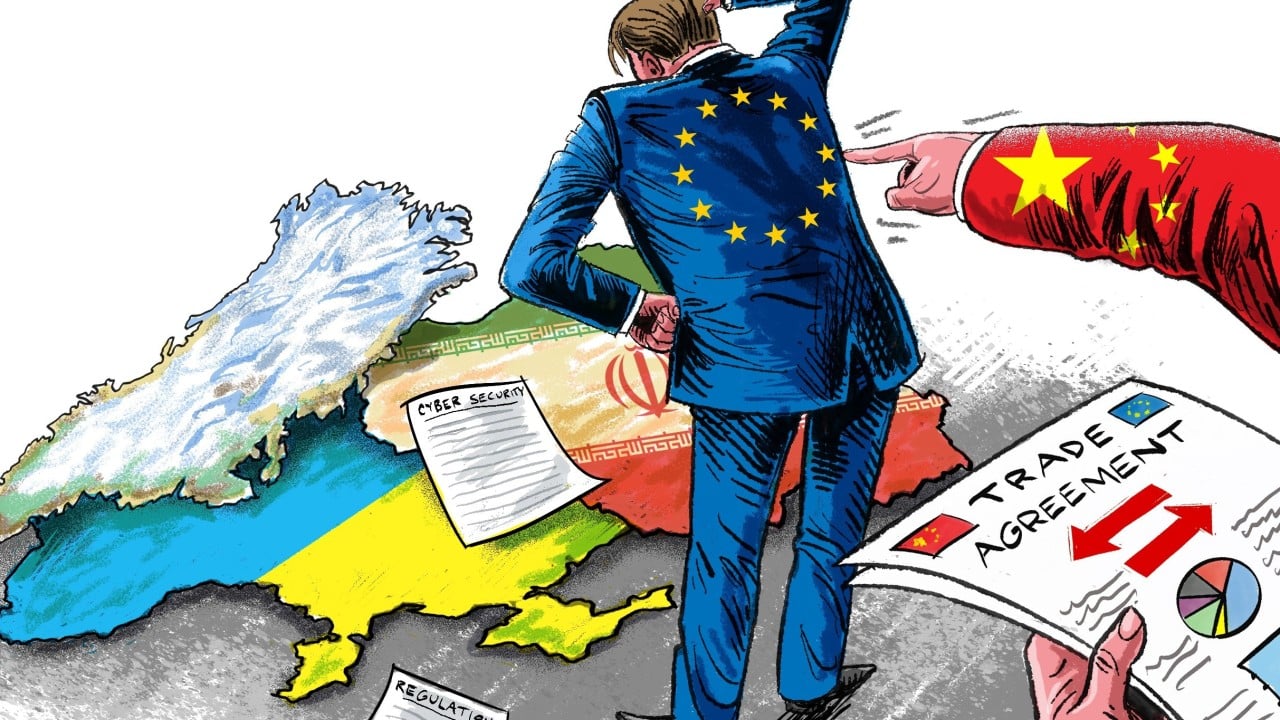
Europe doesn't know what it wants from China. That's the blunt reality facing Brussels right now. While Beijing operates with a hundred-year plan and a unified command structure, the European Union is currently a collection of twenty-seven different agendas masquerading as a single trade bloc. If you're wondering why European leaders keep flying to Beijing only to return with vague promises and no concrete concessions, this is the reason. You can’t win a game when your teammates are playing three different sports at the same time.
The core of the problem is a lack of internal consensus. Germany needs to sell cars. France wants to protect its luxury brands and farmers. Lithuania wants to stand up for democratic values in Taiwan. These goals often pull in opposite directions. Until the EU decides whether China is a vital customer, a systemic rival, or a necessary partner for the green transition, the negotiating table will remain lopsided.
The Divided House of Brussels
Look at the way individual nations handle Beijing. One week, you see a head of state bringing a massive business delegation to sign deals for airplanes and pork. The next week, a different leader gives a speech about "de-risking" and cutting dependencies on Chinese supply chains. It's confusing for everyone involved, especially for the Chinese leadership. They see these fractures and use them. They know that if they pressure one member state, others might stay quiet to protect their own trade interests.
Think about the electric vehicle (EV) situation. The EU launched an anti-subsidy investigation into Chinese EVs, which led to tariffs. But the response from member states was far from a united front. Germany, home to Volkswagen and BMW, was terrified of retaliation. Spain and France were more supportive of the measures. This public bickering makes the EU look weak. It signals that the "union" part of the European Union is optional when things get tough.
China isn't just one big factory anymore. It’s a leader in high-tech sectors like batteries, solar panels, and artificial intelligence. Europe used to hold the cards because it had the technology China wanted. Now, in many green-tech sectors, the roles have reversed. Europe needs Chinese batteries to meet its climate goals. That creates a massive point of tension. How do you play hardball with the person who sells you the engine for your car?
The De-risking Myth
You've probably heard the term "de-risking" a thousand times lately. It sounds smart. It sounds safe. Basically, it means reducing reliance on China for critical goods without totally cutting ties. But in practice, it’s incredibly messy. Most European companies don't actually know how much of their supply chain starts in China. A product might be "Made in Poland," but if the twenty components inside it come from Shenzhen, the risk is still there.
European businesses are stuck in a hard place. They see the huge market potential in China, but they also see the political winds shifting. The European Commission is pushing for more domestic production. Yet, building a factory in Europe is expensive and slow compared to the speed of Chinese manufacturing. Many CEOs are quietly telling politicians to back off because their quarterly profits depend on Chinese consumers.
I've seen this play out in the solar industry. Europe had a thriving solar manufacturing sector fifteen years ago. It got wiped out by cheaper Chinese imports. Now, Europe wants to rebuild that industry, but it’s nearly impossible to compete on price. If the EU puts up massive trade barriers, the price of solar panels goes up, and the green transition slows down. If it doesn't, the remaining European factories close. There's no easy win here.
Playing the Long Game
Beijing understands the European psyche better than Europe understands the Chinese one. Chinese negotiators are patient. they're willing to wait out an election cycle because they know the people they're talking to today might be out of office in four years. European policy is often dictated by the next vote or the latest polling data. This creates a fundamental mismatch in strategy.
To get what it wants, Europe has to stop acting like a group of shoppers and start acting like a superpower. That means making hard choices. It might mean telling German carmakers that they have to accept some pain in the short term to ensure long-term security. It might mean France giving up some of its protectionist tendencies to allow for a more streamlined EU trade policy. Honestly, it’s about sacrifice, and politicians hate talking about sacrifice.
The United States is another factor in this mess. Washington wants a hard line. Brussels wants a middle ground. But as the US-China rivalry heats up, the "middle ground" is shrinking. Europe is being forced to pick a side, even if it doesn't want to. Being the "swing vote" in global geopolitics sounds powerful, but only if you have the spine to actually swing.
Stop Talking and Start Coordinating
The first step isn't a new trade deal. It's an internal audit. Every member state needs to agree on what's "off-limits" for Chinese investment. We're talking about ports, 5G networks, and energy grids. Right now, the rules vary wildly from one country to another. China can just shop around for the most desperate or lenient country to gain a foothold in the European market.
We also need to get serious about reciprocity. If a Chinese company can easily buy a tech firm in Munich, a German company should be able to do the same in Shanghai. Currently, it's a one-way street. Europe has been the "open" economy for decades while China has kept its doors bolted with regulations and joint-venture requirements. It’s time to say that the era of the one-way street is over.
If you're a business owner or a policy analyst, your next move is to look at your dependencies. Don't wait for a government mandate to tell you that relying on a single supplier for 90% of your raw materials is a bad idea. Diversify now. Look at India, Vietnam, or even back home in Europe. It will cost more. It will be a headache. But the alternative is being caught in the middle of a trade war with no way out. Europe needs to find its voice, or it will continue to be a spectator in its own future.