The water off the coast of the Isle of Man does not invite you in. It is a bruised, slate-grey expanse, whipped by northern winds and smelling sharply of kelp and diesel. If you sit on the gunwale of a small research rib long enough, the cold creeps through your oilskins and settles directly into your collarbone.
For hours, there is nothing to see but the repetitive rise and fall of the Irish Sea.
Then, the water tears.
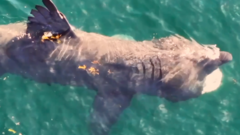
A triangular blade, dark and glistening, cuts through the surface. It does not slice with the menace of a predator. It wobbles. It sways like a drunken sailor. Beneath it, a shadow begins to materialize—an impossibly vast, submarine-shaped silhouette that seems to swallow the grey light.
This is the basking shark. At nearly thirty feet long, it is the second-largest fish on Earth, yet it possesses the gentle temperament of a cow in a summer pasture. For centuries, we looked at these creatures and saw only oil, meat, and monstrous size. Today, a quiet revolution in marine science is revealing that these silent giants are far more complex, vulnerable, and mysterious than we ever dared to imagine.
The Ghost in the Harbor
To understand the basking shark, you must first understand the island communities that grew up alongside them.
Decades ago, the arrival of the sharks in the late spring was not a cause for celebration. It was a harvest. In the post-war years of the mid-twentieth century, local fisheries hunted them relentlessly. A single shark yielded hundreds of gallons of oil from its massive liver, which was used for industrial lubricants and street lamps. Their skin was turned into leather; their flesh into fishmeal.
They were easy targets. They are called "basking" sharks because they spend hours floating lazily at the surface, their cavernous mouths hanging wide open to filter zooplankton from the water. They had no fear of boats. Why would they? For millions of years, nothing in the ocean could hurt them.
Then came the harpoon guns.
By the time international protections finally caught up in the late twentieth century, the waters had grown quiet. The great shadows had vanished from the bays. For a generation of coastal residents, the sharks became local myths—ghost stories told by retired fishermen over pints of bitter in harbor pubs.
But nature has a way of holding on in the quiet corners.
The Return to the Shallows
In recent years, the sharks have started coming back.
It began with sporadic sightings reported by kayakers and ferry captains. A fin here. A massive tail thrashing there. Soon, marine biologists realized that the coastal waters around the Isle of Man, Cornwall, and the Scottish Hebrides were hosting a quiet reunion.
When you see a basking shark up close, your brain struggles to register its scale. The mouth of an adult shark can stretch over three feet wide. Inside, it looks like a cavern lined with dark, comb-like structures called gill rakers. As the shark swims forward at a sluggish two knots, it filters thousands of tons of seawater every hour, trapping tiny copepods—microscopic crustaceans no larger than a grain of rice.
It is a dizzying paradox. The ocean’s second-largest creature survives entirely on its smallest inhabitants.
This dietary choice makes them biological sentinels. If the water temperature shifts even slightly, the plankton blooms move. If the plankton blooms move, the sharks vanish. Their presence is a direct report card on the health of our coastal ecosystems. When the sharks are here, the sea is alive.
The Secret Lives of Giants
For a long time, the scientific consensus on basking sharks was straightforward: they were solitary, slow-witted vacuum cleaners of the sea. It was assumed they simply drifted with the currents, eating when they could and shutting down when the winter cold set in.
Recent research has shattered that assumption.
By using advanced satellite tracking tags and underwater cameras, scientists have begun to peek behind the curtain of the shark’s private life. What they found was not a lazy drifter, but a highly sophisticated navigator capable of extraordinary feats.
The Twilight Descent
When summer fades and the plankton blooms disappear from the surface, the sharks do not hibernate in the mud as older textbooks claimed. Instead, they vanish into the abyss.
Tracking data revealed that these animals undertake massive vertical migrations. As the northern hemisphere cools, they dive down into the twilight zone—depths of over three thousand feet where the sun never reaches. Here, in the pitch-black cold, they find deep-water plankton layers and follow them across the globe.
Some sharks tagged off the coast of Scotland have been tracked traveling thousands of miles south, crossing the equator to the waters of North Africa and South America. They navigate these vast, featureless ocean deserts with pinpoint accuracy, returning to the exact same coastal bays in the north the following spring.
How do they do it?
We still do not entirely know. It is highly likely they navigate using the Earth's magnetic field, guided by sensory organs on their snout called the ampullae of Lorenzini. These tiny, jelly-filled pores can detect electrical fields weaker than a flashlight battery. To a basking shark, the ocean floor is not dark; it is mapped out in glowing lines of electromagnetic energy.
A Ballet of Giants
Perhaps the most startling discovery of recent years is that these sharks are highly social.
In certain bays around the Irish Sea, researchers have documented a behavior known as "breaching"—where these eight-ton beasts launch themselves entirely out of the water, crashing back down with the sound of a cannon shot. For a long time, we thought they were simply trying to shake off parasites.
But there is another theory. The breaching often happens when the sharks gather in large numbers.
Scientists have observed groups of basking sharks swimming in tight, nose-to-tail circles, forming a slow-motion underwater carousel. This is courtship behavior. The giant, solitary wanderers of the deep ocean use these shallow summer bays as meeting grounds. The breaching may be a massive, acoustic calling card—a way for a shark to say, I am here, and I am immense.
The Invisible Hazards
Because these sharks spend so much time at the surface, they exist in constant conflict with the human world.
They do not have the fearsome reputation of great whites. No one hunts them with harpoons anymore. Yet, the threats they face today are far more insidious because they are accidental.
- Entanglement: The sharks frequently become tangled in the ropes of crab and lobster pots. Once trapped, they cannot swim forward to force water over their gills. They slowly suffocate.
- Boat Strikes: Because they bask at the surface and are slow to react, they are frequently hit by recreational yachts and speedboats. Propeller scars are a common sight on the backs of returning sharks.
- Microplastics: As filter feeders, basking sharks inhale vast quantities of water. The tiny plastic beads and fibers floating in our seas are concentrated in their digestive tracts, with unknown long-term consequences for their health.
To protect them, we have to change how we interact with the ocean. It requires boaters to slow down during the summer months. It requires fishermen to adopt shark-safe gear. It requires us to look at the water not as a highway or a playground, but as a fragile, shared home.
The View from the Water
Back on the research boat, the giant shark slowly glides past our port side.
Its eye, small and dark, passes just inches from the hull. There is no spark of predatory cunning in that eye, but there is an undeniable, ancient awareness. It has survived ice ages, the rise and fall of human empires, and the brutal decades of the harpoon fisheries.
The shark sinks slowly back into the grey depths, its massive tail sweeping side to side in a rhythm as old as the tides. The water closes over it, leaving nothing but a smooth circle of calm on the surface.
We sit in silence for a moment, listening to the slap of the waves against the aluminum hull. The cold does not feel quite as sharp anymore. We have shared a breath with a giant, and the sea feels a little less empty, and infinitely more alive.