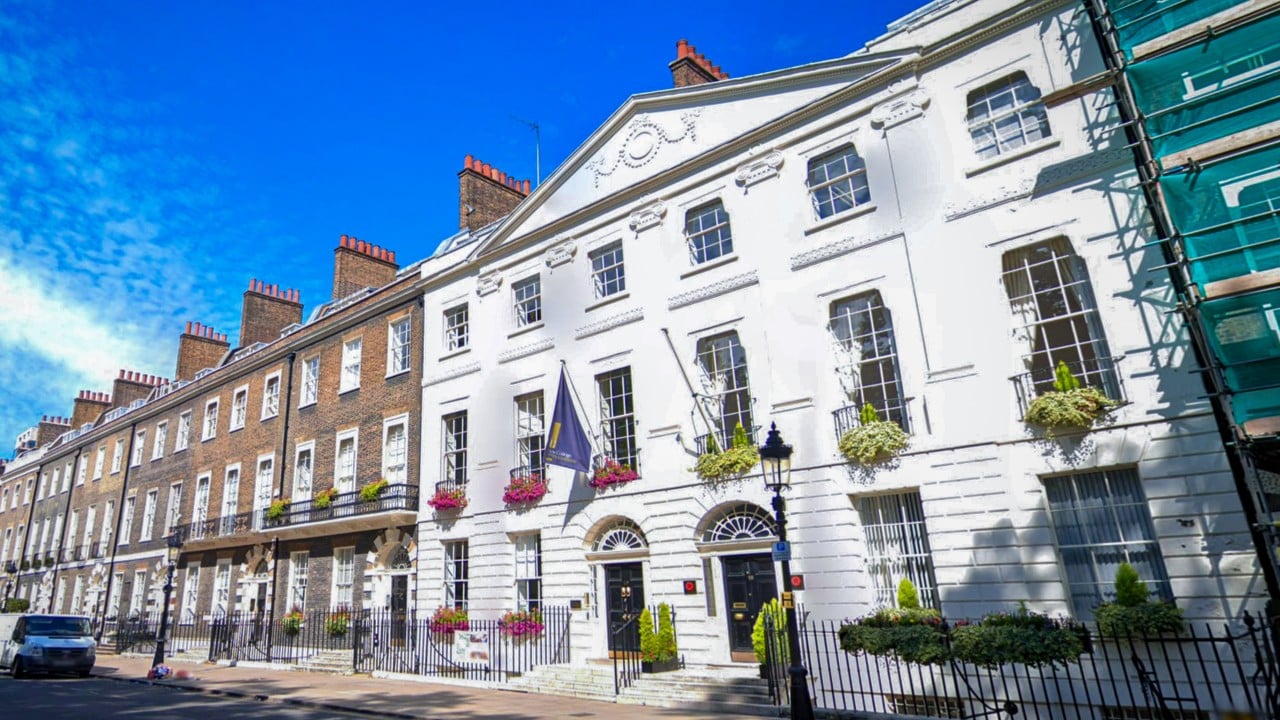
The United Kingdom’s decision-making process regarding the Hong Kong Economic and Trade Office (HKETO) in London is not a matter of moral signaling but a cold calculation of diplomatic friction versus economic utility. While the 2024 spying convictions involving an office staffer created a temporary surge in political pressure, the structural reality remains: the British government views the HKETO through the lens of institutionalized risk management rather than a simple binary of security. Closing the office would trigger a sequence of retaliatory measures that outweigh the marginal security gains achieved by its removal.
The Institutional Architecture of the HKETO
To understand why a closure is statistically unlikely, one must first deconstruct the HKETO’s legal status. Unlike a standard consulate, the HKETO operates under the Hong Kong Economic and Trade Office (Privileges and Immunities) Order 1996. This statutory instrument grants the office a hybrid status that is neither fully diplomatic nor purely commercial.
The legal framework provides:
- Inviolability of Archives: Records cannot be seized, providing a layer of protection that standard foreign commercial entities do not possess.
- Tax Exemptions: The entity is shielded from local fiscal requirements, lowering the friction for high-value capital flow facilitation.
- Diplomatic-Lite Immunities: While staff lack the full personal immunity of career diplomats, the premises themselves enjoy a degree of protection that complicates standard law enforcement intervention.
The existence of this framework means that revoking the office’s status requires a legislative repeal or a specific ministerial order, both of which serve as high-visibility escalations. In the hierarchy of diplomatic responses, a legislative repeal is a "hard" signal that limits the government’s future flexibility—a trade-off the Foreign, Commonwealth & Development Office (FCDO) historically avoids.
The Retaliatory Symmetry Model
Geopolitical decisions are rarely made in isolation; they are governed by the principle of reciprocity. The UK must account for the Symmetric Vulnerability of its own presence in Hong Kong.
The British Consulate-General in Hong Kong is one of the largest UK diplomatic missions in the world. It serves as the primary hub for:
- Managing the interests of approximately 3.5 million British National (Overseas) passport holders.
- Supporting over 600 British companies currently operating in the territory.
- Facilitating the activities of the British Council and various educational partnerships.
If the UK moves to shutter the HKETO in London, the Hong Kong SAR government—supported or directed by Beijing—would almost certainly apply an equivalent "cost-plus" retaliation. This would likely manifest as the systematic restriction of the British Consulate-General’s operational capacity or the selective enforcement of the National Security Law against British personnel. The UK’s "integrated review" strategy emphasizes the Indo-Pacific tilt; losing its primary operational base in Hong Kong would effectively decapitate its regional strategy for a negligible gain in domestic security.
Quantifying the Economic Friction
The HKETO functions as a primary lubricant for the Hong Kong-London Financial Corridor. Despite the political tension, Hong Kong remains the UK’s second-largest trading partner in Asia. The office serves three critical economic functions that cannot be easily replicated by a general consulate or a trade body:
- Capital Pipeline Management: It acts as a point of contact for the flow of institutional capital between the City of London and the Greater Bay Area.
- Regulatory Harmonization: It facilitates communication between the Financial Conduct Authority (FCA) and the Hong Kong Monetary Authority (HKMA).
- Direct Investment Advocacy: It provides a streamlined path for Hong Kong-based family offices to enter the UK property and infrastructure markets.
The removal of the HKETO would introduce "transactional friction." Without the dedicated office, the responsibility for these functions would shift to the Chinese Embassy’s commercial section. This shift would actually decrease transparency for UK security services, as the HKETO provides a localized, discrete entity that is easier to monitor than the broader, more complex machinery of the PRC Embassy in Marylebone.
The Intelligence Paradox
From a security perspective, the "spying verdict" paradoxically makes the HKETO more likely to stay open in the short term. Intelligence agencies often prefer "known quantities."
By successfully prosecuting individuals linked to the office, the UK’s MI5 and Metropolitan Police have demonstrated that the HKETO’s legal privileges are not a "get out of jail free" card. The prosecution set a legal precedent that defines the limits of the HKETO’s activities.
Closing the office would simply force illicit activity into more clandestine channels—likely through private front companies or digital platforms that are significantly harder to track than a physical office in Bedford Square with a known staff list. In the logic of counter-intelligence, a compromised but monitored entity is often more valuable than a vacuum that will inevitably be filled by a more sophisticated, less visible threat actor.
The Three Pillars of Continuity
The British government's refusal to close the office rests on three specific pillars:
Pillar 1: Legal Proportionality
Under the 1996 Order, the threshold for revoking privileges is high. The recent court case involved individuals acting on behalf of the office, but the government has not yet established that the office’s entire existence is fundamentally incompatible with UK law. Moving to close it without a broader systemic failure would be seen as an overreach, potentially inviting legal challenges in UK courts that would further embarrass the administration.
Pillar 2: Global Financial Signaling
London’s status as a global financial hub depends on a degree of political neutrality regarding trade offices. If the UK begins shuttering trade offices based on the actions of individual staff members, it signals to other "non-aligned" or "adversarial" states that their commercial outposts in London are subject to political volatility. This creates a "sovereign risk premium" that could deter investment from other Middle Eastern or Asian economies.
Pillar 3: The "Wait and See" Strategy
The UK is currently in a state of diplomatic recalibration. By maintaining the status quo, the government keeps the HKETO as a "bargaining chip." Closing it now exhausts the escalation ladder. Keeping it open, while increasing surveillance and tightening the interpretation of the 1996 Order, allows the UK to maintain pressure without triggering a total breakdown in communication.
The Bottleneck of Alternative Representation
The argument that the Chinese Embassy could simply absorb the HKETO’s functions ignores the administrative reality of the "One Country, Two Systems" framework—even if that framework is under strain. The HKETO handles specific technical matters—shipping registries, civil aviation agreements, and specific trade quotas—that are legally distinct from the PRC’s national interests.
If these functions were moved to the PRC Embassy:
- UK businesses would lose the specific "Hong Kong" legal distinction in their dealings.
- Administrative delays would increase as requests are processed through the more bureaucratic PRC national system.
- The UK would be tacitly acknowledging the total end of "One Country, Two Systems" earlier than necessary, potentially undermining its own legal arguments regarding the Sino-British Joint Declaration.
Strategic Constraint Analysis
The government faces a "Constraint Trilemma" where it can only prioritize two of the following three objectives:
- Maximum Domestic Security: (Requires closing the office).
- Economic Connectivity: (Requires keeping the office).
- Diplomatic Reciprocity: (Requires maintaining the status quo).
The current policy path prioritizes Economic Connectivity and Diplomatic Reciprocity. The "security" component is being addressed through localized enforcement (arrests and surveillance) rather than institutional destruction. This is a targeted surgical approach rather than a blunt-force amputation.
The strategic play for the UK government is not the closure of the HKETO, but the Conditional Normalization of its operations. Expect a quiet increase in the "transparency requirements" for HKETO staff and a more frequent review of the privileges granted under the 1996 Order. The office will remain, but its "diplomatic-lite" shadow will be significantly shortened by the recent judicial outcomes.
The UK will likely use the threat of closure to extract concessions regarding the treatment of British businesses in Hong Kong, effectively transforming a security liability into a diplomatic lever. Closure remains a "nuclear option" that, if used, would signal the final decoupling of the London-Hong Kong financial axis—a price the Treasury is currently unwilling to pay.