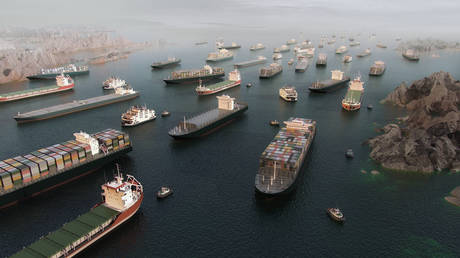
The rusted steel of an oil tanker does not care about geopolitics. It only understands pressure. For years, the massive vessels sitting off the coast of Kharg Island in the Persian Gulf have stayed quiet, their hulls riding high in the water, empty and waiting. Engineers kept the engines humming just enough to prevent the salt air from seizing the pistons. On the docks, workers smoked cigarettes in the heavy, humid heat, watching a stagnant sea.
Then came the memo from Washington. If you liked this article, you might want to read: this related article.
With a few strokes of a pen, the United States government issued a temporary waiver on sanctions. Just like that, the invisible economic dam broke. Millions of barrels of crude oil, trapped for years behind a wall of international diplomacy and financial penalties, were suddenly cleared to flood back into the global mainstream market.
To the analysts sitting in air-conditioned offices in London and New York, this is a line item on a balance sheet. It is a shifting variable in a supply-and-demand equation designed to lower prices at the pump before an election. But on the water, and in the homes of those who live by the rhythm of the oil trade, it feels like a sudden intake of breath after a long suffocation. For another angle on this event, check out the latest update from Reuters.
To understand how we arrived at this moment, look at a hypothetical engineer named Javad. For nearly a decade, Javad has walked the catwalks of Iran’s aging refineries. He knows every shudder of the distillation towers. He knows which valves leak because the replacement parts, blocked by trade embargoes, had to be smuggled in through third-party countries at three times their actual value.
When sanctions hit, the world did not stop using oil. It just stopped buying it openly from people like Javad.
Imagine trying to run a household where your income is suddenly slashed by eighty percent, not because you ran out of things to sell, but because the neighborhood bank blocked your debit card. You would adapt. You would trade with the few neighbors who did not care about the bank’s rules. You would sell your goods at a steep discount just to keep the lights on. That is exactly what happened to the Iranian energy sector. A shadow fleet of aging tankers, operating under flags of convenience with their transponders turned off, carried "ghost crude" across the oceans, playing a high-stakes game of hide-and-seek with satellite surveillance.
It was an exhausting, dangerous way to do business.
But the temporary waiver changes the math instantly. It legitimizes the flow. For the global market, the arrival of this oil is like finding a hidden reservoir of water in the middle of a drought. Inflation has been squeezing Western economies for months. Central banks have raised interest rates until consumers can barely afford their mortgages. Energy prices underpin everything from the cost of a gallon of milk to the price of shipping a plastic toy across the Pacific. By allowing Iranian oil back into the mainstream pipeline, policy makers are betting that a sudden surge in supply will force prices down, giving weary voters some breathing room.
The stakes are entirely invisible until you look at the price tickers in Chicago.
Global Crude Oil Supply Flow (Simplified Impact)
[OPEC+ Caps] ----> \
                     [Global Market Bottleneck] ===> High Prices at Pump
[US Production] -> /

                     vs.

[Iranian Return] -> [Mainstream Integration] ===> Price Relief / Market Stabilization
The immediate reaction from rival oil-producing nations was a cold silence. Groups like OPEC+ have spent the last year carefully cutting their own production to keep prices high and revenues stable. They viewed the US waiver not as a diplomatic breakthrough, but as a deliberate disruption of their market control. It is a game of economic chess where the pieces are giant steel storage tanks and the board is the entire planet.
Consider what happens next inside the trading pits.
When the news broke, the price of Brent crude dropped two dollars in twenty minutes. That might seem insignificant to someone filling up a sedan on a Tuesday afternoon, but for a hedge fund manager holding millions of dollars in energy futures, it was a financial earthquake. Phones rang off the hook. Algorithms executed thousands of sell orders per second. The market was pricing in the reality of hundreds of thousands of new barrels arriving at refineries every single day.
Yet, this sudden abundance comes with a massive catch. The word temporary hangs over the entire operation like a pendulum.
A temporary waiver is not a peace treaty. It is a political pause button. It means the infrastructure must wake up, scale up, and ship out as much product as possible before the political winds shift again. If a new administration takes office in Washington, or if regional tensions flare up in the Middle East, the waiver can be revoked as quickly as it was granted.
This creates a psychological whiplash for everyone involved. Shipping companies are hesitant to sign long-term contracts. Insurance underwriters are demanding exorbitant premiums to cover vessels entering the region, knowing that a sudden policy reversal could leave a cargo worth eighty million dollars stranded in legal limbo mid-voyage. It is hard to build a stable business when your entire industry relies on a permit that expires in six months.
The true cost of this volatility is borne by the people who have to navigate the uncertainty.
The market gets its cheap gasoline, the politicians get their favorable economic data, and the shadow traders retreat into the background for a little while. But the structural cracks in the global energy system remain unhealed. We are still deeply dependent on a volatile commodity extracted from some of the most geopolitically fractured regions on earth, living from one temporary policy shift to the next.
As dusk falls over the Gulf, the black smoke from a newly fired-up tanker engine rises into the purple sky. The anchor chains rattle as they are winched aboard. The ship begins its slow, heavy turn toward the open ocean, carrying its cargo into a world that desperately needs the fuel, but remains terrified of the hands that produced it.