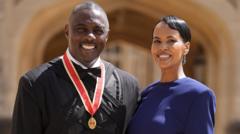
King Charles III bestowed knighthoods and damehoods upon actor Idris Elba, ice skating icons Jayne Torvill and Christopher Dean, and writer-actress Meera Syal at Windsor Castle today. While mainstream media outlets framed the investiture ceremony as a standard celebration of celebrity achievement, the event highlights a calculated alignment between the British monarchy and the influential figures driving global cultural capital. Facing systemic shifts and ongoing institutional scrutiny, the Crown is actively leaning on popular cultural icons to reinforce its relevance and secure its long-term survival.
The 68 individuals honoured on Tuesday represent a deliberate mix of artistic excellence and high-impact social advocacy. This intersection provides the Palace with a powerful mechanism for soft-power projection. Don't forget to check out our earlier post on this related article.
The Full Circle Economy of the King Trust
The knighthood of Sir Idris Elba serves as the most prominent example of this institutional alignment. Officially recognized for his services to young people through his Elba Hope Foundation, Elba's relationship with the monarch is deeply transactional and historically rooted.
At age 18, Elba utilized a £1,500 grant from the Prince’s Trust—now rebranded as the King’s Trust—to secure his place at the National Youth Music Theatre. Without that specific state-adjacent charitable intervention, the career of one of Britain’s most bankable global stars may never have materialized. If you want more about the history here, The New York Times provides an excellent summary.
The Palace understands the immense value of this narrative. Elba has partnered directly with the King to produce a high-profile documentary celebrating the 50th anniversary of the charity, scheduled to stream on Netflix this autumn.
By elevated Elba to a Knight Bachelor, the Crown completes an institutional loop. It transforms a historical recipient of state charity into a frontline defender of royal legacy on a global streaming platform. This strategy transforms traditional royal patronage into media-savvy co-branding.
Secular Saints and the Soft Power of Nostalgia
While Elba represents contemporary global influence, the inclusion of Dame Jayne Torvill and Sir Christopher Dean taps into a different asset class: deep national nostalgia.
The Olympic gold-medal-winning duo, who defined British sporting dominance in the 1980s with their "Bolero" routine, retired from live touring last year. Their elevation to the highest echelons of the honours system at this specific moment is not accidental.
During the investiture, Dean reportedly joked with the King that he highly recommended retirement, a moment of scripted levity that quickly circulated through media channels. This interactions humanizes the monarch while leveraging the goodwill built by the skating duo over a forty-year career in the public eye.
The inclusion of Dame Meera Syal for services to literature and drama, alongside Paul Elliott of the Chuckle Brothers receiving an MBE for his work with Marie Curie, broadens the cultural reach of the ceremony. Syal’s breakthrough work on Goodness Gracious Me challenged cultural perceptions in late-1990s Britain. Bringing her into the establishment fold allows the monarchy to signal modern inclusivity and a progressive view of British identity.
| Recipient | Honour Bestowed | Core Sector | Institutional Value to Crown |
|---|---|---|---|
| Sir Idris Elba | Knight Bachelor | Entertainment & Philanthropy | Validates King's Trust legacy; anchors upcoming Netflix documentary. |
| Dame Jayne Torvill | DBE | Sports & Television | Captures multi-generational public goodwill post-retirement. |
| Sir Christopher Dean | Knight Bachelor | Sports & Television | Projects a relatable, humanizing image of the monarch via lighthearted media interactions. |
| Dame Meera Syal | DBE | Literature & Television | Demonstrates establishment embrace of multicultural, boundary-pushing art. |
The Mechanics of Modern Investiture
The honours system is often criticized as an archaic remnant of empire. Yet, it continues to function effectively as a tool for statecraft. The modern investiture ceremony is a highly managed media production engineered to project stability.
By honoring individuals who command genuine public affection, the Crown absorbs a portion of their popularity. The state honors system relies on a basic psychological exchange: the celebrity receives validation of their life's work, and the institution receives validation of its authority to judge merit.
This dynamic becomes vital as traditional institutions face declining trust among younger demographics. A knighthood for an actor with the global profile of Elba carries more cultural weight with audiences under forty than any official palace press release or traditional royal tour.
The autumn Netflix documentary will test whether this deployment of cultural capital yields tangible results. With the King’s Trust reaching its half-century milestone, the production will serve as an extended infomercial for royal philanthropy, narrated by a newly knighted Hollywood star.
The Windsor Castle ceremony demonstrates that the British honours system is not merely an annual exercise in tradition. It remains an active, evolving mechanism designed to recruit the architects of popular culture into the long-term defense of the realm.